
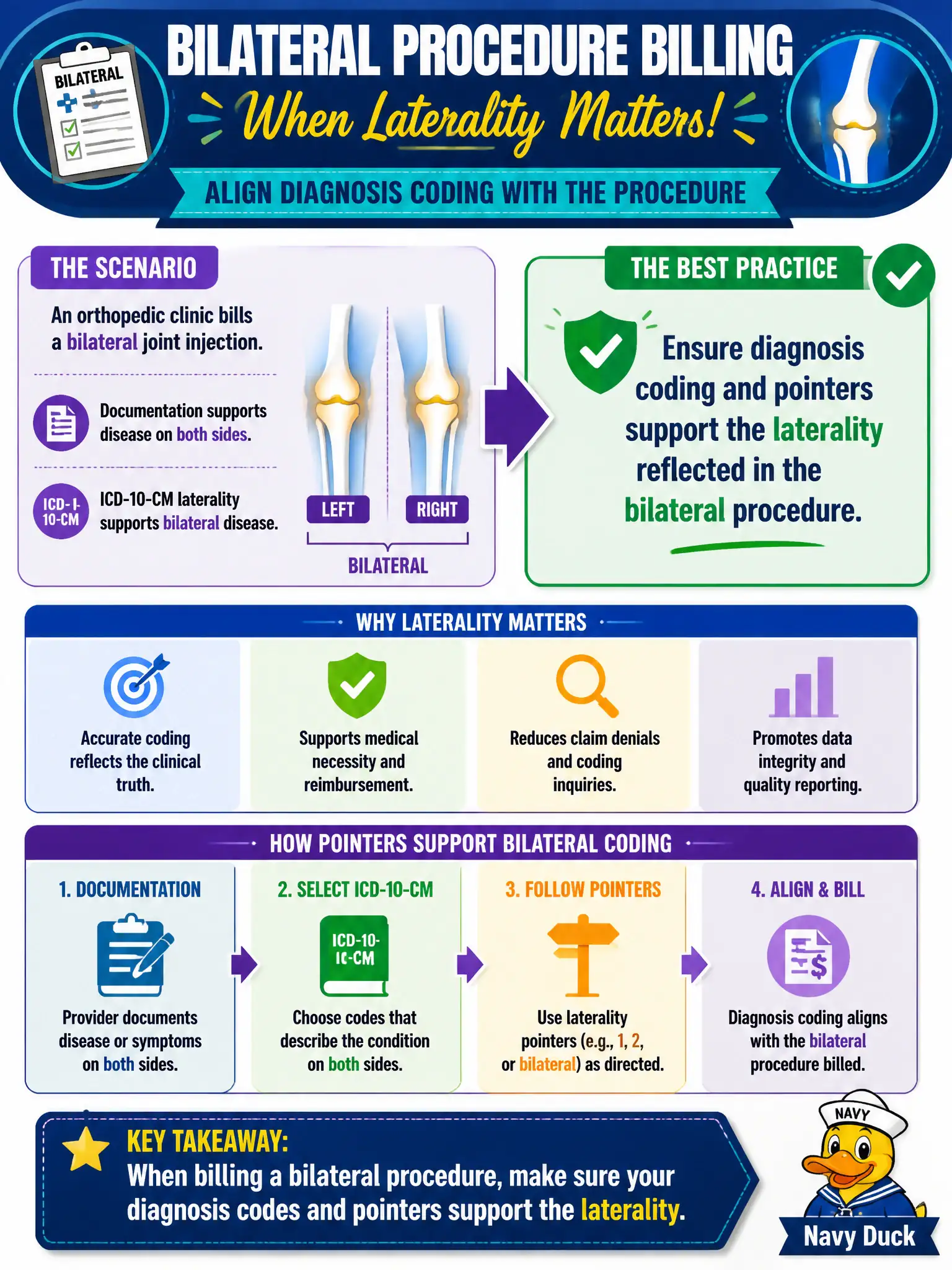
An orthopedic clinic bills a bilateral joint injection. Documentation and ICD-10-CM laterality support disease on both sides. Which diagnosis-association practice best aligns with bilateral procedure billing when laterality matters?
Select an answer to reveal the explanation.
Short Explanation
Bilateral work is like painting both sides of a fence—you need documentation that both sides needed the paint. When the procedure is bilateral and laterality matters, diagnoses should support both sides. One-sided or unspecified codes leave a hole in the story.
Full Explanation
When an orthopedic clinic bills a bilateral joint injection and documentation plus ICD-10-CM laterality support disease on both sides, diagnosis coding and pointers should support the laterality reflected in the bilateral procedure. Matching both sides of the clinical story to the bilateral CPT preserves medical-necessity coherence for professional-fee claims in civic musculoskeletal clinics.
Reporting only a left-sided diagnosis for a bilateral procedure to simplify scrubbing fails by concept because one-sided diagnosis support understates the bilateral service. Using a single unspecified-laterality code when both sides are clearly documented fails because it discards available specificity. Dropping all diagnosis codes and relying on a bilateral CPT modifier alone fails because modifiers do not replace diagnosis reporting.
Exam caveat: some payers want separate lines or specific modifiers for bilateral reporting; still keep diagnosis laterality aligned with whatever bilateral CPT construct is used. Operational check: verify left and right (or bilateral) diagnosis codes against the procedure note before release, and reject claims where bilateral CPT meets only unilateral diagnosis support.