
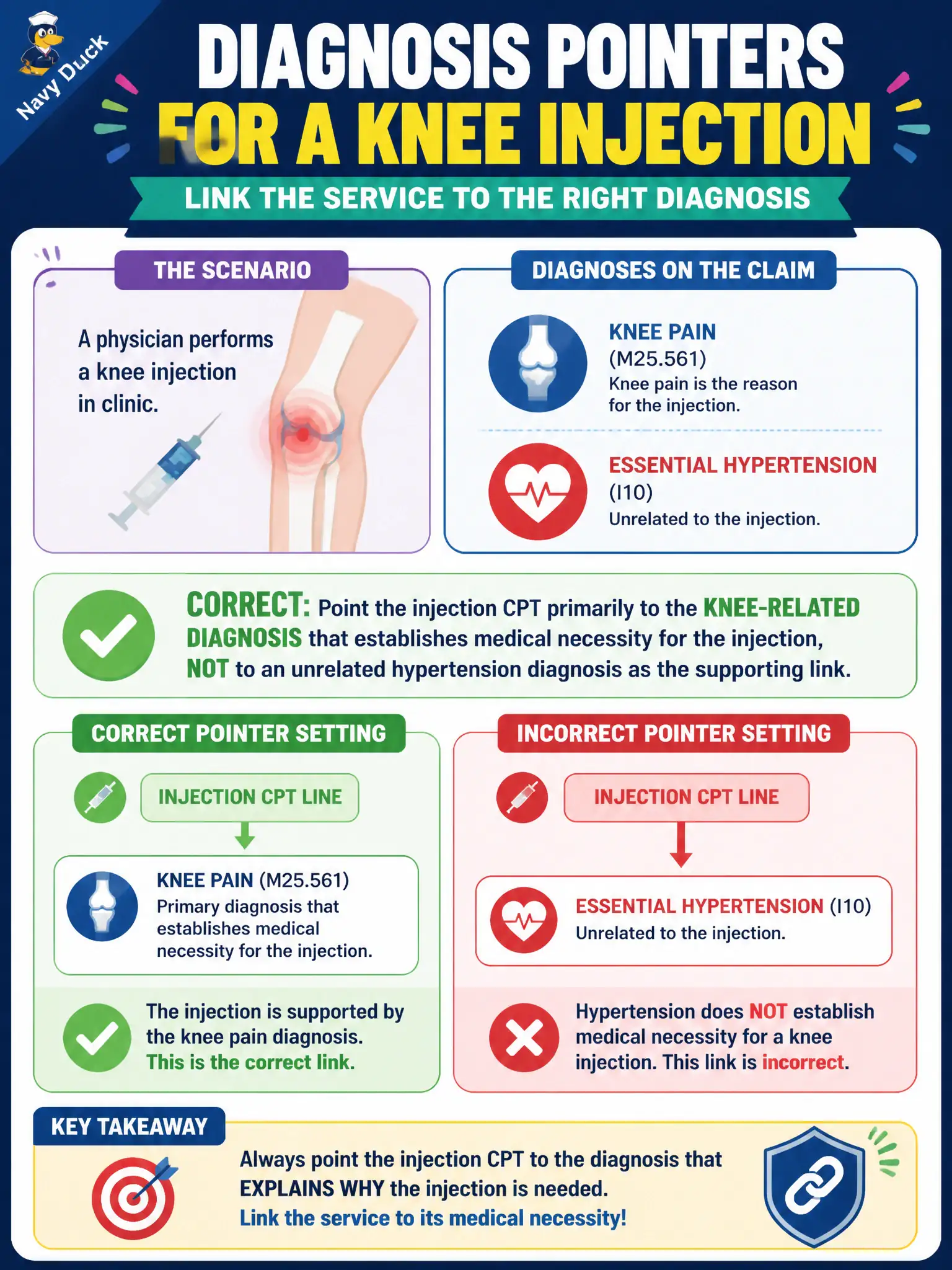
A physician performs a knee injection in clinic. Diagnoses on the claim include knee pain and unrelated essential hypertension. How should diagnosis pointers be set for the injection CPT line?
Select an answer to reveal the explanation.
Short Explanation
Pointers are how you tell the payer “this needle is for that knee,” not for the blood-pressure problem in the next sentence. Link the injection to the knee diagnosis that makes the service necessary. Hypertension can stay on the claim if treated, but it should not be the fake reason for the shot.
Full Explanation
Diagnosis pointers on a professional claim should link each CPT line to the ICD-10-CM diagnosis that establishes medical necessity for that service. For a clinic knee injection when diagnoses include knee pain and unrelated essential hypertension, the injection CPT should point primarily to the knee-related diagnosis—not to hypertension as the supporting link. Accurate pointer logic protects medical-necessity adjudication for public-program and commercial professional claims.
Pointing the injection only to hypertension so the payer sees a chronic condition fails by concept because an unrelated chronic disease does not justify the joint injection. Omitting pointers and listing diagnoses alphabetically fails because alphabetical order is not medical-necessity linkage. Pointing every procedure only to the first diagnosis slot regardless of relevance fails when the first-listed code is unrelated to that procedure line.
Exam caveat: hypertension may remain on the claim if addressed, but it should not be the injection’s necessity pointer. Operational check: for procedure lines, verify pointer digits resolve to clinically related diagnoses before submission and correct auto-pointer defaults that always select diagnosis 1.