
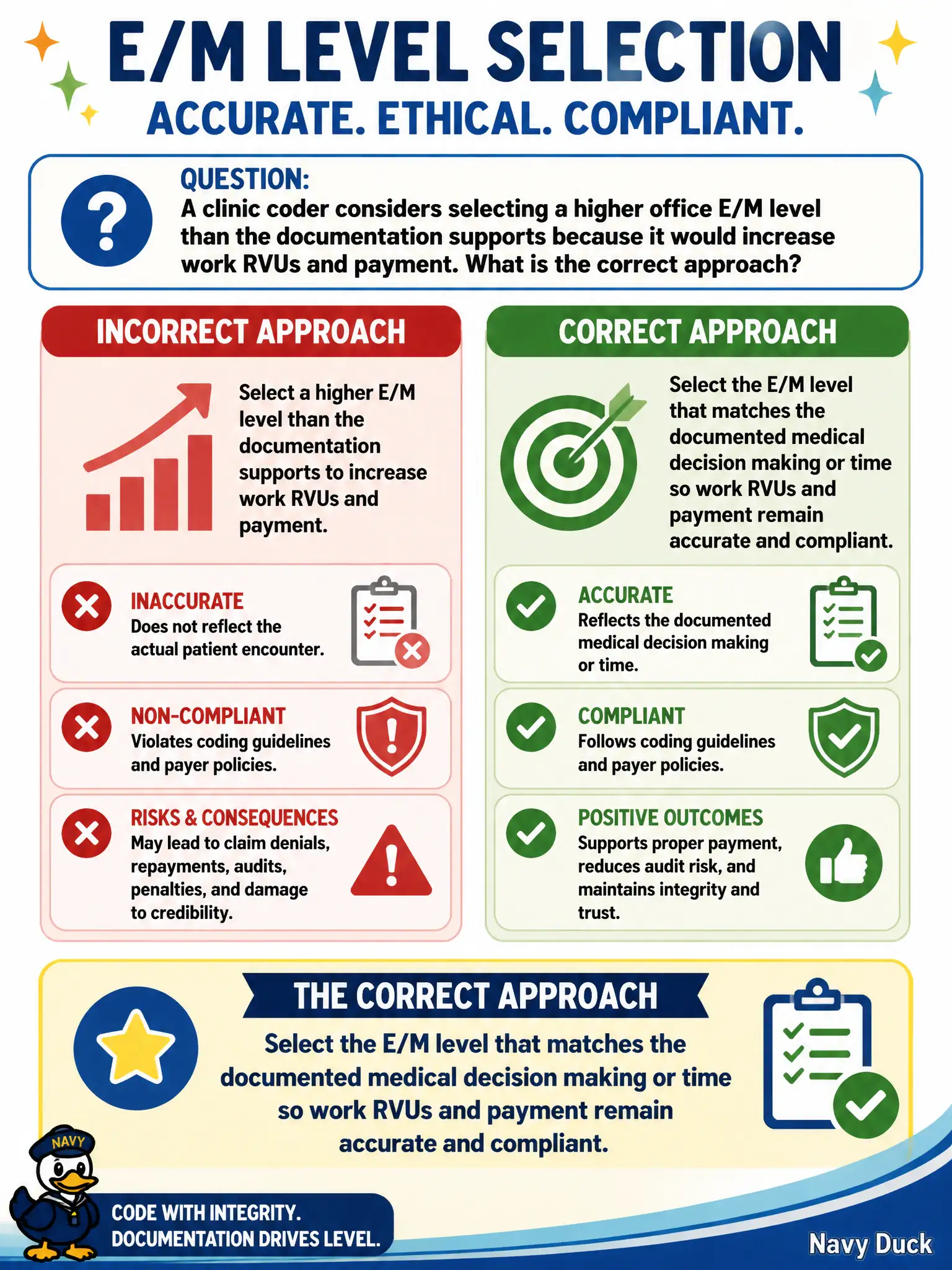
A clinic coder considers selecting a higher office E/M level than the documentation supports because it would increase work RVUs and payment. What is the correct approach?
Select an answer to reveal the explanation.
Short Explanation
Higher E/M levels pay more because they carry more work RVUs—but only when the note earns them. Pick the level the documentation actually supports, not the level that flatters the revenue report. Inflating levels for RVUs is a compliance problem wearing a financial costume.
Full Explanation
Work RVUs and payment rise with higher office E/M levels only when documentation supports those levels. The correct approach is to select the E/M level that matches documented medical decision making or time so work RVUs and payment remain accurate and compliant. Inflating levels to chase RVUs in a county primary-care clinic is upcoding, not revenue optimization, and undermines public-program trust.
Always billing the highest E/M whenever multiple chronic conditions appear on the problem list fails by concept because problem-list volume does not automatically equal today’s MDM or time. Downcoding every visit to the lowest level to avoid scrutiny fails because systematic undercoding misrepresents care and can harm quality and risk metrics. Reporting two E/M levels on the same visit for the payer to pick the higher RVU fails because duplicate E/M reporting is not a legitimate selection method.
Exam caveat: prolonged services and other add-on constructs have separate rules; they do not justify inventing a higher base E/M level. Operational check: audit E/M distribution against MDM/time documentation, coach outliers, and reject charge tickets that request a level the note cannot support.