
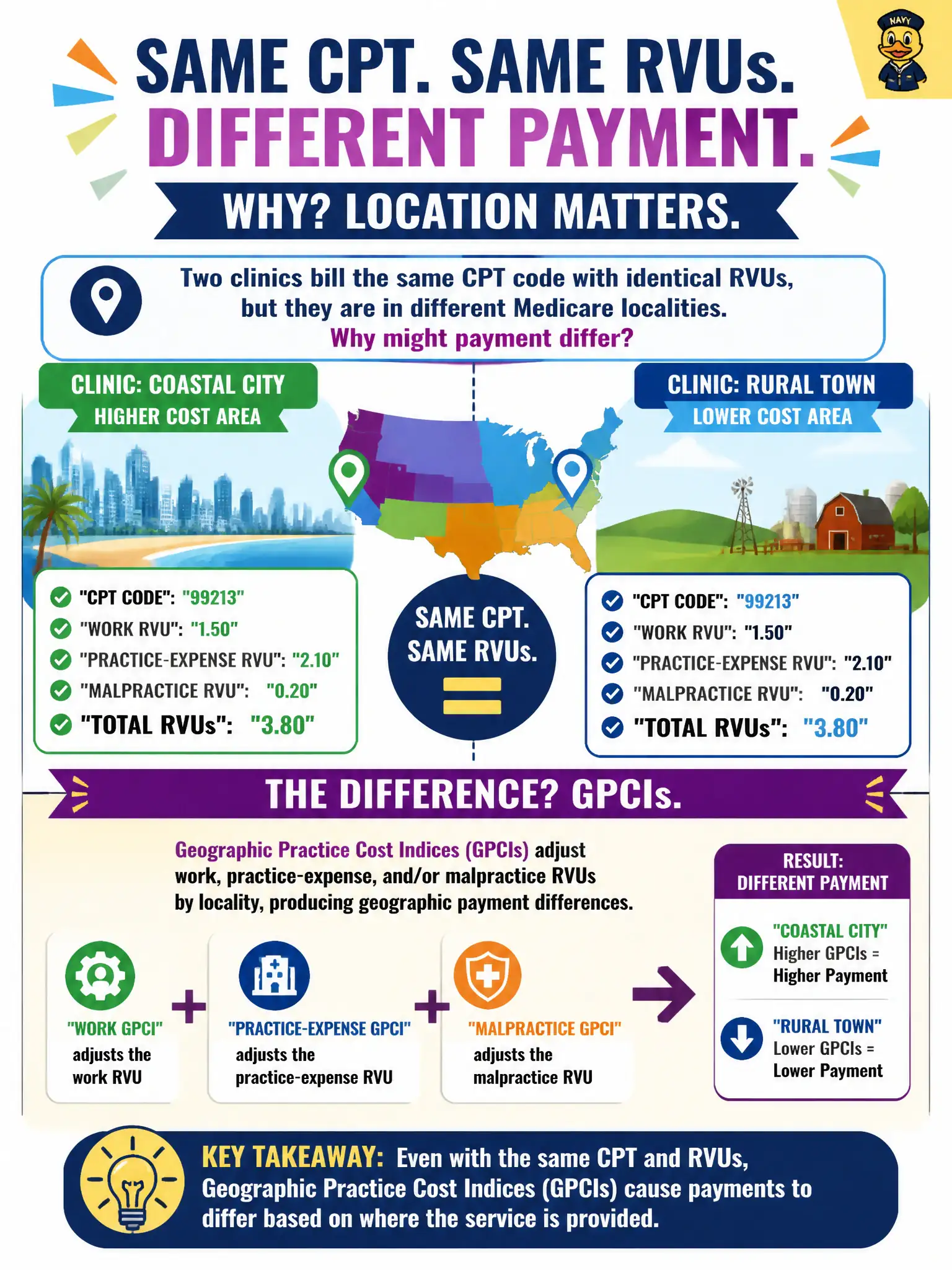
Two clinics bill the same CPT with identical RVUs, but they are in different Medicare localities. Why might payment differ?
Select an answer to reveal the explanation.
Short Explanation
Same code, same RVU skeleton—different ZIP-code seasoning. GPCIs nudge the RVUs up or down by locality so a service in one Medicare area is not priced exactly like another. Geography is baked into RBRVS on purpose.
Full Explanation
Two clinics can bill the same CPT with identical base RVUs yet receive different Medicare payment because Geographic Practice Cost Indices adjust work, practice-expense, and/or malpractice RVUs by locality. Geography is an intentional RBRVS ingredient, so civic clinics in different Medicare localities should expect geographic payment differences even when coding patterns match.
Claiming localities never affect payment and only a uniform national conversion factor applies fails by concept because GPCIs exist specifically to adjust by area. Attributing payment differences only to different first-listed ICD-10-CM diagnoses fails because diagnosis selection does not replace geographic RVU adjustment for fee-schedule pricing. Asserting that malpractice RVUs are removed entirely in rural localities as the sole explanation fails because it invents a one-dimensional myth rather than the actual multi-component GPCI mechanism.
Exam caveat: locality boundaries and GPCI values update periodically; payment estimates must use the locality effective for the date of service and billing provider address rules. Operational check: when comparing payment across sites, pull each site’s locality GPCIs alongside the conversion factor before concluding that coding quality differs.