
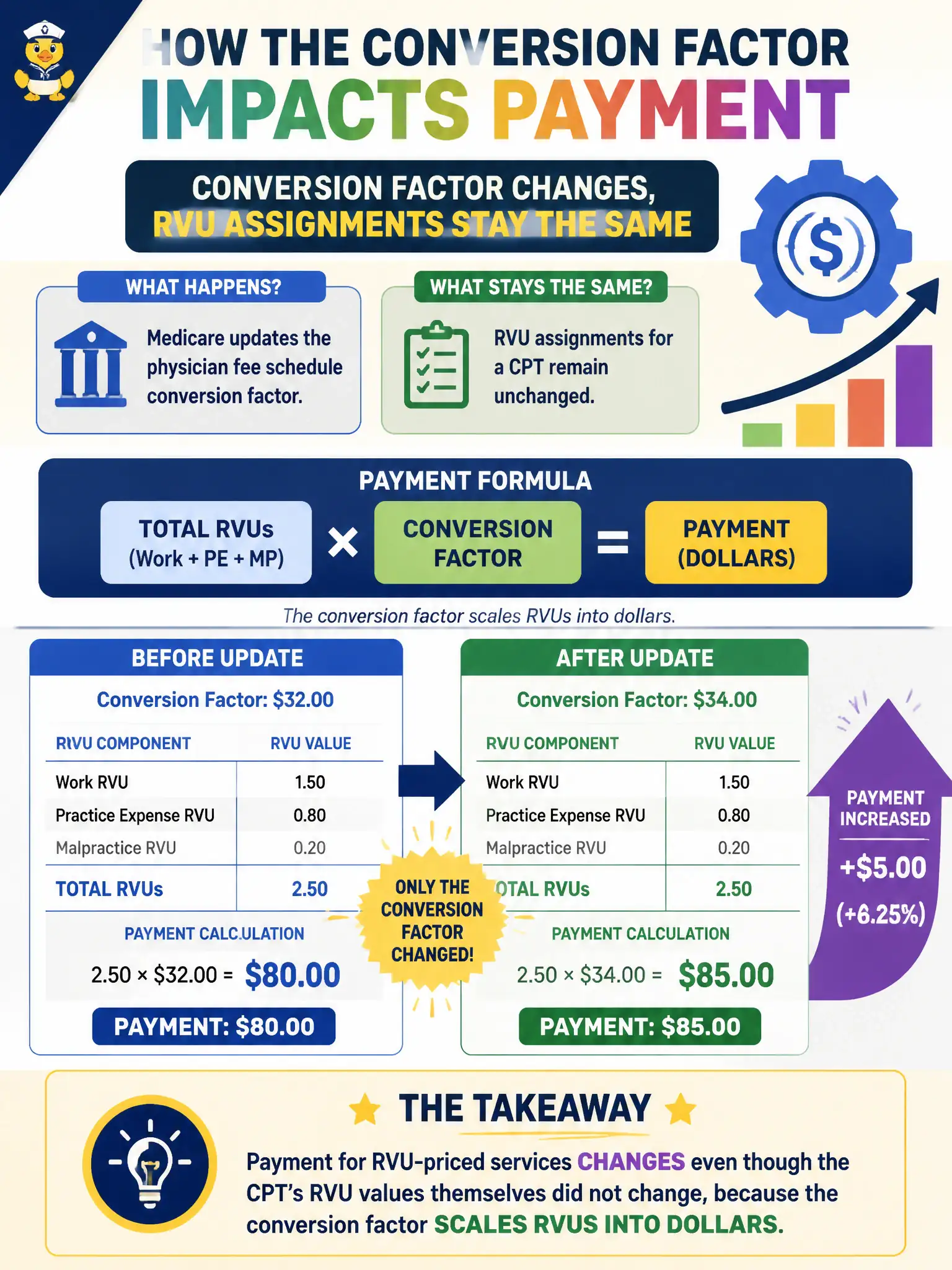
Medicare updates the physician fee schedule conversion factor while RVU assignments for a CPT remain unchanged. What is the financial impact?
Select an answer to reveal the explanation.
Short Explanation
Think of RVUs as the recipe quantities and the conversion factor as the price per unit. Congress or CMS can change the price tag without rewriting the recipe—so payment moves even when the CPT’s RVUs sit still. Watch CF updates; they hit across RVU-priced services.
Full Explanation
When Medicare updates the physician fee schedule conversion factor while a CPT’s RVU assignments remain unchanged, payment for RVU-priced services still changes because the conversion factor scales RVUs into dollars. Public-program professional-fee budgets therefore move with CF updates even when clinical coding patterns and RVU skeletons are stable. Coders and revenue analysts in civic clinics should separate “RVUs changed” from “dollar conversion changed” when explaining payment variance.
Claiming only malpractice RVUs change while work, PE, and payment stay fixed forever fails by concept because a CF change reprices the whole RVU stack. Saying payment is unaffected because conversion factors never multiply RVUs fails because multiplication by the CF is the core pricing step. Asserting ICD-10-CM codes must be renumbered whenever the CF changes fails because diagnosis code sets are independent of the conversion factor.
Exam caveat: Congress or CMS can change the CF mid-year or with legislative patches; always use the CF effective for the date of service. Operational check: when average payment per RVU shifts across many CPTs simultaneously, check for a CF update before launching a coding audit.