
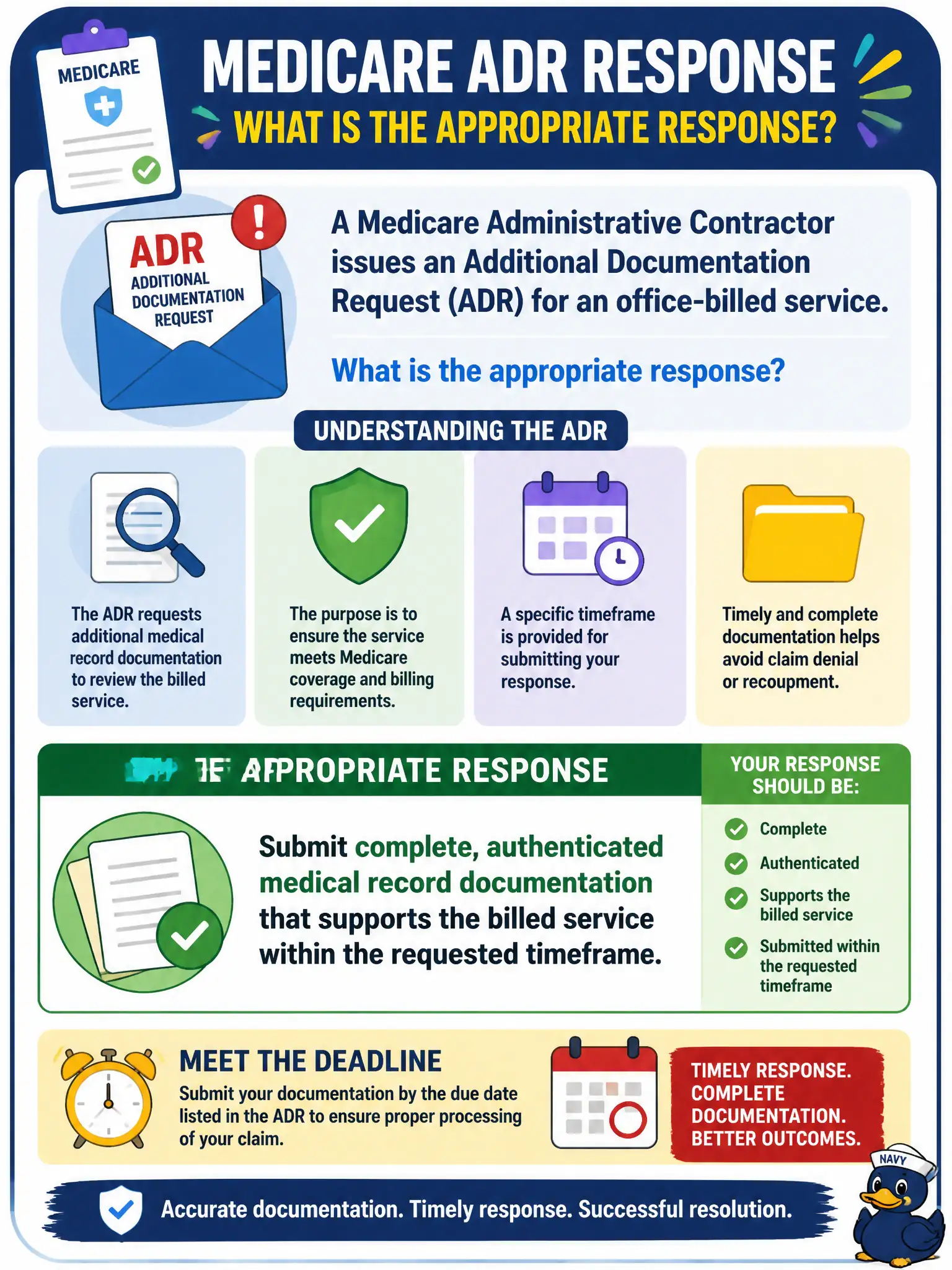
A Medicare Administrative Contractor issues an Additional Documentation Request (ADR) for an office-billed service. What is the appropriate response?
Select an answer to reveal the explanation.
Short Explanation
An ADR is a homework assignment with a due date—send the real chart, signed and complete, that backs the service you billed. Superbill scraps or silence will not satisfy medical review. Answer on time with the authenticated notes, not a quiet CPT downgrade to dodge the request.
Full Explanation
When a Medicare Administrative Contractor issues an Additional Documentation Request for an office-billed service, the appropriate response is to submit complete, authenticated medical record documentation that supports the billed service within the requested timeframe. Civic physician practices should treat ADRs as formal medical-review homework: send the real chart that backs the CPT/ICD claim, not silence or substitute paperwork.
Ignoring the ADR because professional claims are supposedly never subject to medical review fails by concept because office claims are routinely reviewed. Responding with only superbills and charge tickets while omitting clinical notes fails because charge artifacts do not prove medical necessity or service performance. Changing the CPT on a new claim to a lower-level code instead of answering the ADR fails because it dodges the review rather than substantiating (or correcting through proper channels) the billed service.
Exam caveat: submit only relevant authenticated records; do not flood the MAC with unrelated volumes, and track the ADR due date closely. Operational check: assign an ADR owner, pull the complete note/order/results package, verify signatures, submit by the deadline, and log confirmation of receipt.