
A payer denies a professional claim for timely filing. What should the revenue-cycle team evaluate before writing the balance off?
Select an answer to reveal the explanation.
Short Explanation
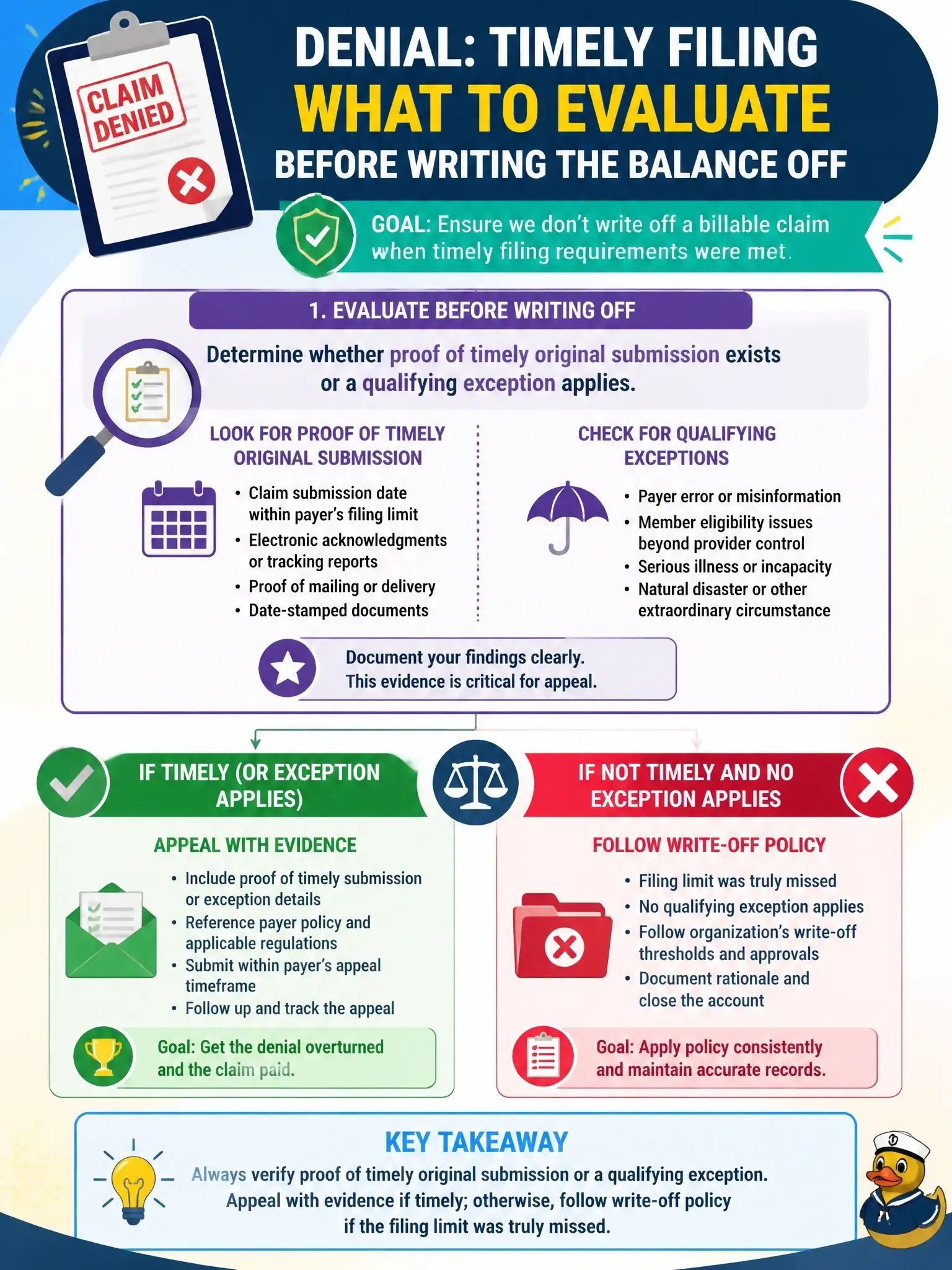
Before you write off a timely-filing denial, check whether you can prove the claim was filed on time or a real exception applies. If you can, appeal with that proof; if the deadline truly slipped, follow write-off policy instead of dumping it on the patient.
Full Explanation
A timely-filing denial on a professional claim should trigger evaluation of the filing-limit facts before any write-off or balance transfer. Revenue-cycle staff in a civic clinic should determine whether proof of timely original submission exists or a qualifying exception applies; appeal with evidence if the claim was timely, otherwise follow write-off policy if the filing limit was truly missed. That evidence-first approach stewards public and commercial accounts receivable without dumping provider filing failures onto patients by default.
Transferring the denial to the patient as noncovered charges regardless of filing-limit facts fails by concept because provider untimely filing is generally not converted into patient liability as if it were a beneficiary noncoverage issue. Always rebilling the claim under a new patient account number to restart the filing clock fails because creating a new account to evade timely filing is an integrity violation. Increasing the billed amount by 50% and resubmitting as a corrected claim without addressing filing dates fails because charge inflation does not cure lateness.
Exam caveat: payer portals, clearinghouse acceptance reports, and certified-mail proofs are common appeal artifacts; retain them prospectively. Operational check: on timely-filing denials, pull submission logs first; appeal within deadline when proof exists; if late, write off per policy rather than balance-billing the patient for the practice’s filing miss.