
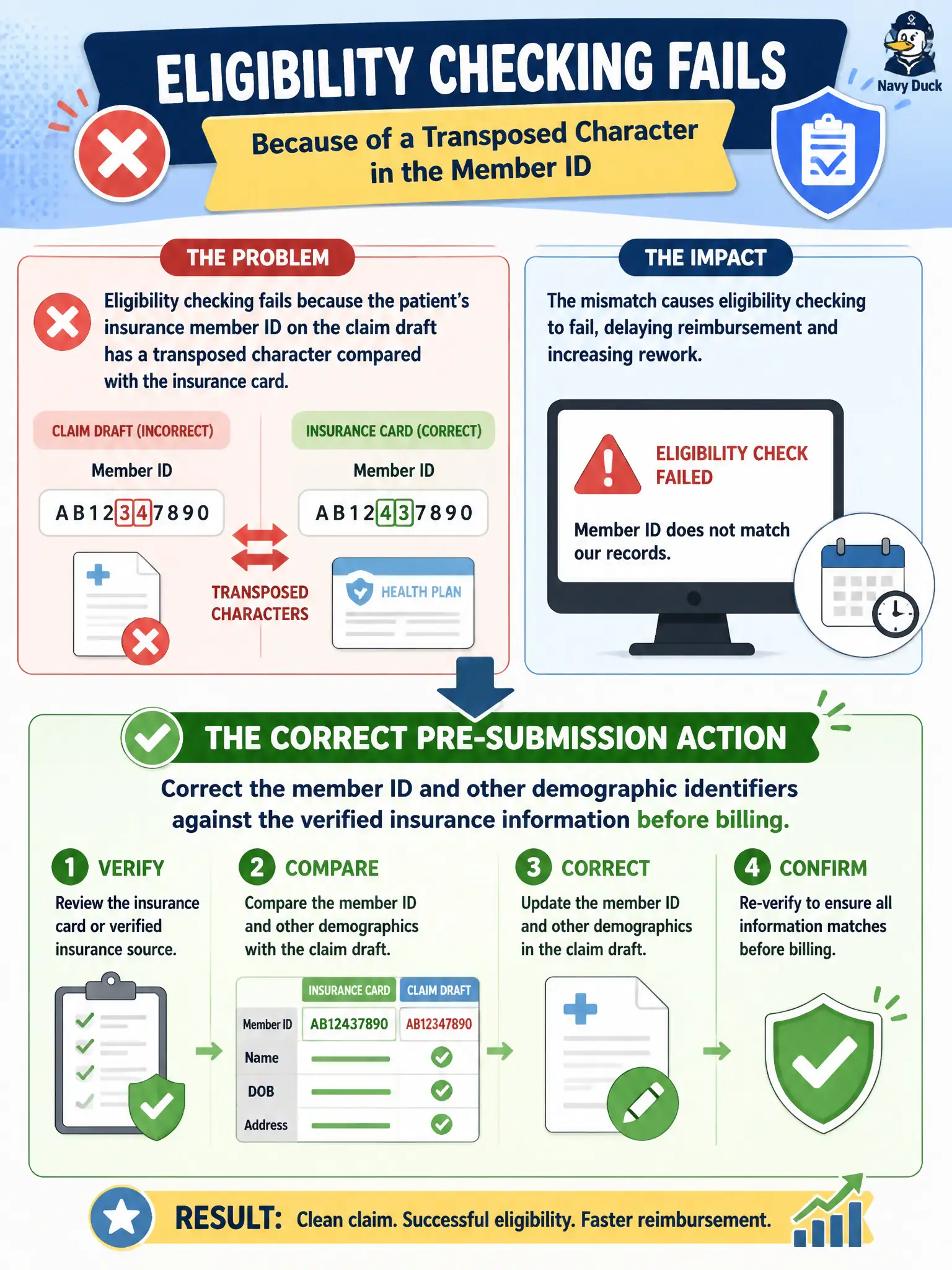
Eligibility checking fails because the patient’s insurance member ID on the claim draft has a transposed character compared with the insurance card. What is the correct pre-submission action?
Select an answer to reveal the explanation.
Short Explanation
A single swapped digit in the member ID is enough to make the payer say “who?” Catch that typo at the front door—match the card, fix the draft, then bill. Hoping the clearinghouse will mind-read the right ID is not a clean-claim strategy.
Full Explanation
Eligibility failures caused by a transposed member ID are demographic clean-claim defects. The correct pre-submission action in a county clinic is to correct the member ID and other demographic identifiers against verified insurance-card information before billing. Accurate identifiers are the first gate for public-program and commercial adjudication; fixing typos early prevents avoidable rejects and delayed professional-fee payment.
Submitting anyway so the clearinghouse can repair the member ID automatically fails by concept because clearinghouses do not reliably mind-read correct identifiers and often simply reject. Changing the patient’s date of birth until eligibility returns active fails because falsifying demographics to force a match is fraudulent and dangerous. Billing as self-pay without correcting insurance data and refunding later fails because it abandons coordination-of-benefits diligence and creates unnecessary patient billing churn.
Exam caveat: correct the full eligibility suite (member ID, payer ID, subscriber relationship, plan dates)—not only the single transposed character—before resubmission. Operational check: compare claim draft fields to a scanned card or payer portal eligibility response, lock corrected IDs, and re-run eligibility until active coverage matches the patient.