
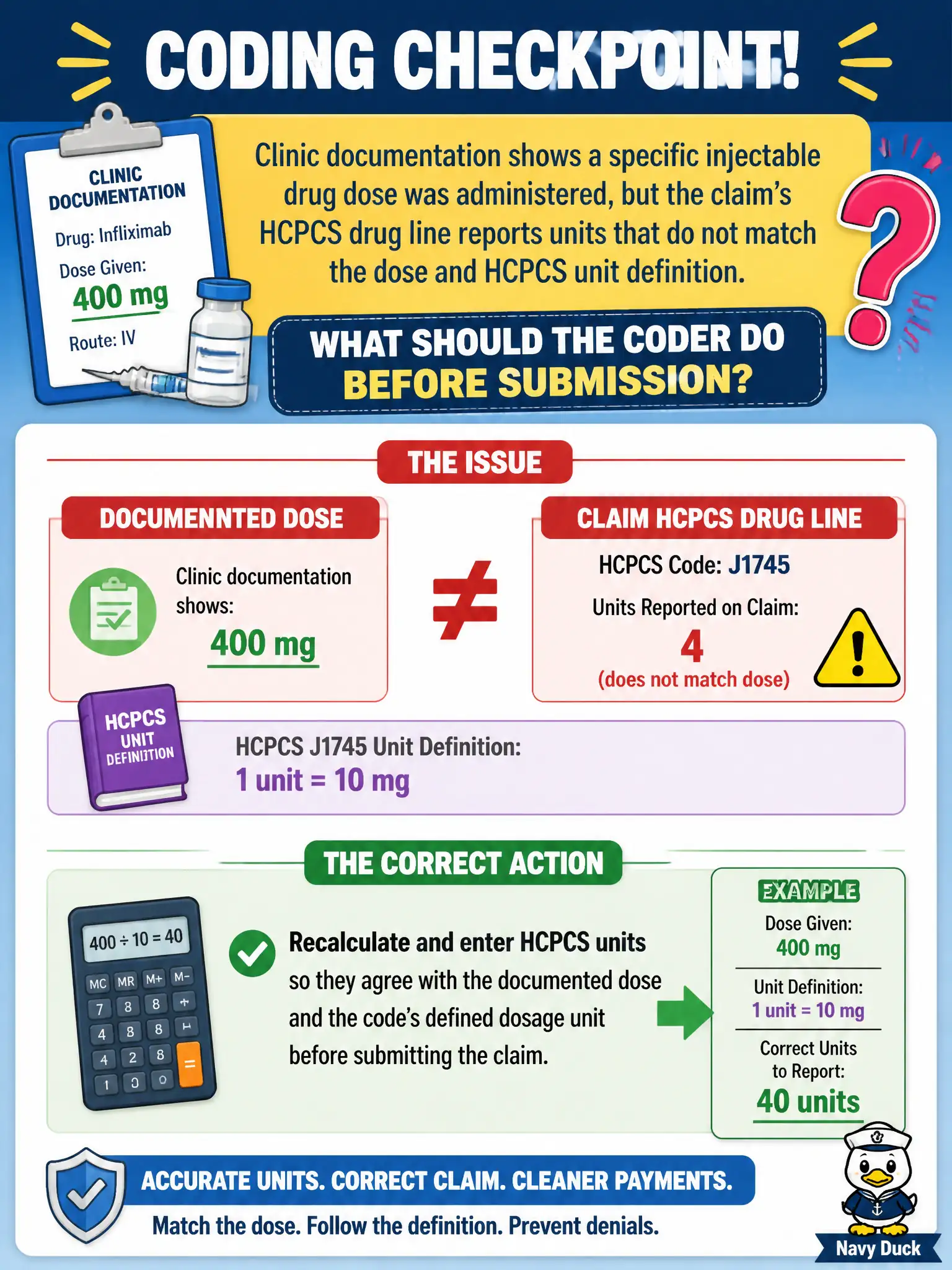
Clinic documentation shows a specific injectable drug dose was administered, but the claim’s HCPCS drug line reports units that do not match the dose and HCPCS unit definition. What should the coder do before submission?
Select an answer to reveal the explanation.
Short Explanation
Drug units are math, not vibes. If the note says a certain dose and the HCPCS code is priced per a defined amount, the unit count has to match that recipe. Fix the units to the documented dose before the claim goes out—padding or guessing just invites takebacks.
Full Explanation
HCPCS drug units must agree with the documented dose and the code’s defined dosage unit. When clinic documentation shows a specific injectable dose but the claim’s drug line reports mismatched units, the coder must recalculate and correct units before submission. Accurate unit math protects Medicare and other public-program payments from over- or under-billing on physician-office drug claims and is a core clean-claim control in civic outpatient revenue integrity.
Always billing one unit for any injectable regardless of dose fails by concept because many HCPCS codes define units as fractions or multiples of a standard dose. Rounding units up to the next ten to maximize payment fails because unit inflation is abusive billing, not estimation. Omitting the drug HCPCS line and billing only administration CPT to avoid unit edits fails when the drug itself is separately reportable and documented—it hides rather than solves the dosing problem.
Exam caveat: discarded-drug and single-dose vial rules can add complexity; apply JW/JZ and related guidance when applicable rather than inventing unit padding. Operational check: build dose-to-unit calculators for high-volume injectables, compare EHR documented dose to claim units in scrubbing, and correct before drop to payer.