
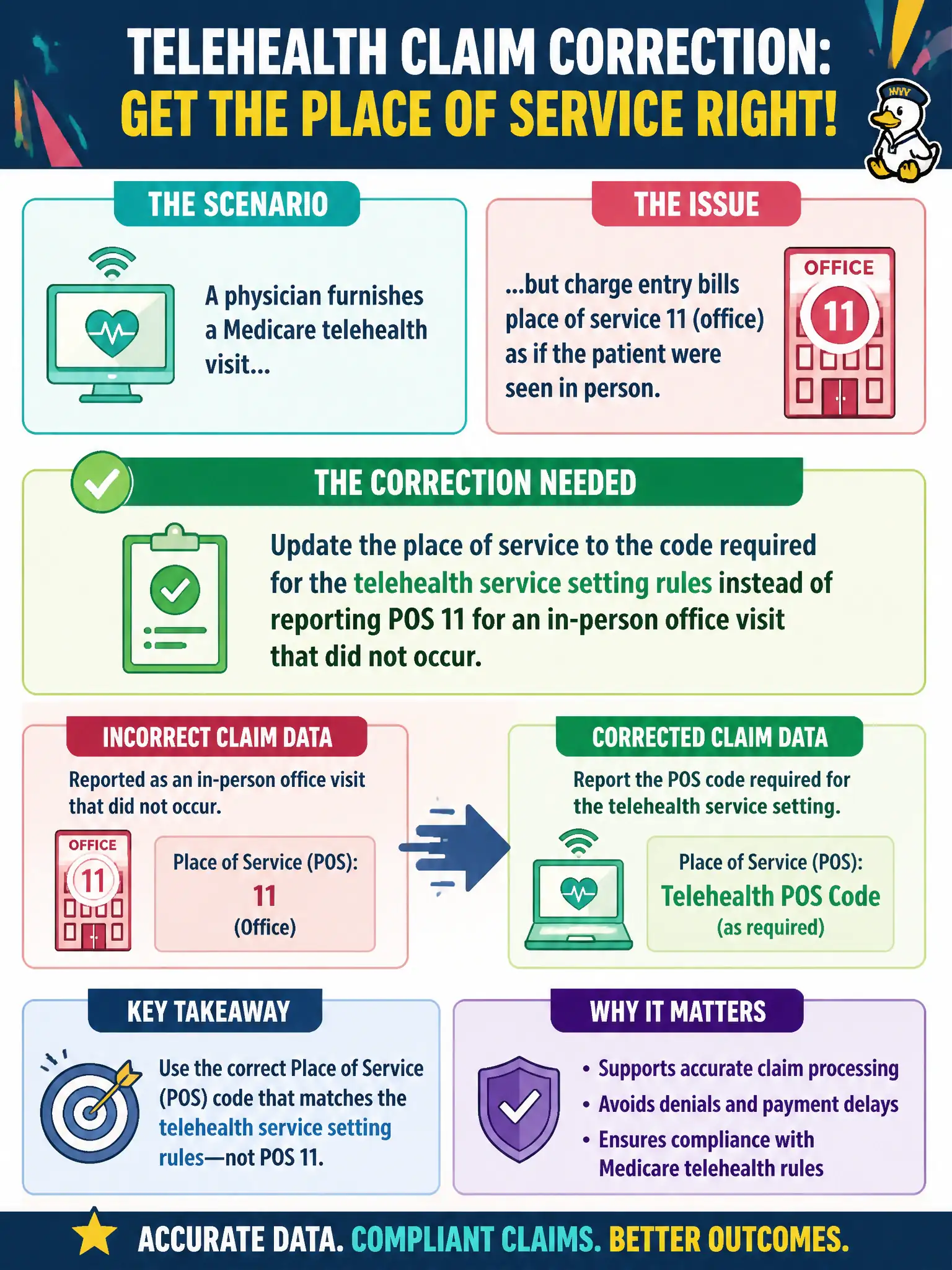
A physician furnishes a Medicare telehealth visit, but charge entry bills place of service 11 (office) as if the patient were seen in person. What claim-data correction is needed?
Select an answer to reveal the explanation.
Short Explanation
Place of service is the claim’s “where did this happen?” label. If the visit was telehealth, POS 11 for a face-to-face office visit is the wrong address on the envelope. Swap in the POS that telehealth rules call for so the claim matches the real setting.
Full Explanation
When a physician furnishes a Medicare telehealth visit but charge entry bills place of service 11 as if the patient were seen in person, the claim misstates the setting. The needed correction is to update POS to the code required under current telehealth service-setting rules rather than reporting POS 11 for an in-person office visit that did not occur. Civic clinics expanding virtual care must keep POS aligned with modality so public-program site-of-service and telehealth edits adjudicate correctly.
Keeping POS 11 and adding a facility revenue code on a professional claim fails by concept because professional CMS-1500 claims do not absorb facility revenue codes to “combine” settings. Removing POS because telehealth supposedly needs none fails because professional claims still report place of service. Changing only the CPT to an inpatient hospital E/M while leaving POS 11 fails because it invents the wrong service family and still leaves an incorrect office POS.
Exam caveat: telehealth POS values and modifiers change over time; apply the payer’s current instruction for the date of service. Operational check: charge-entry templates for video visits should default to telehealth POS logic, and scrubbers should flag POS 11 on encounters documented as audiovisual telehealth.