
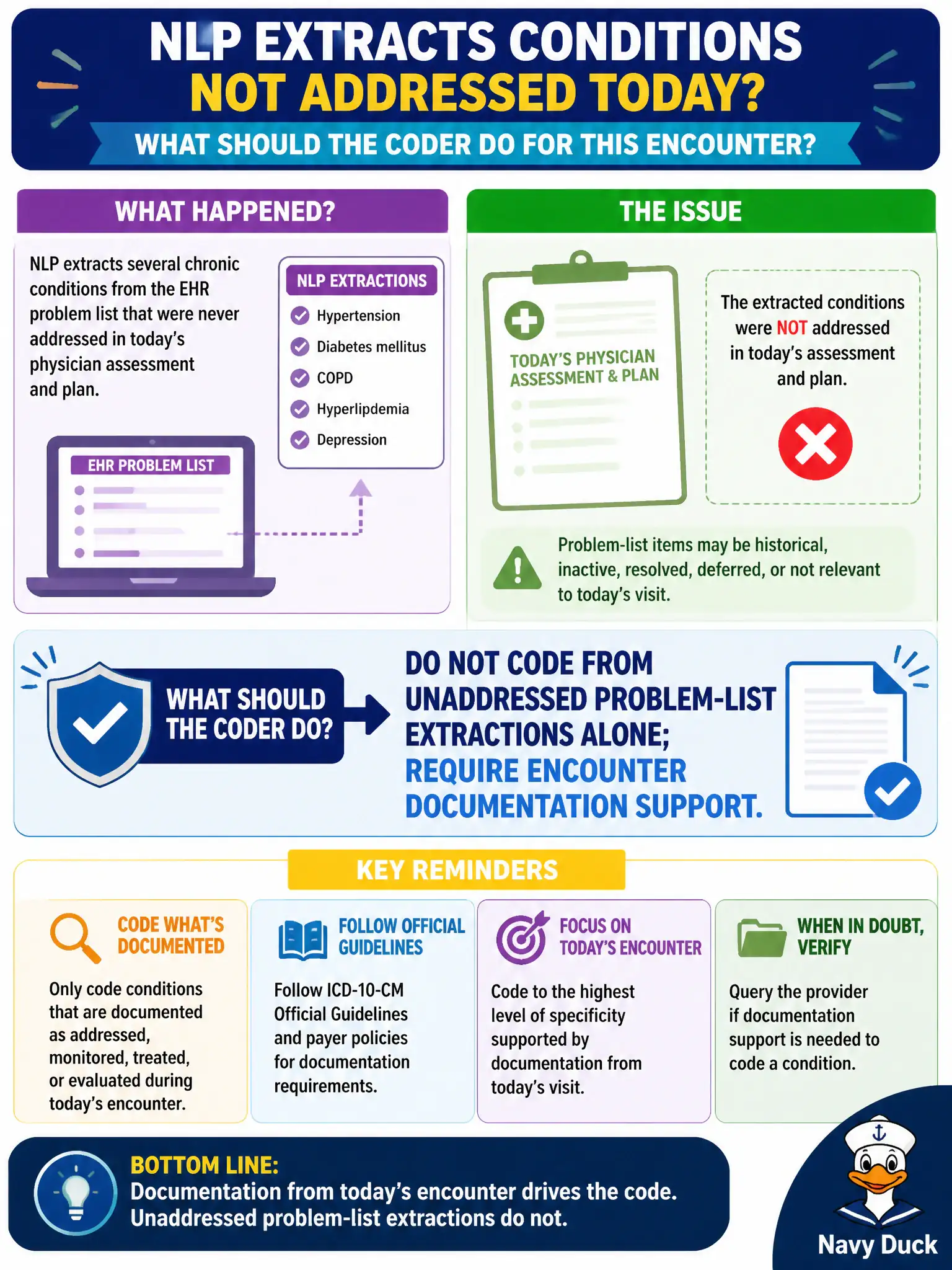
NLP extracts several chronic conditions from the EHR problem list that were never addressed in today’s physician assessment and plan. What should the coder do for this encounter?
Select an answer to reveal the explanation.
Short Explanation
A dusty problem list is not today’s visit. If the provider did not address those chronic items, NLP pulling them still does not make them reportable for this encounter. Code what today’s documentation supports.
Full Explanation
Problem lists often contain historical or inactive entries. NLP extraction of problem-list diagnoses does not by itself establish that conditions were monitored, evaluated, assessed, or treated at the current physician encounter. For today’s visit in a public clinic, the coder should not code from unaddressed problem-list extractions alone and should require encounter documentation support. Risk-adjustment integrity similarly expects MEAT-style (or equivalent) support when those diagnoses are reported for risk capture. Coding every NLP-extracted problem-list item to maximize HCC capture fails encounter-based and ethical coding expectations. Converting the entire problem list into primary diagnoses for every visit fails sequencing and relevance rules. Assuming problem-list NLP output replaces the need for an assessment fails documentation standards. Exam caveat: chronic conditions can be coded when addressed in today’s documentation—even briefly—but list presence alone is not addressment. Operational check: compare NLP problem-list hits to today’s assessment/plan, code only addressed conditions, query when indicators exist without a statement, and suppress auto-HCC problem-list mining in the county ambulatory coding workflow.