
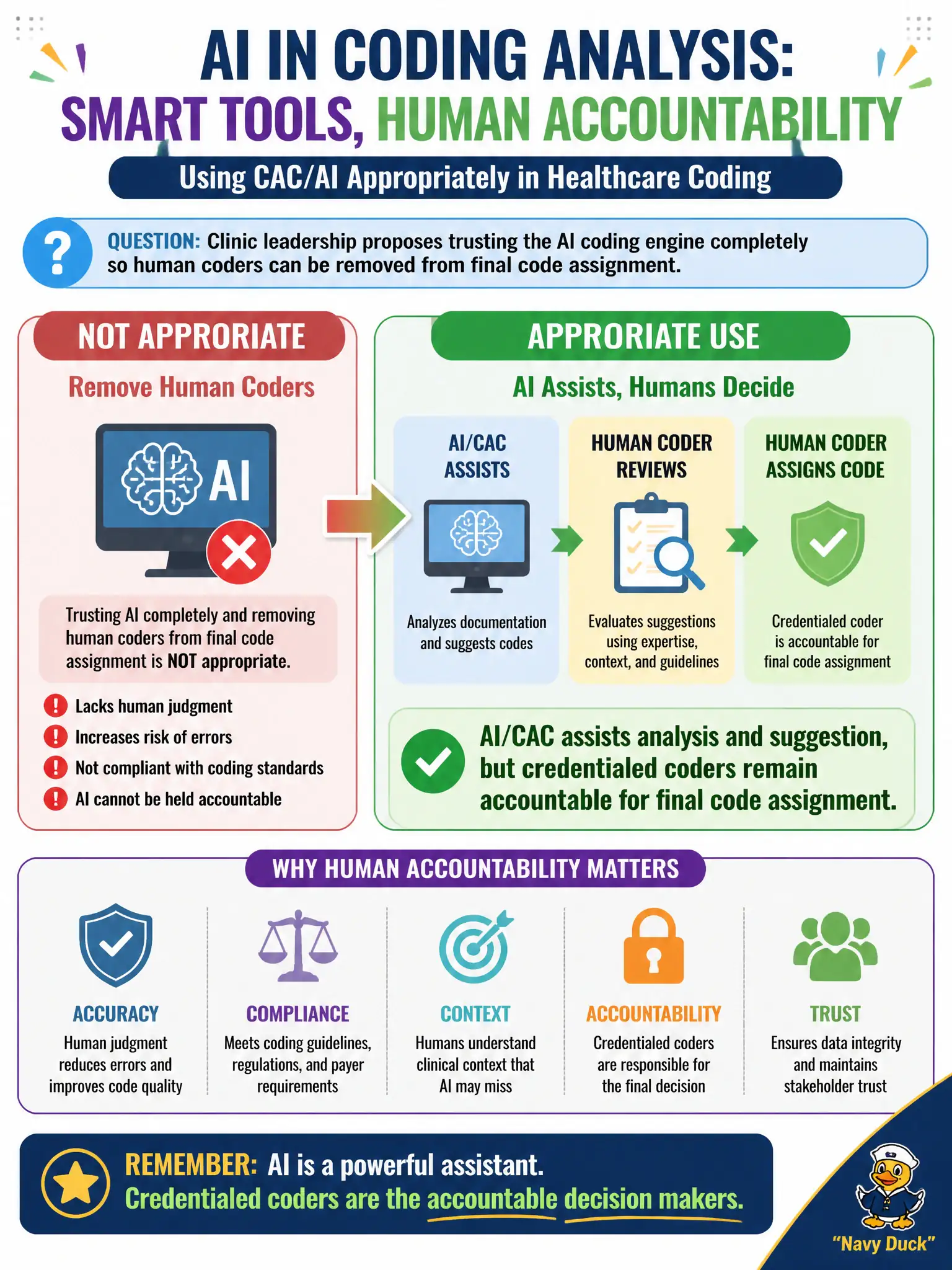
Clinic leadership proposes trusting the AI coding engine completely so human coders can be removed from final code assignment. Which statement aligns with appropriate use of CAC/AI in coding analysis?
Select an answer to reveal the explanation.
Short Explanation
AI is a junior assistant with a tireless highlighter—not a licensed coder. Leadership can buy tools, but accountability for the final codes still sits with humans who know the guidelines. “Trust the AI” is not a compliance strategy.
Full Explanation
NLP/AI/ML/CAC tools assist analysis and code suggestion for physician professional claims, but credentialed coders remain accountable for final code assignment under Official Guidelines, CPT rules, payer policy, and ethics standards. When clinic leadership proposes trusting the AI engine completely so human coders can be removed from final assignment, the statement that aligns with appropriate use is that AI/CAC assists—while humans remain accountable for finals. Fully unsupervised AI coding increases compliance, payment, and quality-reporting risk for civic practices. Stopping review of outpatient diagnosis and procedure codes once AI is installed fails accountability expectations. Claiming AI output is legally immune from audit fails because organizations remain responsible for submitted claims. Asserting that removing coder validation is required to meet AHIMA ethical coding standards fails—the reverse is true: ethical standards support accurate human-validated coding. Exam caveat: assistive AI is in-scope for CCS-P research/analysis topics; “replace the coder entirely” is a distractor pattern. Operational check: keep a human validation step in the civic coding SOP, define CAC confidence thresholds for auto-suggest only, require coder sign-off on finals, and report AI exception rates to the compliance committee.