
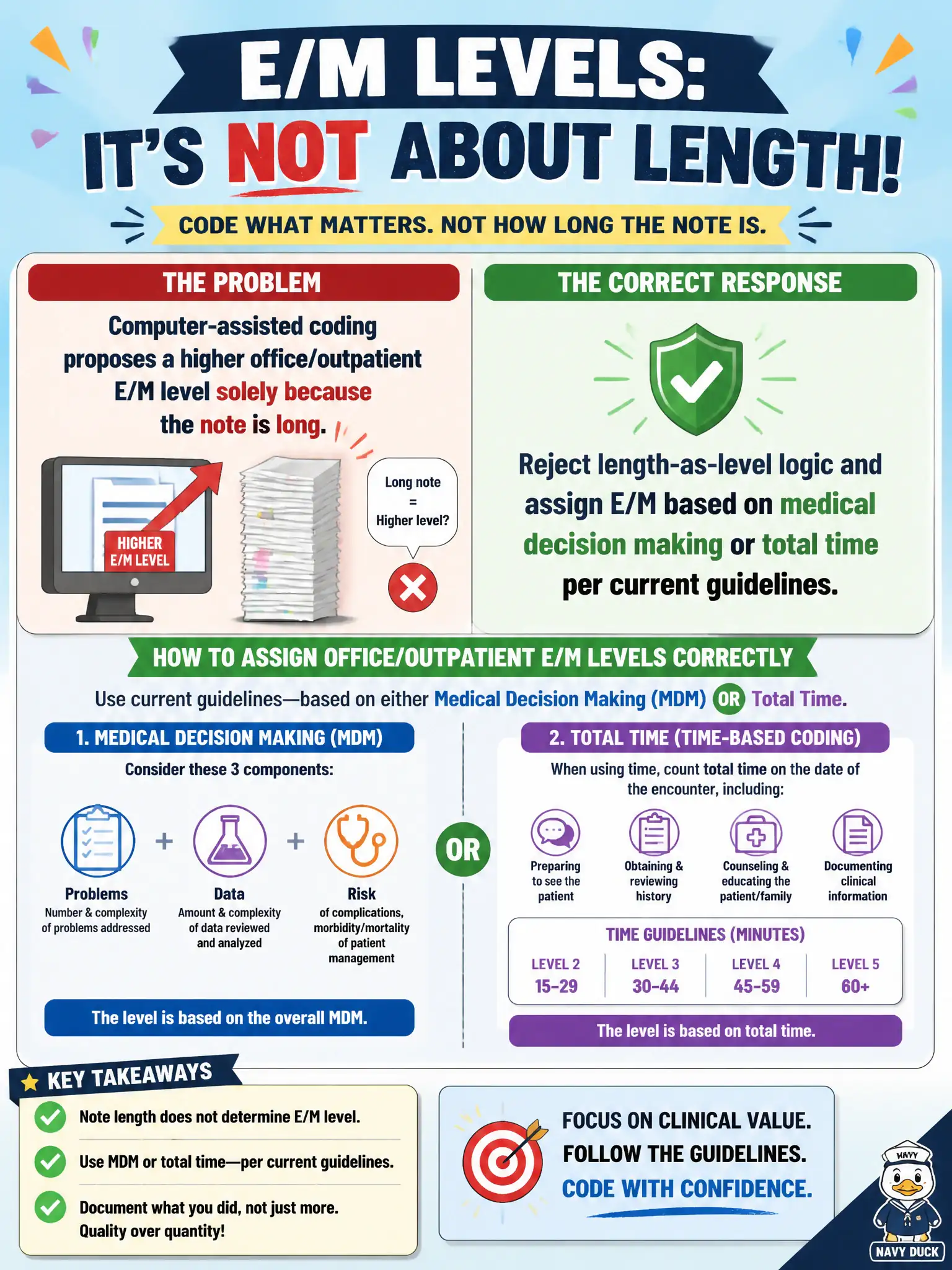
Computer-assisted coding proposes a higher office/outpatient E/M level solely because the note is long. What is the correct response?
Select an answer to reveal the explanation.
Short Explanation
Long notes are not free upgrades. E/M still rides on MDM or time under current office/outpatient rules—not on how many paragraphs the template dumped. If CAC levels by length alone, override it.
Full Explanation
Current office/outpatient E/M selection is based on medical decision making or total time, not history/exam volume or note length. When computer-assisted coding proposes a higher E/M level solely because the note is long, the correct response for a CCS-P coder in a civic clinic is to reject length-as-level logic and assign E/M based on MDM elements or documented total time per current CPT guidelines. Verbosity, template expansion, and copied review-of-systems text do not equal medical decision making. Accepting the higher level because note length equals MDM fails CPT E/M rules and invites upcoding findings on public-program claims. Always billing the highest E/M in the category when CAC flags verbosity fails as systematic, engine-driven upcoding. Replacing MDM scoring with a clinic word-count threshold written into policy fails by inventing a noncompliant leveling methodology that conflicts with CPT. Exam caveat: time-based leveling still requires documented total time meeting CPT thresholds on the date of encounter—not page count, character count, or dictation duration alone without the required time statement. Prolonged-services logic, when applicable, is separate from using length to invent a base E/M level. Operational check: score problems addressed, data, and risk (or validated total time) from today’s note; override CAC length heuristics; educate providers in the municipal clinic that macros and verbose templates do not raise levels; and sample length-driven CAC suggestions during monthly E/M QA with refund/rebill when unsupported levels were released.