
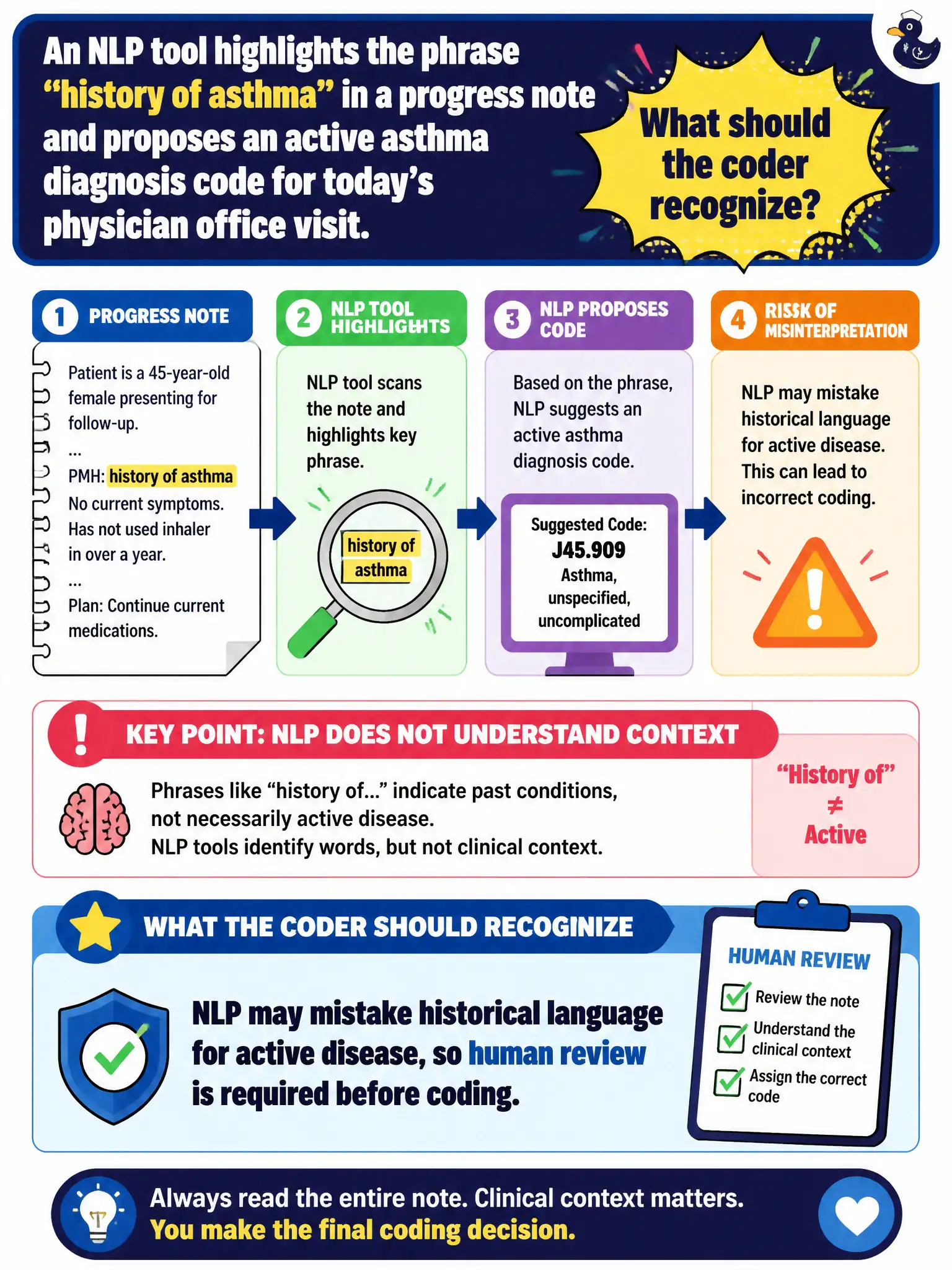
An NLP tool highlights the phrase “history of asthma” in a progress note and proposes an active asthma diagnosis code for today’s physician office visit. What should the coder recognize?
Select an answer to reveal the explanation.
Short Explanation
“History of” is a classic NLP trap. The engine sees the disease word and sometimes forgets the timeline. A human still has to decide whether today’s visit actually treats active asthma.
Full Explanation
Natural language processing can misclassify status, certainty, and temporality cues such as “history of,” “rule out,” or resolved conditions. When an NLP tool highlights “history of asthma” and proposes an active asthma diagnosis for today’s physician office visit, the coder must recognize that NLP may mistake historical language for active disease and that human review is required before coding. Active disease codes need encounter support consistent with Official Guidelines and the provider’s statements for that visit. Assuming NLP never misreads status language fails because temporality errors are a known NLP failure mode. Treating any NLP highlight as automatic medical necessity for inhaler billing fails by conflating text detection with coverage and medical-necessity determination. Equating history-of language with an acute exacerbation fails outpatient diagnosis coding logic. Exam caveat: “history of” may still be codeable as a personal-history status when guidelines and documentation support that concept—but that is not the same as active asthma. Operational check: read the surrounding sentence and assessment, determine history versus active disease, assign only the supported concept, override the NLP proposal when wrong, and feed the error example into the civic clinic’s NLP tuning/education log.