
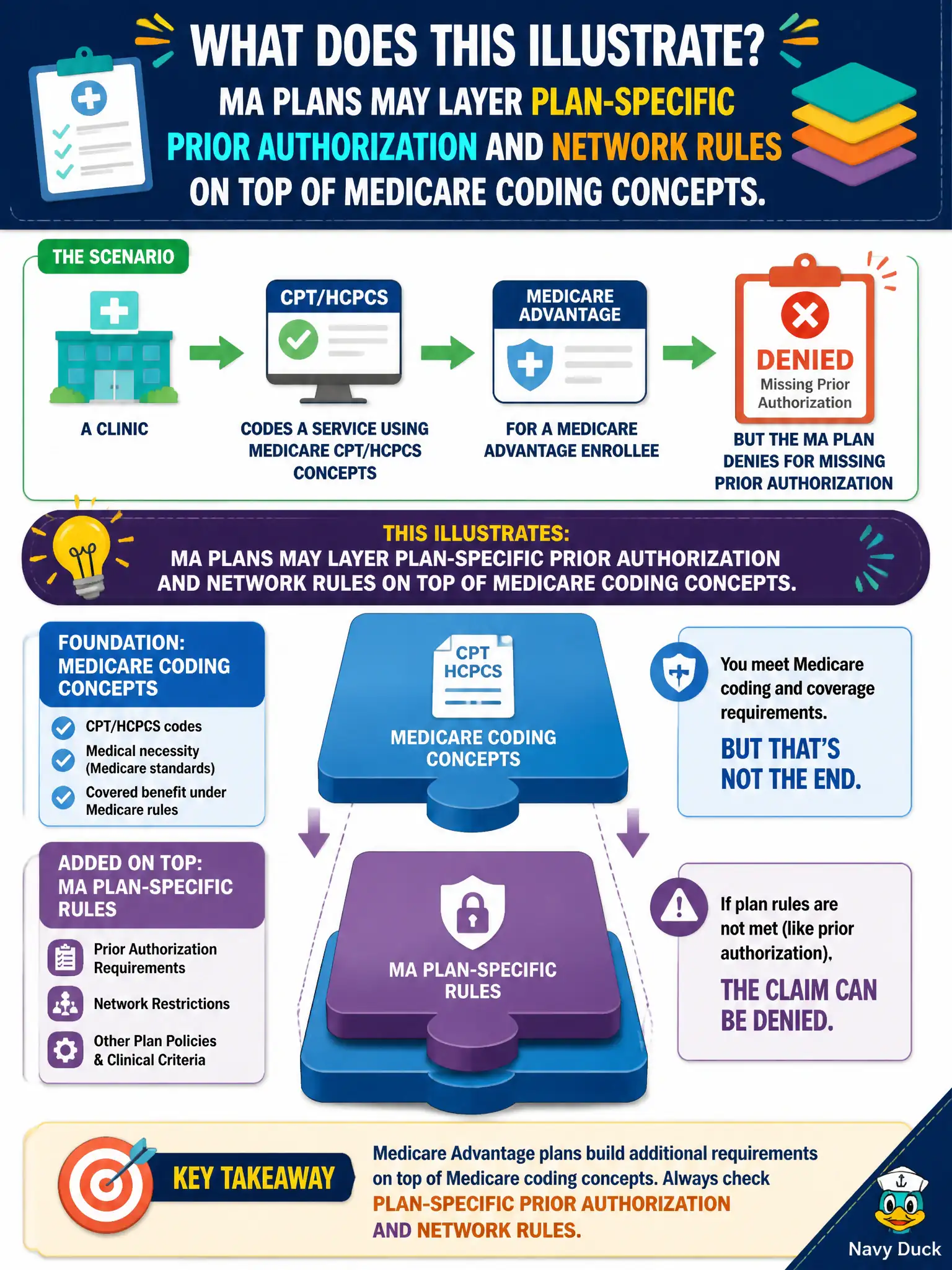
A clinic codes a service using Medicare CPT/HCPCS concepts for a Medicare Advantage enrollee, but the MA plan denies for missing prior authorization. What does this illustrate?
Select an answer to reveal the explanation.
Short Explanation
MA often speaks Medicare coding language but runs its own front-desk rules—auth, network, referrals. Right code, wrong gate, still a denial.
Full Explanation
Medicare Advantage (MA) organizations generally use Medicare coding frameworks (CPT/HCPCS/ICD concepts) but may impose additional operational requirements such as prior authorization, referrals, and network constraints. When a clinic codes a service correctly using Medicare CPT/HCPCS concepts for an MA enrollee yet the MA plan denies for missing prior authorization, the scenario illustrates plan-specific administration layered on top of coding concepts. Correct code assignment does not erase MA prior-auth rules. Claiming MA never uses CPT codes fails because MA claims routinely use CPT/HCPCS. Declaring prior authorization illegal for all Medicare-related plans fails as an inaccurate legal generalization and ignores MA plan operations. Assuming traditional Medicare FFS prior-auth mechanics always apply identically to every MA denial fails because MA plan contracts and utilization management differ from FFS. Exam caveat: distinguish coding correctness from coverage/administration; CCS-P research items often test payer-type differentiation, not just code lookup. Operational check: verify MA plan and auth requirements before the service when possible, confirm auth number on the claim, differentiate FFS vs MA workqueues in the county clinic PMS, and educate schedulers that “Medicare-looking codes” still need MA plan clearance.