
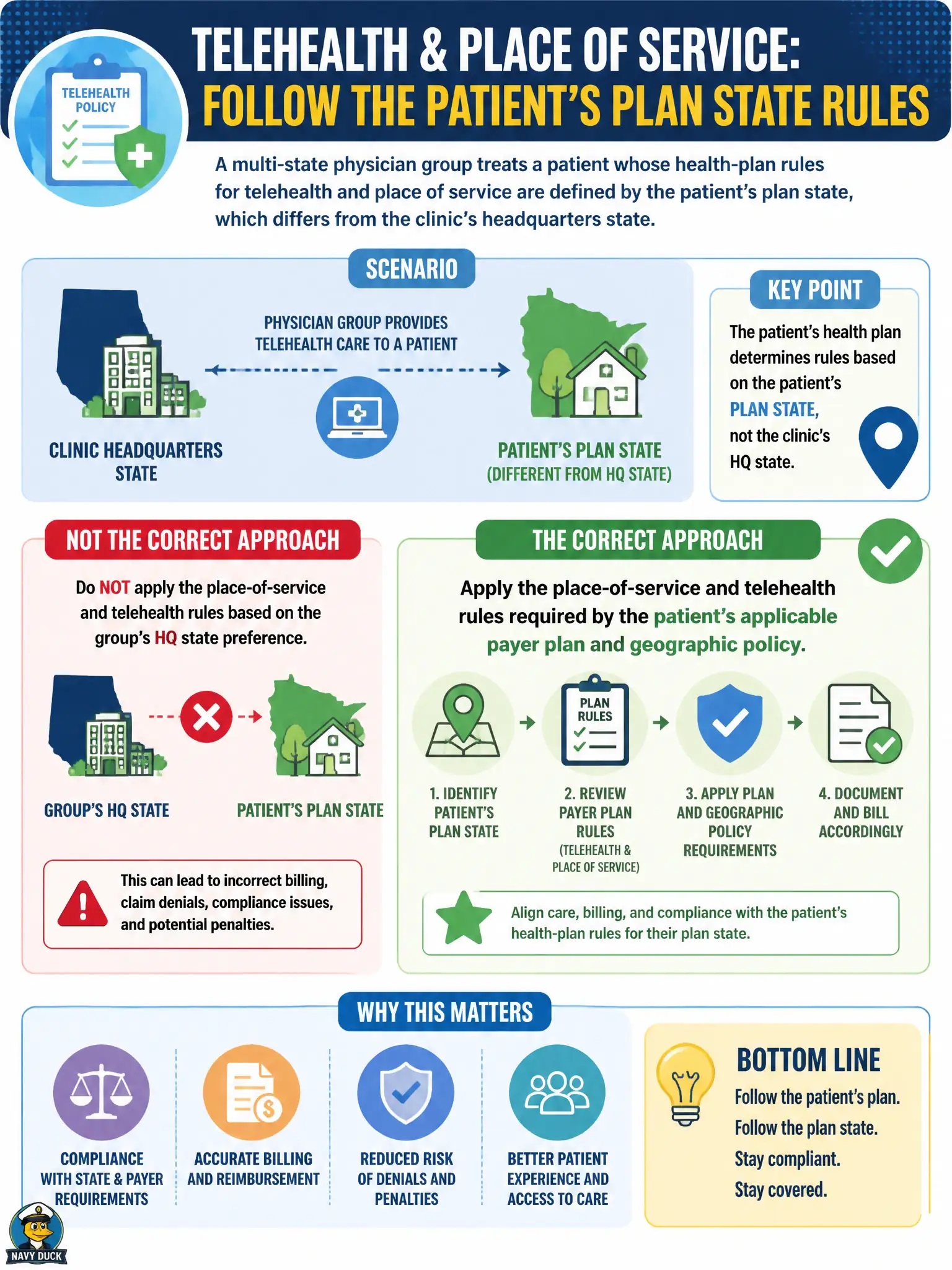
A multi-state physician group treats a patient whose health-plan rules for telehealth and place of service are defined by the patient’s plan state, which differs from the clinic’s headquarters state. Which approach is correct?
Select an answer to reveal the explanation.
Short Explanation
The patient’s plan state is the referee for that claim—not the fancy HQ zip code on the letterhead. Code to the payer’s geography.
Full Explanation
Multi-state physician groups must determine which payer’s and which geographic policy’s telehealth and place-of-service rules govern each claim. Headquarters state preference does not override the patient’s applicable plan policy or the state Medicaid/commercial rules that apply to that enrollee and encounter. The correct approach is to apply the POS and telehealth requirements required by the patient’s applicable payer plan and geographic policy. Always applying only the headquarters state’s Medicaid manual to every patient fails when patients are covered by other states’ plans or different payers. Using international coding guidelines to neutralize state differences fails because U.S. professional claims follow U.S. payer/state rules, not a global homogenizer. Omitting POS and telehealth modifiers on all cross-state visits fails by stripping required claim elements and inviting denials. Exam caveat: “plan state,” “rendering location,” and “patient location” can all matter depending on telehealth policy—read the governing bulletin for the DOS rather than inventing a HQ-only shortcut. Operational check: identify payer and plan state on the eligibility file, retrieve that plan’s telehealth/POS rules, set claim fields accordingly, and document the governing source on the multi-state civic group’s coding research log.