
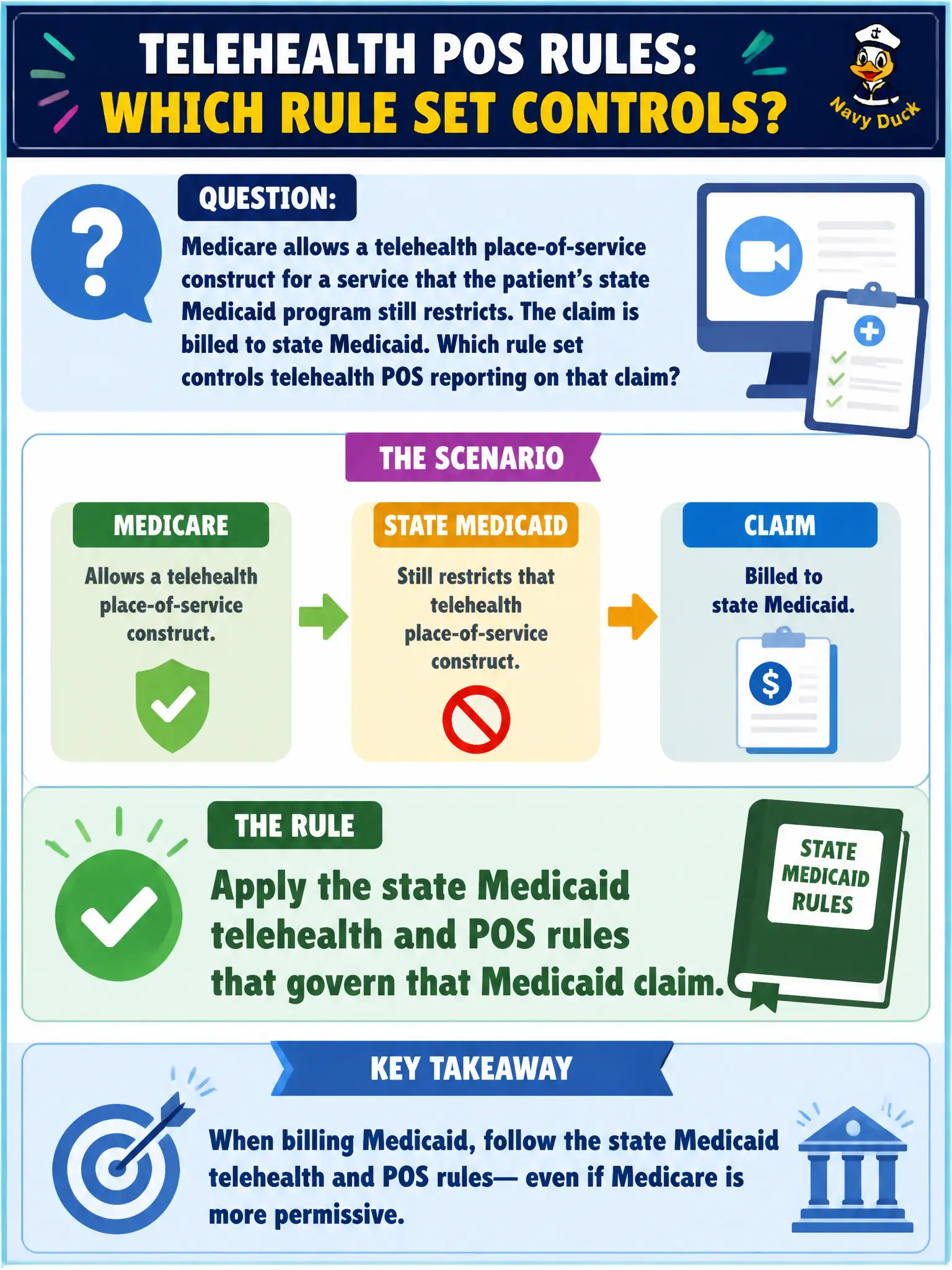
Medicare allows a telehealth place-of-service construct for a service that the patient’s state Medicaid program still restricts. The claim is billed to state Medicaid. Which rule set controls telehealth POS reporting on that claim?
Select an answer to reveal the explanation.
Short Explanation
Whoever is paying the claim writes the telehealth dress code. Medicaid on the claim? Wear Medicaid’s rules—even if Medicare would have dressed it differently.
Full Explanation
Telehealth coding and place-of-service requirements are payer-specific. Medicare telehealth POS constructs do not automatically control a state Medicaid claim. When a civic clinic bills state Medicaid for a service that Medicare would allow under a telehealth POS framework but Medicaid still restricts, the coder applies that state’s Medicaid telehealth coverage, POS, and modifier rules for the Medicaid claim. Differentiating federal Medicare, state Medicaid, and commercial policies is core research skill for CCS-P. Always using Medicare telehealth POS for every payer fails because Medicare is not a universal overlay for Medicaid claims. Omitting place of service entirely fails because POS is required claim data and telehealth adjudication often depends on it. Defaulting to the physician’s home-state commercial PPO policy fails when the claim is Medicaid and a different rule set governs. Exam caveat: telehealth flexibilities change by program and date—verify the policy effective for the date of service and payer, not last year’s Medicare FAQ alone. Operational check: confirm the payer is state Medicaid, open the current Medicaid telehealth/POS bulletin, set POS/modifiers accordingly (or do not bill telehealth if noncovered), and save the citation in the municipal telehealth coding binder.