
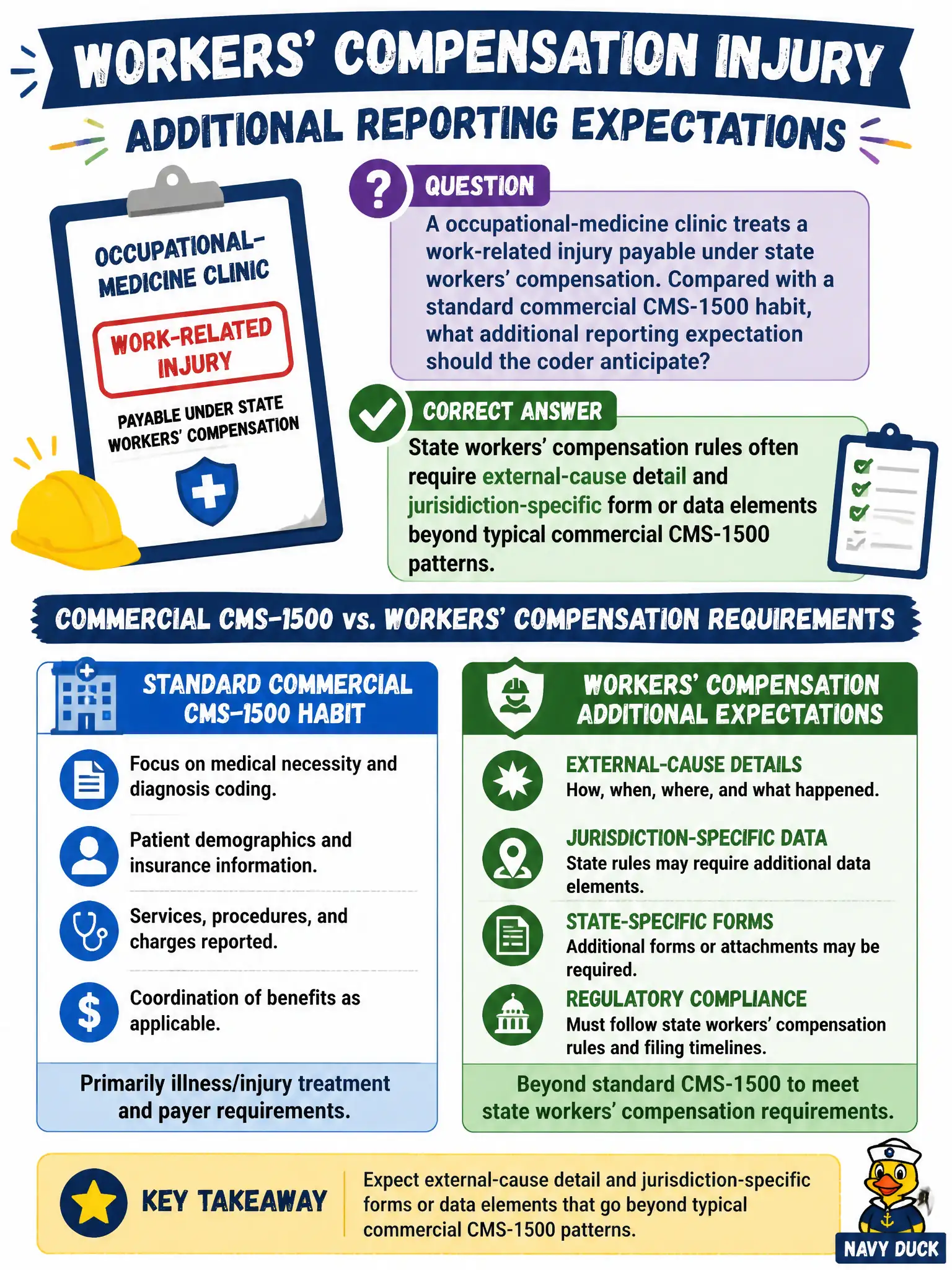
A occupational-medicine clinic treats a work-related injury payable under state workers’ compensation. Compared with a standard commercial CMS-1500 habit, what additional reporting expectation should the coder anticipate?
Select an answer to reveal the explanation.
Short Explanation
Work-comp is its own sport. Besides the usual codes, states often want the “how it happened” external causes and special form fields commercial health plans shrug off.
Full Explanation
Workers’ compensation is regulated primarily at the state level and often demands reporting elements beyond ordinary commercial CMS-1500 habits—commonly external-cause of injury detail, jurisdiction-specific forms, and other data elements. An occupational-medicine clinic treating a work-related injury payable under state workers’ compensation should anticipate those additional expectations rather than copying standard commercial health-plan claim patterns. Claiming workers’ compensation never requires diagnosis codes fails because injury diagnoses (and often external causes) are central to WC reporting. Dropping all CPT codes for a narrative-only letter fails when the jurisdiction still expects coded services on prescribed forms. Forcing Medicare crossover logic first fails because WC is not administered as Medicare FFS crossover by default and primacy rules differ. Exam caveat: WC rules vary by state—never assume one state’s form or external-cause mandate applies nationwide; research the jurisdiction covering the claim. Operational check: identify the WC jurisdiction and carrier, pull the state reporting checklist (external cause, form type, timely filing), code injury/external-cause detail as required, and route the civic clinic claim through the WC workqueue—not the commercial 1500 default path.