
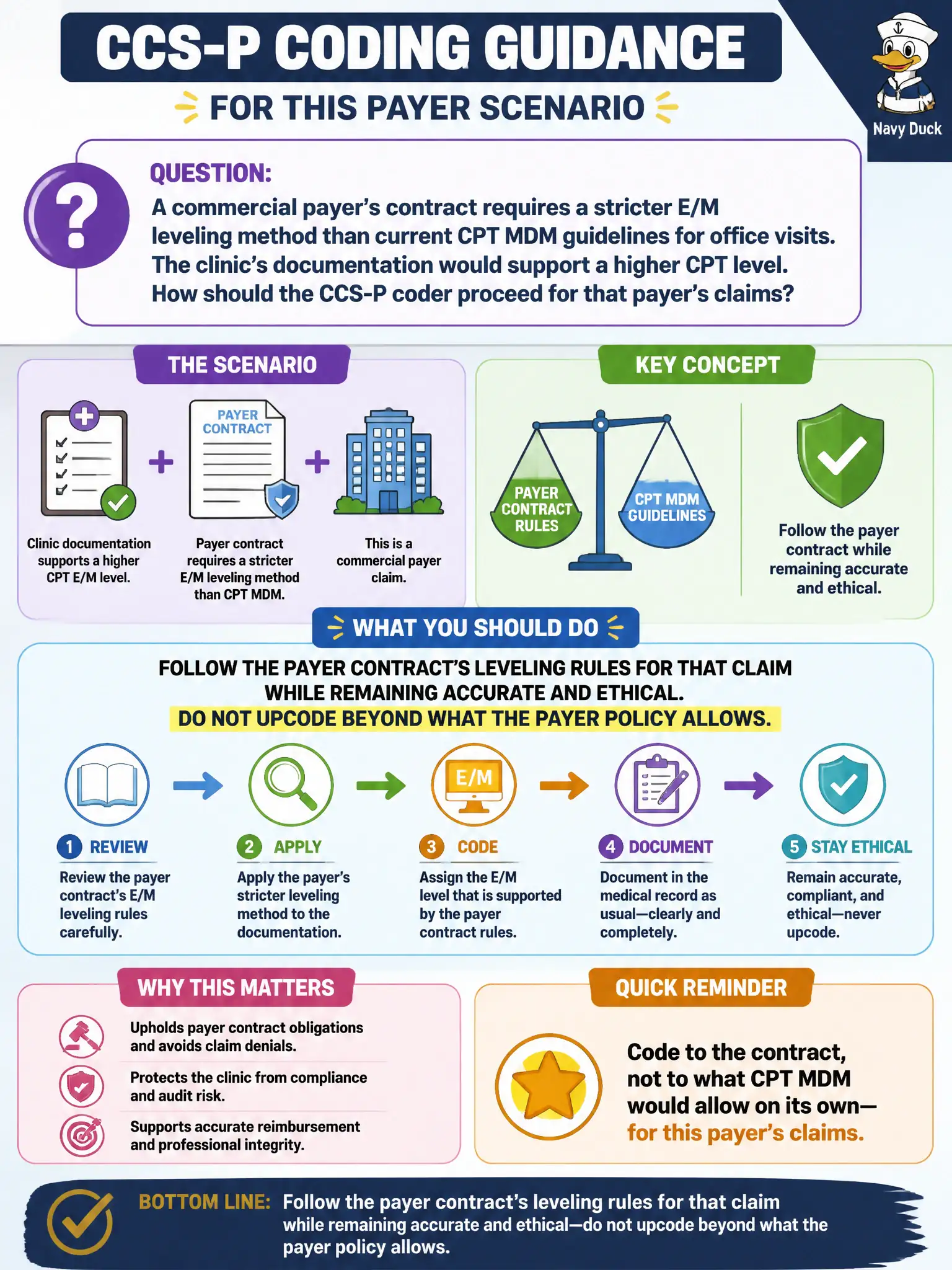
A commercial payer’s contract requires a stricter E/M leveling method than current CPT MDM guidelines for office visits. The clinic’s documentation would support a higher CPT level. How should the CCS-P coder proceed for that payer’s claims?
Select an answer to reveal the explanation.
Short Explanation
CPT is the national playbook; the contract can still set a tighter house rule. For that payer, play by the house rule without inventing services—ethics stay on, just the level may come down.
Full Explanation
Physician coding must reconcile CPT guidelines with payer-specific contractual policies. When a commercial payer’s contract imposes a stricter E/M leveling method than current CPT MDM office-visit guidelines, claims to that payer should follow the contract’s leveling rules while remaining accurate and ethical. The CCS-P coder for a public clinic does not upcode beyond what that payer policy allows merely because the note could support a higher CPT level under unmodified CPT MDM logic. Always billing the highest CPT level the note could support while ignoring the contract fails as a contractual and potentially abusive billing practice. Refusing to code any E/M until CPT and the contract match fails operationally and leaves legitimate services unbilled. Billing facility DRG levels fails by setting: DRGs are inpatient facility payment constructs, not professional-fee E/M substitutes, and commercial professional contracts absolutely can govern physician fees. Exam caveat: different payers on the same calendar day can require different leveling methods—apply the rule set that governs each claim, and keep documentation truthful regardless of level. Operational check: identify the payer/contract E/M methodology in the contract library, level the visit under that method, compare to CPT literacy for education (not for ignoring the contract), and note the governing source on the county clinic coding sheet for audit defense.