
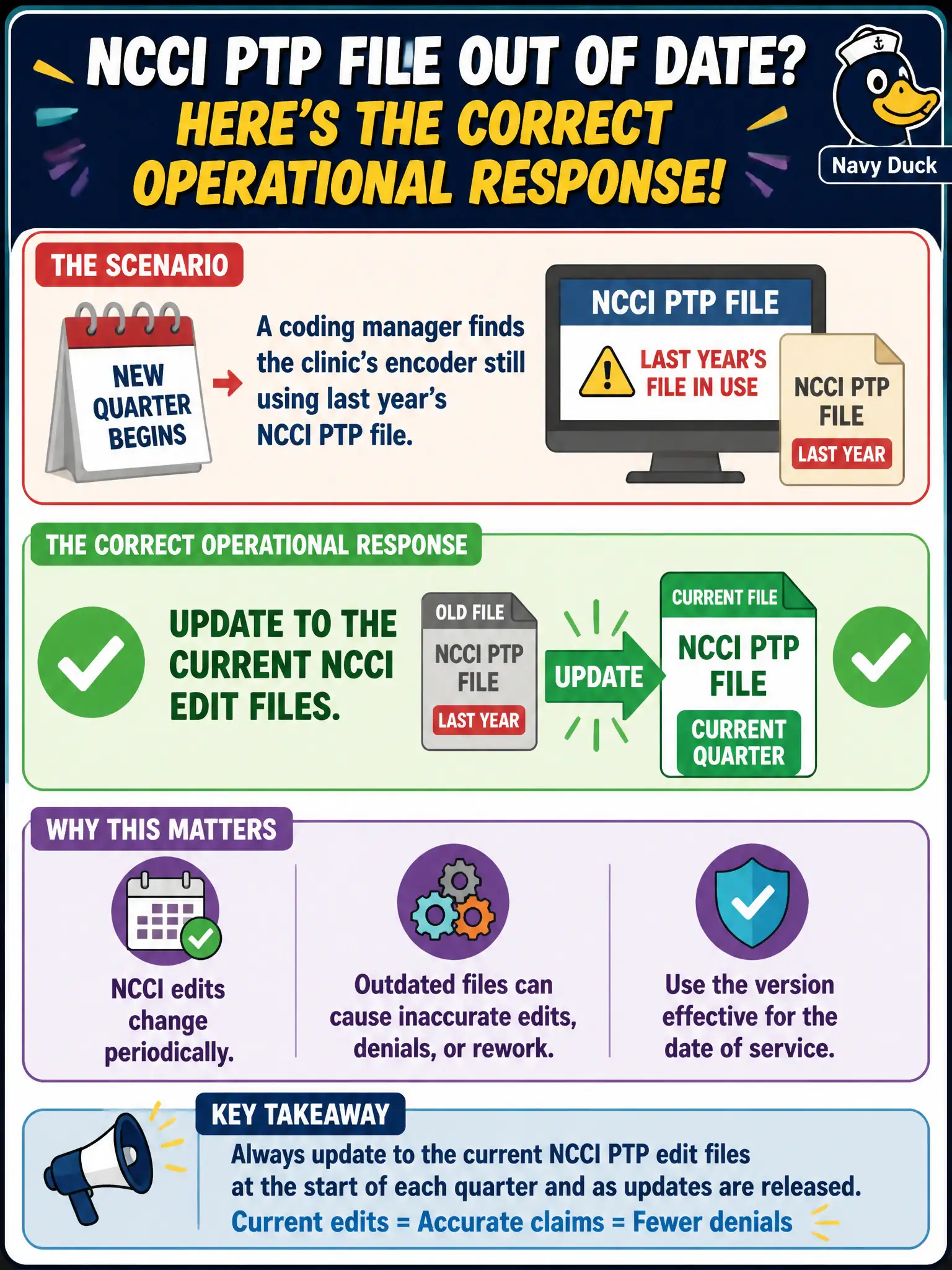
A coding manager finds the clinic’s encoder still using last year’s NCCI PTP file after a new quarter begins. What is the correct operational response?
Select an answer to reveal the explanation.
Short Explanation
NCCI is a living list, not a dusty binder. When the new quarter drops, swap in the current file—old edits can miss new bundles or wrongly block clean pairs.
Full Explanation
CMS updates NCCI PTP and MUE files on a periodic schedule (typically quarterly). Physician practices—including county and municipal clinics—must apply the edit version effective for the date of service. When a coding manager finds the encoder still loaded with last year’s PTP file after a new quarter begins, the correct operational response is to update immediately to the current files so daily claims use effective edits. Stale tables create both overcoding and undercoding risk and undermine public-program stewardship. Keeping the old file permanently to preserve historical payment patterns fails because payment history does not authorize outdated correct-coding edits. Applying NCCI only at year-end audits fails because edits are prospective claim controls, not annual academic exercises. Disabling NCCI checking for commercial payers so updates “never matter” fails because many commercial payers adopt CMS edits or close variants, and turning controls off removes a core compliance safeguard. Exam caveat: commercial payer variants may differ slightly from CMS, but using an obsolete CMS file is never an acceptable substitute for current research. Operational check: calendar quarterly NCCI release dates, update encoder/edit tables with version validation, spot-check a sample of civic claims against the CMS file for the DOS, and document the update in the practice’s IT/compliance change log.