
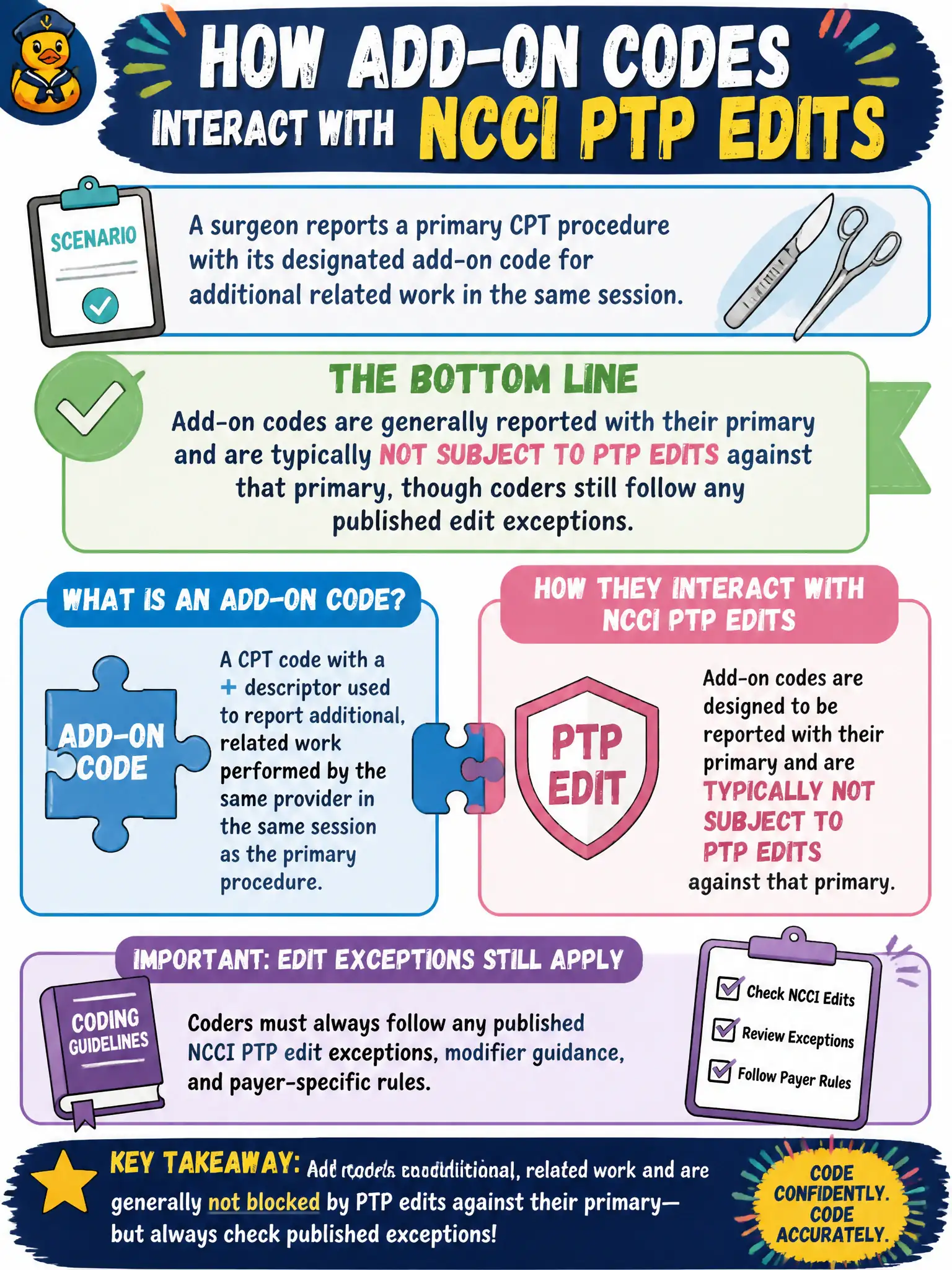
A surgeon reports a primary CPT procedure with its designated add-on code for additional related work in the same session. How do add-on codes generally interact with NCCI PTP edits?
Select an answer to reveal the explanation.
Short Explanation
Add-ons are the extra scoop that only exists with the cone. You do not usually need a special “unbundle” stamp to serve them with their primary—just make sure you still obey any rare edit exception CMS publishes.
Full Explanation
CPT add-on codes describe additional related work reported with a primary procedure in the same session and are not reported as stand-alone services. As a general NCCI principle, add-on codes are typically not subject to PTP edits against their primary procedure, although coders must still review current edit files for any published exceptions. In a civic surgical clinic, the correct approach is to report the primary plus the designated add-on when documentation supports the additional work, without inventing a distinct-service modifier solely because an add-on is present. Claiming add-on codes are never payable on physician claims fails by setting and concept: add-ons are commonly used on professional surgical claims when criteria are met. Requiring modifier 59 on every add-on to pay with its primary fails because add-ons are designed to accompany the primary; 59 is not a routine add-on tax. Replacing the primary with the add-on fails because an add-on cannot stand alone and would understate the primary service. Exam caveat: never report an add-on without its required primary, and always check the current quarter’s edits for rare exceptions rather than memorizing “never edited” as absolute forever. Operational check: confirm primary CPT eligibility, confirm add-on descriptor matches documented extra work, verify no unexpected PTP exception for the DOS, omit unnecessary 59, and include both codes with units/linking consistent with the county OR coding checklist.