
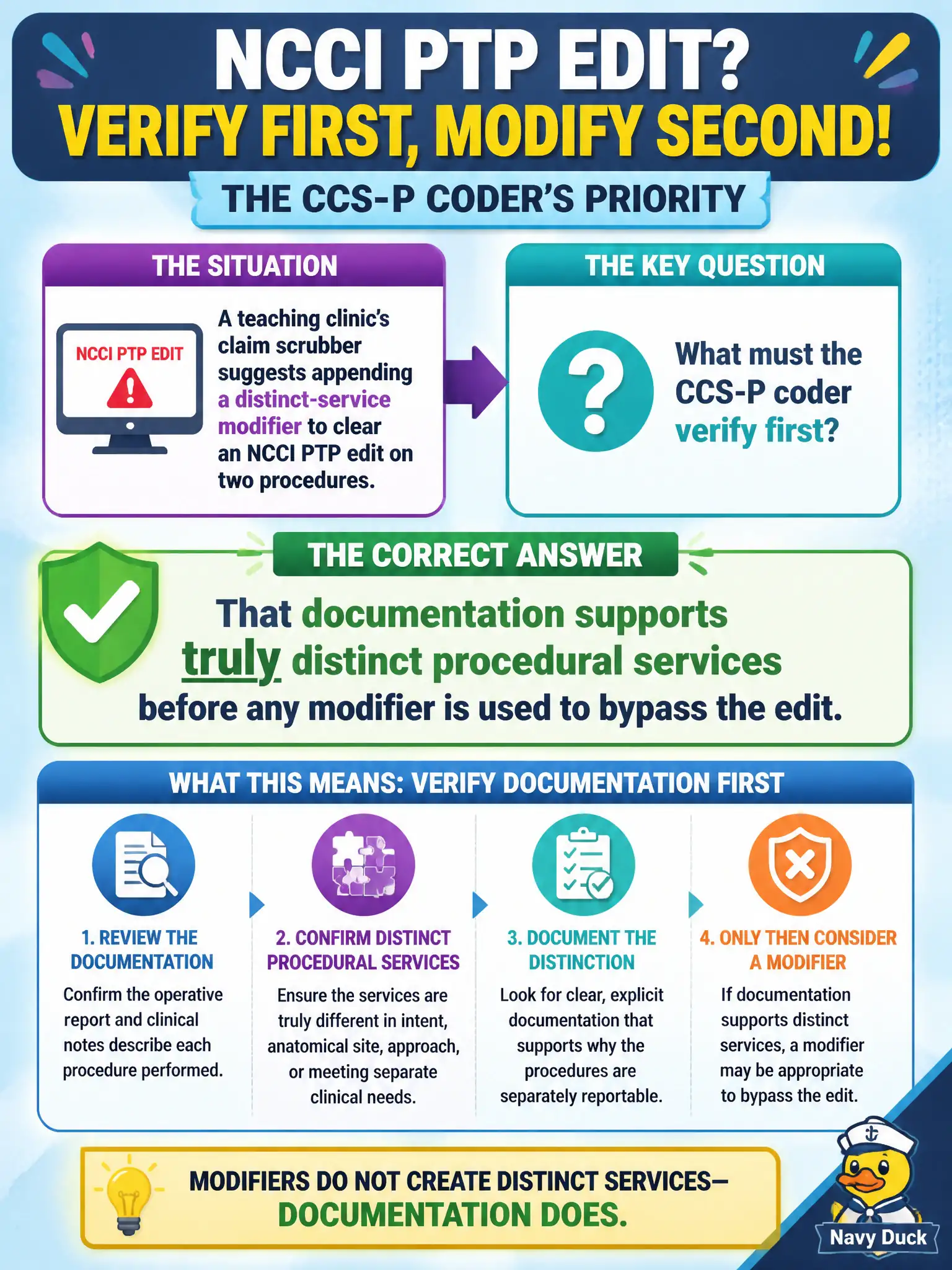
A teaching clinic’s claim scrubber suggests appending a distinct-service modifier to clear an NCCI PTP edit on two procedures. What must the CCS-P coder verify first?
Select an answer to reveal the explanation.
Short Explanation
The scrubber is a smoke alarm, not a permission slip. Before you hang a distinct-service modifier, open the note and prove the work was really separate—otherwise you are just silencing the alarm.
Full Explanation
A claim scrubber suggestion to append a distinct-service modifier is only a workflow alert—not clinical proof. Before bypassing an NCCI PTP edit in a teaching civic clinic, the CCS-P coder must verify that documentation supports truly distinct procedural services (for example separate encounter, structure, practitioner, or non-overlapping unusual work as applicable) and that the modifier indicator allows a modifier. Automatic modifier application without that verification is a leading revenue-integrity failure mode. Relying on a resident’s name appearing in the chart fails because teaching-physician or resident documentation rules do not override NCCI distinct-service standards. Trusting that the charge master lists both codes as always payable together fails because chargemaster configuration cannot rewrite CMS edit logic. Holding the claim overnight so the edit “expires” fails because NCCI edits are not time-limited cookies; they apply by DOS version and policy. Exam caveat: indicator “0” cannot be bypassed even with perfect documentation of “distinctness”; indicator “1” still needs both permission and supporting facts. Operational check: read both operative descriptions, confirm non-overlapping distinctness criteria, match X{EPSU}/59 to the true reason and payer preference, refuse scrubber auto-59 when support is absent, and escalate unclear cases to the municipal coding compliance lead before submission.