
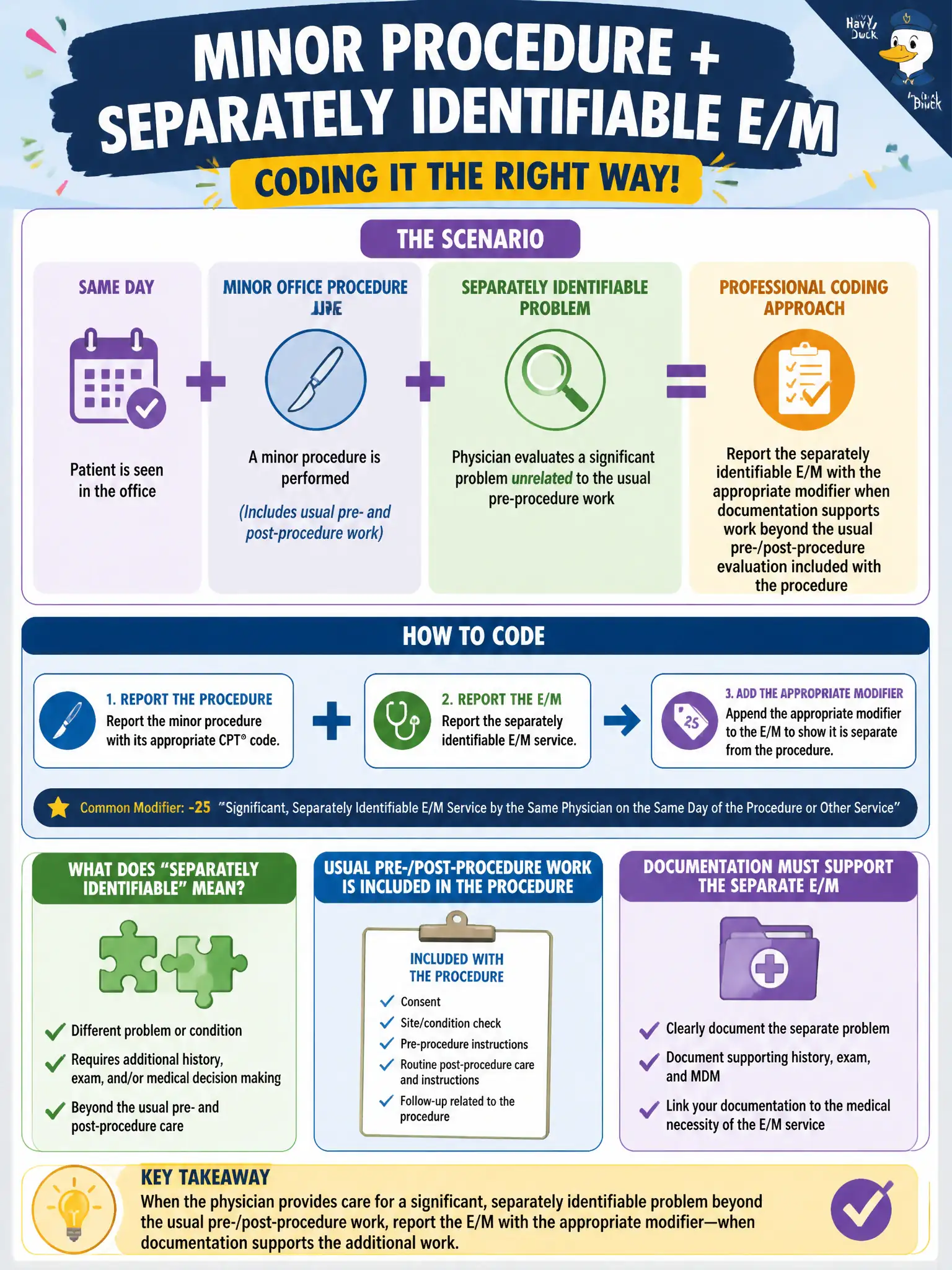
On the same day as a minor office procedure, the physician also evaluates a significant, separately identifiable problem unrelated to the usual pre-procedure work. How should professional coding treat the E/M?
Select an answer to reveal the explanation.
Short Explanation
The little look-over that comes with a procedure is already in the procedure’s price of admission. A real second problem that needs its own brainpower can still get an E/M—with the right modifier and a note that proves it was separate.
Full Explanation
On the same day as a minor office procedure, when the physician also evaluates a significant, separately identifiable problem unrelated to the usual pre-procedure work, report the separately identifiable E/M with the appropriate modifier when documentation supports work beyond the usual pre-/post-procedure evaluation included with the procedure. Community clinics frequently handle a second problem during a procedure visit; honest separation keeps both services visible without automatic bundling or automatic unbundling.
Always bundling every same-day E/M into the procedure with no exceptions ignores CPT constructs for significant separately identifiable E/M services. Always reporting the E/M without a modifier because procedures never include evaluation denies that usual pre-procedure evaluation is included and that modifiers communicate separate work. Reporting only the E/M and omitting the procedure code to maximize medical decision making erases the procedure actually performed.
Exam caveat: modifier 25 is the usual professional construct for significant separately identifiable E/M with a same-day minor procedure—documentation must prove separation. Operational check: write distinct E/M and procedure narratives, append the appropriate modifier to the E/M, link diagnoses to each service, and retain both notes for civic clinic compliance review.