
Before appending modifier 50 for a bilateral procedure on a professional claim, what fee-schedule concept should inform the coder’s approach?
Select an answer to reveal the explanation.
Short Explanation
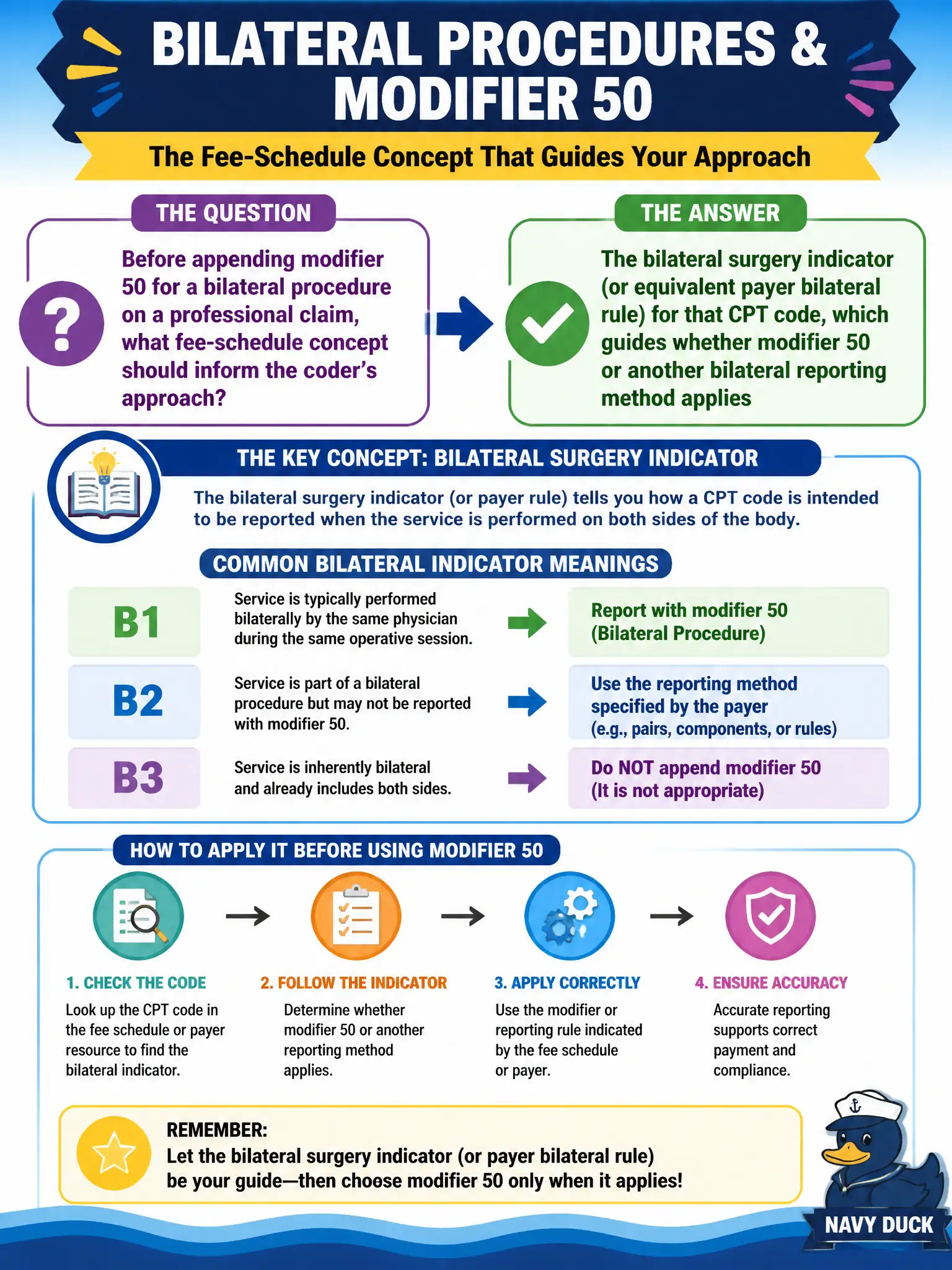
Modifier 50 is not a free bilateral stamp for every code. Check the fee schedule’s bilateral surgery indicator (or the payer’s twin rule) so you know whether 50, paired modifiers, or ‘already bilateral’ logic applies.
Full Explanation
Before appending modifier 50 for a bilateral procedure on a professional claim, consult the bilateral surgery indicator (or equivalent payer bilateral rule) for that CPT code, which guides whether modifier 50 or another bilateral reporting method applies. Modifier 50 is not a universal stamp. Checking indicators prevents incorrect bilateral billing that can over- or under-pay community surgical and injection claims.
The hierarchical condition category coefficient for the patient’s chronic diagnoses only addresses risk adjustment, not bilateral surgical reporting. The hospital wage index used for inpatient PPS facilities addresses facility payment geography, not physician bilateral modifiers. The CPT anesthesia base unit value regardless of the surgical code billed addresses anesthesia valuation, not whether modifier 50 is appropriate for the surgical/procedure code.
Exam caveat: indicators may require 50, RT/LT without 50, or may show the concept does not apply—follow the indicator, not habit. Operational check: look up the bilateral surgery indicator for the CPT code, choose modifier 50 versus paired modifiers versus another method as directed, document both sides treated, and avoid HCC, wage-index, or anesthesia-base shortcuts for bilateral decisions.