
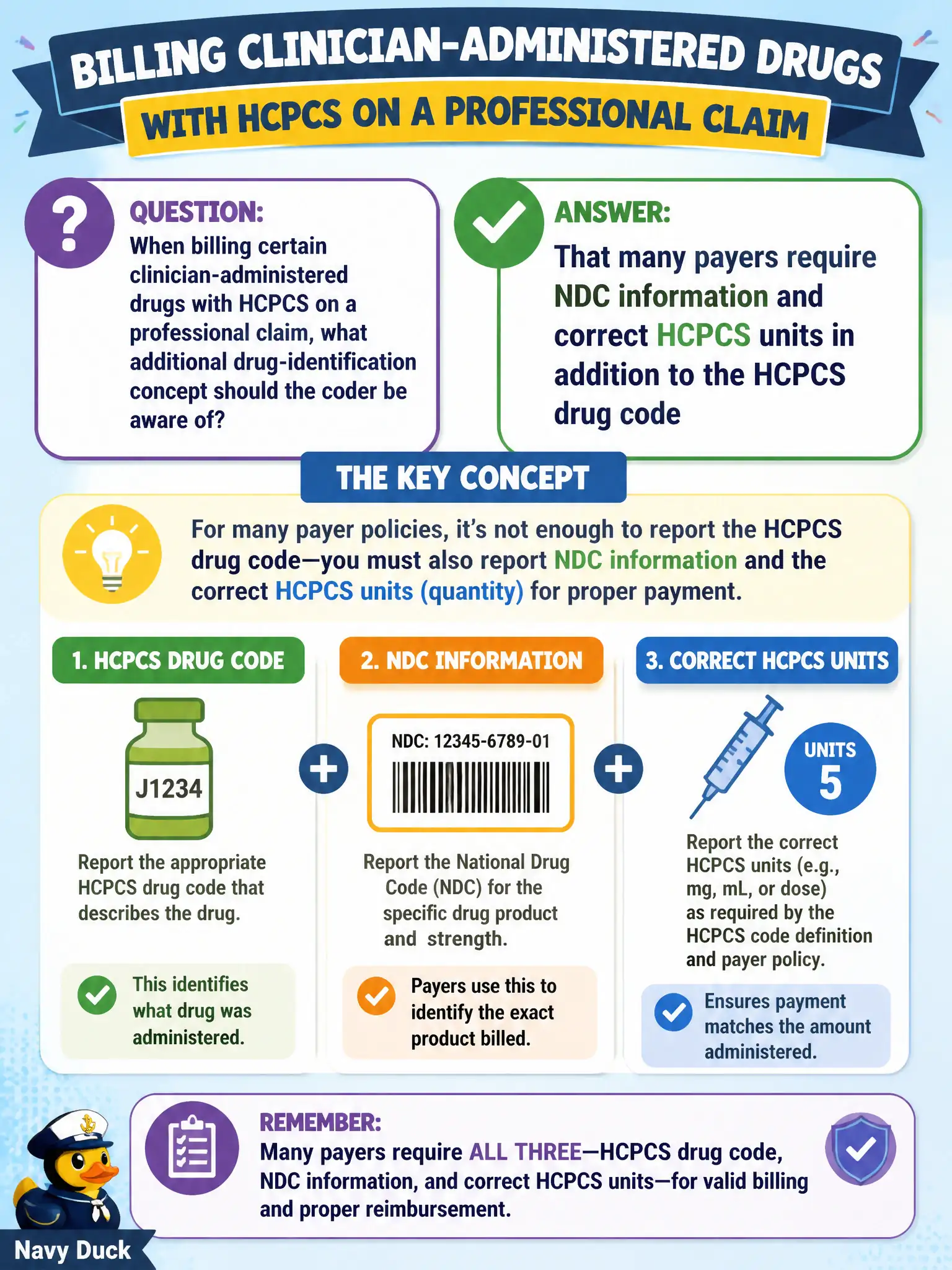
When billing certain clinician-administered drugs with HCPCS on a professional claim, what additional drug-identification concept should the coder be aware of?
Select an answer to reveal the explanation.
Short Explanation
A HCPCS drug code is not the whole grocery label. Lots of payers also want the NDC and honest units for the dose given—diagnosis pointers and ‘just bill one unit’ shortcuts do not replace that.
Full Explanation
When billing certain clinician-administered drugs with HCPCS on a professional claim, many payers require NDC information and correct HCPCS units in addition to the HCPCS drug code. A HCPCS code alone is often incomplete drug identification. Capturing NDC and honest units in community infusion and injection clinics protects patients from dose-billing errors and protects public payers from unit inflation.
Assuming diagnosis pointers replace any need for drug identifiers on all payers confuses diagnosis linkage with product identification. Claiming NDCs are used only on dental claims and never on physician drug lines is false for many medical drug claims. Reporting units always as “1” regardless of dose administered understates multi-unit doses and invites compliance findings.
Exam caveat: unit definitions (billing units versus vial size) are code-specific—follow the HCPCS descriptor and payer drug policy, not a universal “one line equals one unit” habit. Operational check: enter the HCPCS drug code, accurate units for the dose given, NDC as required, administration code when applicable, and retain vial/lot documentation for civic pharmacy-compliance audits In county and community practices, that discipline also reduces rework from preventable denials and supports transparent stewardship of Medicaid and Medicare professional payments..