
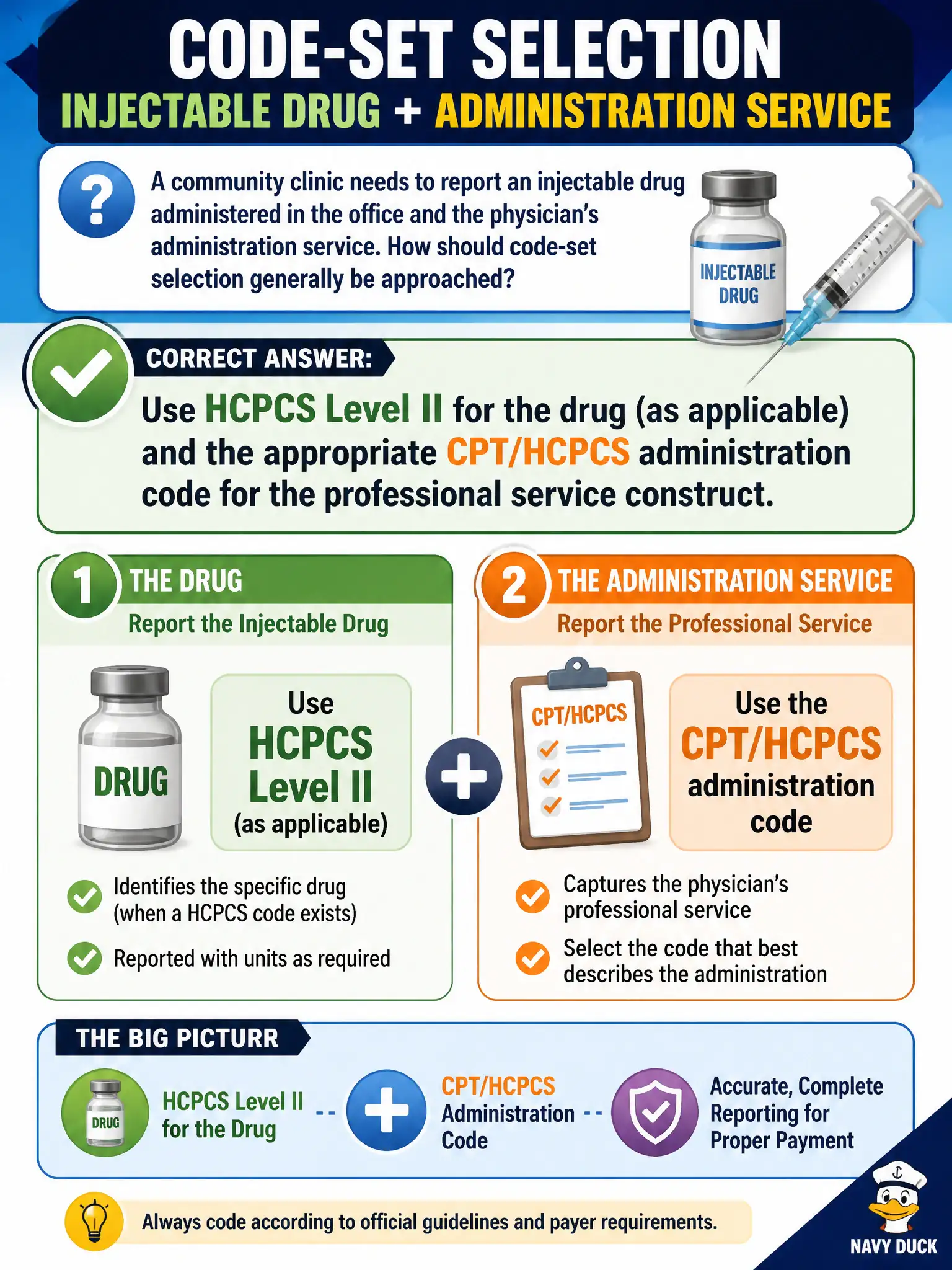
A community clinic needs to report an injectable drug administered in the office and the physician’s administration service. How should code-set selection generally be approached?
Select an answer to reveal the explanation.
Short Explanation
Drugs and physician work are different shopping aisles. HCPCS Level II often carries the drug, while CPT (or the proper admin code) carries giving it—do not shove everything into PCS, Category III, or a juiced-up E/M.
Full Explanation
Injectable drugs administered in a community clinic generally use HCPCS Level II for the drug (as applicable) plus the appropriate CPT/HCPCS administration code for the professional administration construct. Separating product from administration keeps pharmaceutical stewardship and clinician work visible on professional claims serving publicly insured patients.
Using only ICD-10-PCS because office drug administration is an inpatient procedure misapplies inpatient facility procedure coding to office professional billing. Using only CPT Category III emerging-technology codes for every office drug invents Category III necessity for routine drugs. Omitting the drug code and increasing the E/M level to include medication cost hides drug identity and misuses E/M leveling to carry product cost.
Exam caveat: some drugs are reported with CPT vaccine or other specific supply constructs rather than a miscellaneous HCPCS—follow the current code set for that product. Operational check: identify the drug HCPCS (or specific product code), select the administration code matching route, capture units/NDC as required, and leave E/M leveling to MDM or time rather than drug cost In county and community practices, that discipline also reduces rework from preventable denials and supports transparent stewardship of Medicaid and Medicare professional payments..