
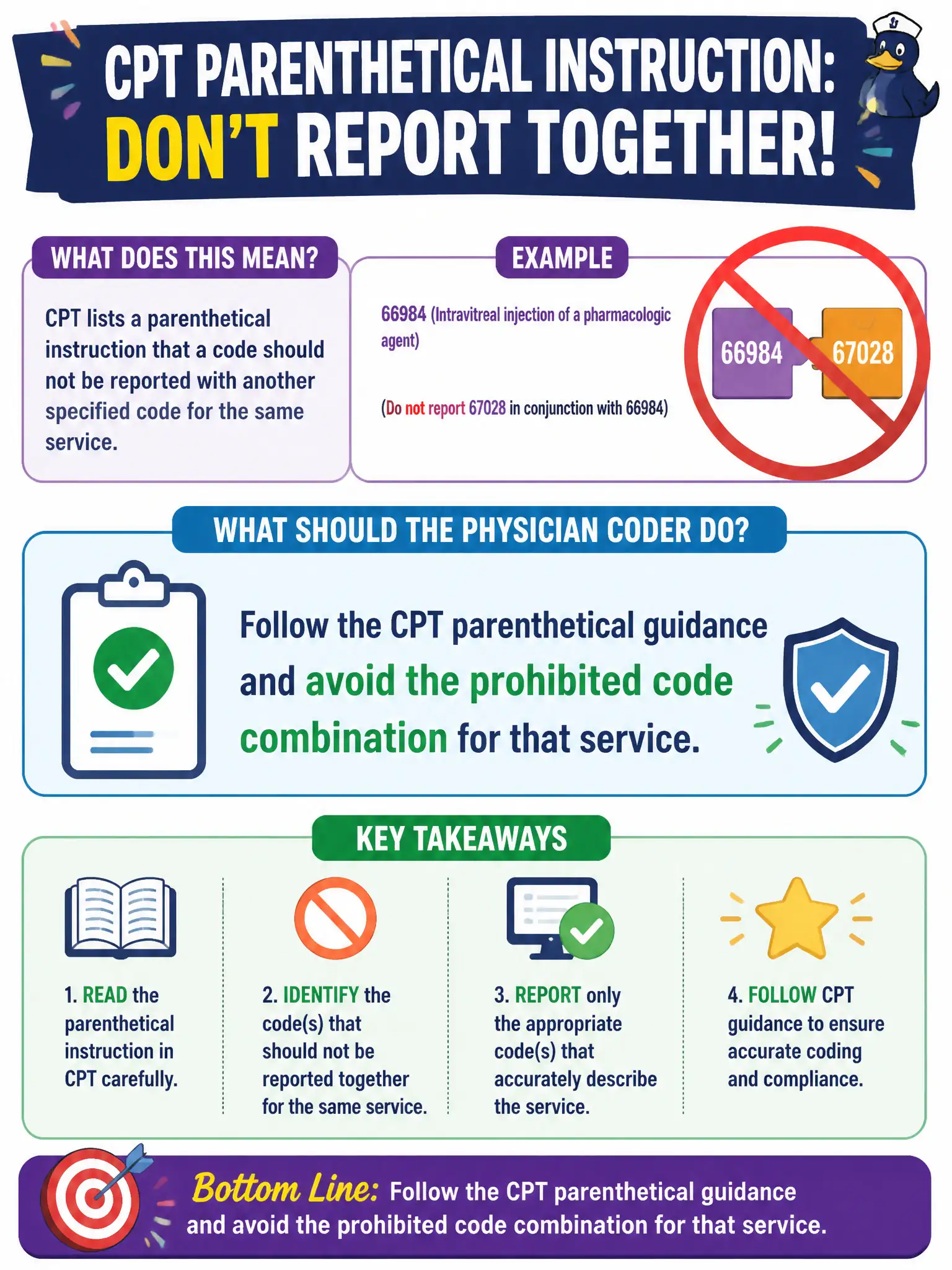
CPT lists a parenthetical instruction that a code should not be reported with another specified code for the same service. What should the physician coder do?
Select an answer to reveal the explanation.
Short Explanation
Those little parenthetical ‘do not report with’ notes are not decorative footnotes. CPT is telling you the combo is off-limits—so honor it instead of hoping NCCI, modifier 22, or claim-splitting will launder a bad pair.
Full Explanation
When CPT lists a parenthetical instruction that a code should not be reported with another specified code for the same service, the physician coder should follow that CPT parenthetical guidance and avoid the prohibited combination. Parentheticals are part of CPT’s instructional framework for professional coding, not optional footnotes. Honoring them in community specialty billing prevents knowing submission of noncompliant code pairs.
Ignoring parenthetical notes because only NCCI edits are binding for professional claims undervalues CPT instructions that exist alongside NCCI. Reporting both codes with modifier 22 to override the parenthetical restriction misuses increased-service logic as an edit bypass. Reporting both codes on separate claims dated a day apart to bypass the instruction is an integrity failure, not a coding solution.
Exam caveat: CPT parentheticals and NCCI can both apply—complying with one does not excuse violating the other. Operational check: read code descriptors and parentheticals before final code pairs, suppress prohibited combinations, and never split dates or inflate modifiers to circumvent instructions on public-program claims In county and community practices, that discipline also reduces rework from preventable denials and supports transparent stewardship of Medicaid and Medicare professional payments..