
A CPT code is designated as a ‘separate procedure.’ When may the physician-office coder report it independently?
Select an answer to reveal the explanation.
Short Explanation
‘Separate procedure’ is CPT’s polite way of saying ‘alone when it really stands alone.’ If it is just a stepping-stone inside a bigger related service, leave it on the shelf; if it truly ran on its own, then it can hitch a ride on the claim.
Full Explanation
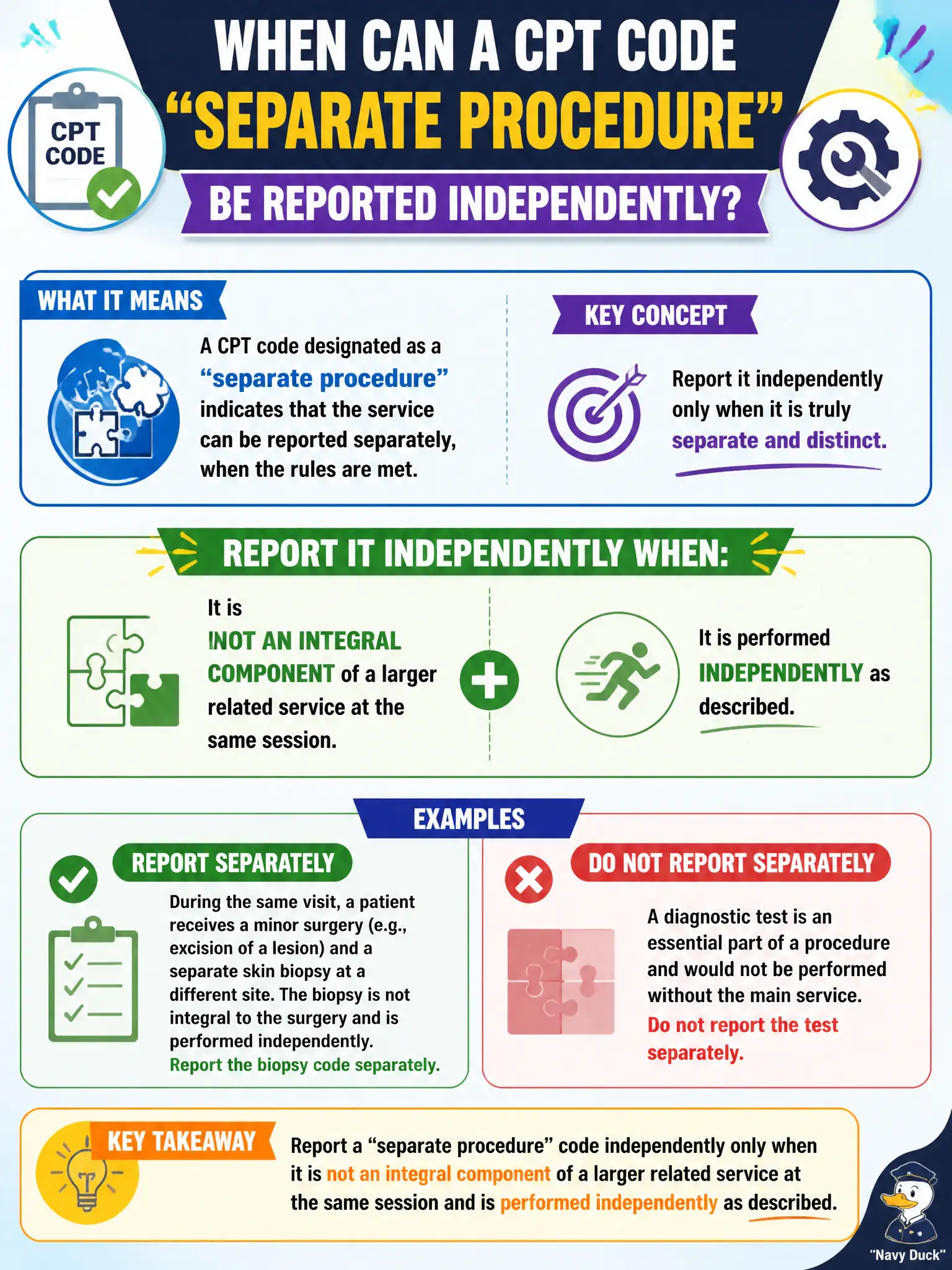
A CPT code designated as a “separate procedure” may be reported independently when it is not an integral component of a larger related service at the same session and is performed independently as described. The designation warns coders not to unbundle integral steps; it does not forbid reporting when the service truly stands alone. Judicious use protects community OR claims from both underreporting standalone work and abusive unbundling.
Reporting a separate-procedure code whenever it appears anywhere in the same operative session, even as an integral component of a larger service, violates the integral-component limitation. Reporting it only when the NCCI PTP edit file lists every code pair as payable without review outsources CPT’s separate-procedure concept solely to edits. Reporting it only when billing a facility UB-04 rather than a professional claim invents a claim-form restriction CPT does not impose on the concept.
Exam caveat: even when CPT allows separate reporting, NCCI or payer edits may still bundle—apply both layers. Operational check: decide whether the service was independent or merely a step inside a larger related operation; report the separate-procedure code only if independent; and check NCCI before finalizing the professional claim.