
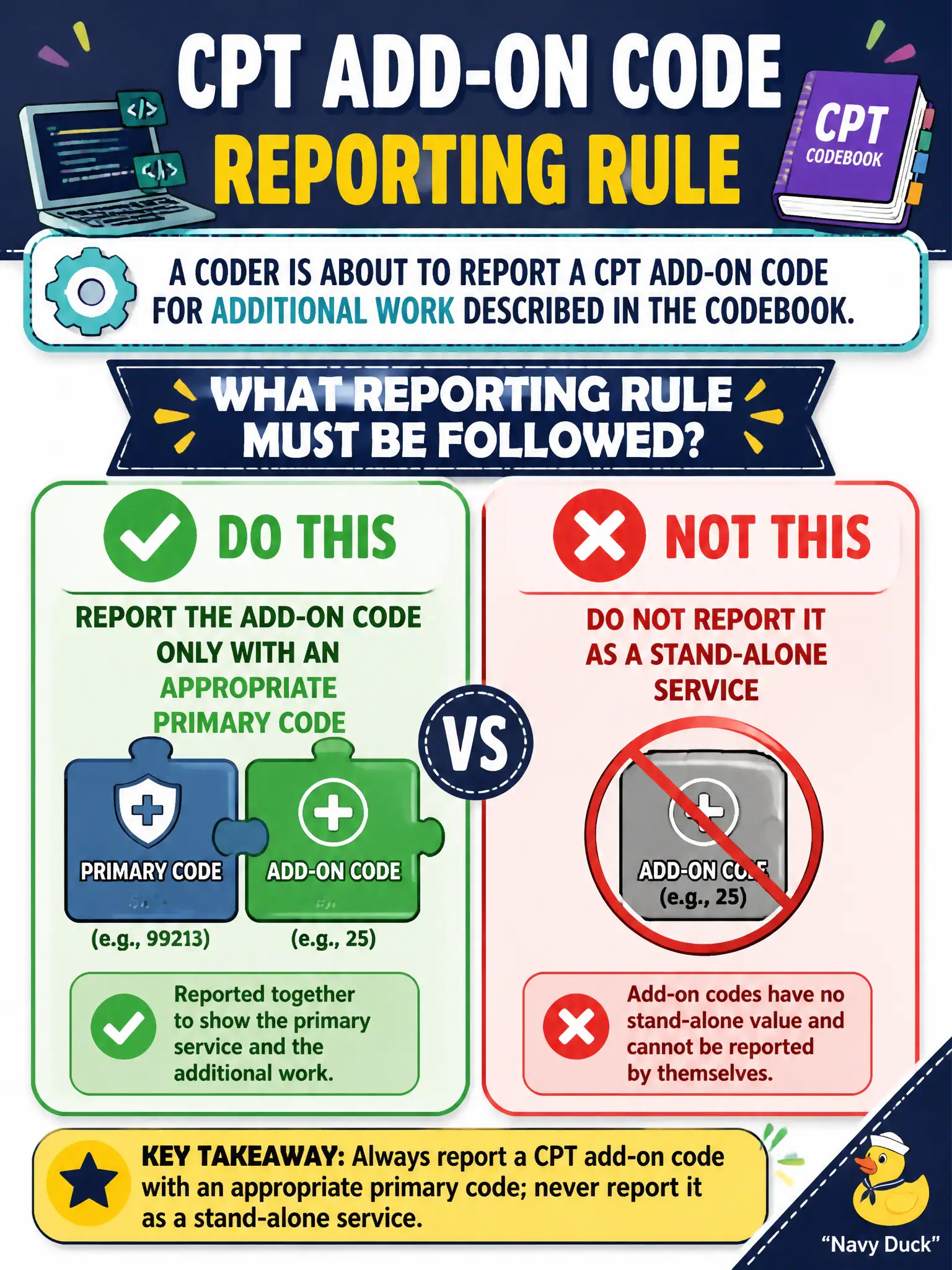
A coder is about to report a CPT add-on code for additional work described in the codebook. What reporting rule must be followed?
Select an answer to reveal the explanation.
Short Explanation
Add-on codes are side dishes—they never get ordered by themselves. Pair them with the main CPT entrée, and do not slap multiple-procedure reduction thinking on codes that CPT already treats as add-ons.
Full Explanation
A CPT add-on code for additional work must be reported only with an appropriate primary code; it is not a stand-alone service. Add-on discipline keeps professional claims sequenced correctly and prevents impossible single-line add-on bills that payers in public programs will reject.
Reporting the add-on code alone whenever it has higher RVUs than the primary code violates add-on pairing rules. Replacing the primary code with the add-on code to avoid multiple-procedure reductions invents a primary from an add-on. Appending modifier 51 to every add-on code because add-ons always take a multiple-procedure cut contradicts CPT’s usual exemption of add-ons from modifier 51 multiple-procedure reductions.
Exam caveat: confirm add-on status in CPT appendices/parentheticals and pair only with listed appropriate primary codes. Operational check: select the primary procedure first, append the add-on on the same claim without treating it as stand-alone, omit modifier 51 on designated add-ons, and verify payer edits still expect that pairing for community specialty billing In county and community practices, that discipline also reduces rework from preventable denials and supports transparent stewardship of Medicaid and Medicare professional payments..