
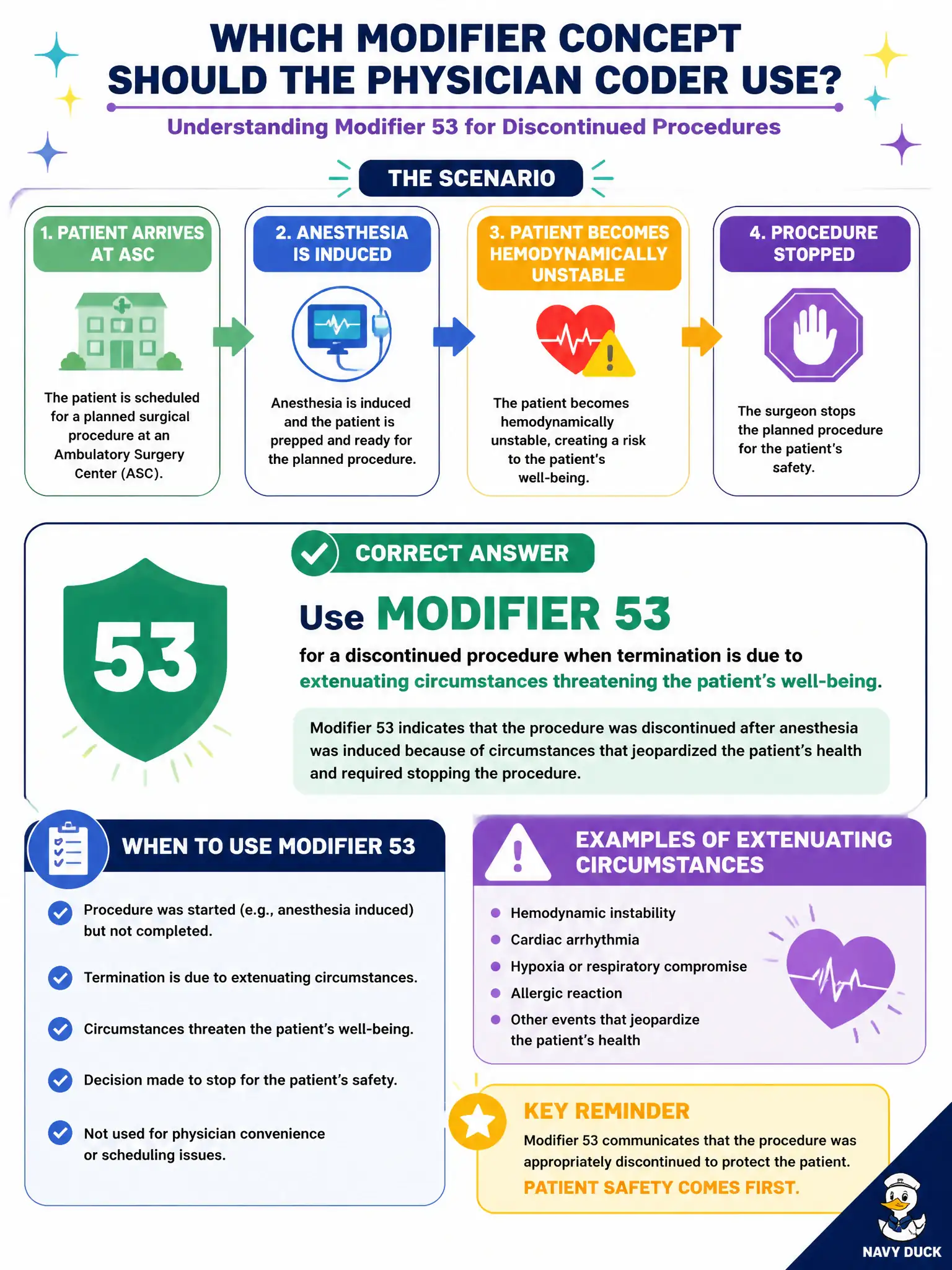
After anesthesia is induced in an ASC-based professional case, the surgeon stops the planned procedure because the patient becomes hemodynamically unstable. Which modifier concept should the physician coder use?
Select an answer to reveal the explanation.
Short Explanation
When the case gets scrubbed after anesthesia because the patient is crashing, that is not a casual ‘we did less’ moment—that is discontinued for safety. Modifier 53 is the concept that matches a stop driven by the patient’s well-being, not a tidy elective trim.
Full Explanation
Modifier 53 reports a discontinued procedure when termination is due to extenuating circumstances threatening the patient’s well-being—classically after anesthesia is induced when hemodynamic instability forces stopping. Patient-safety discontinuations in ASC-based community cases must not be coded as casual elective reductions. Modifier 53 communicates that clinical reality to payers.
Modifier 52 because the surgeon intentionally shortened the CPT description for convenience mislabels a safety stop as elective reduction. Modifier 54 because only intraoperative surgical care was provided before stopping confuses surgical care split (intraoperative only) with discontinuation. Modifier 76 because the same surgeon will repeat the identical procedure later the same day invents a same-day repeat without establishing the discontinuation concept first.
Exam caveat: timing relative to anesthesia induction and the reason for stopping distinguish 53 from 52 in standard teaching. Operational check: document instability or other extenuating threat, when anesthesia began, that the planned procedure was stopped, append modifier 53, and retain vital-sign or event detail supporting the safety discontinuation for civic surgical quality review.