
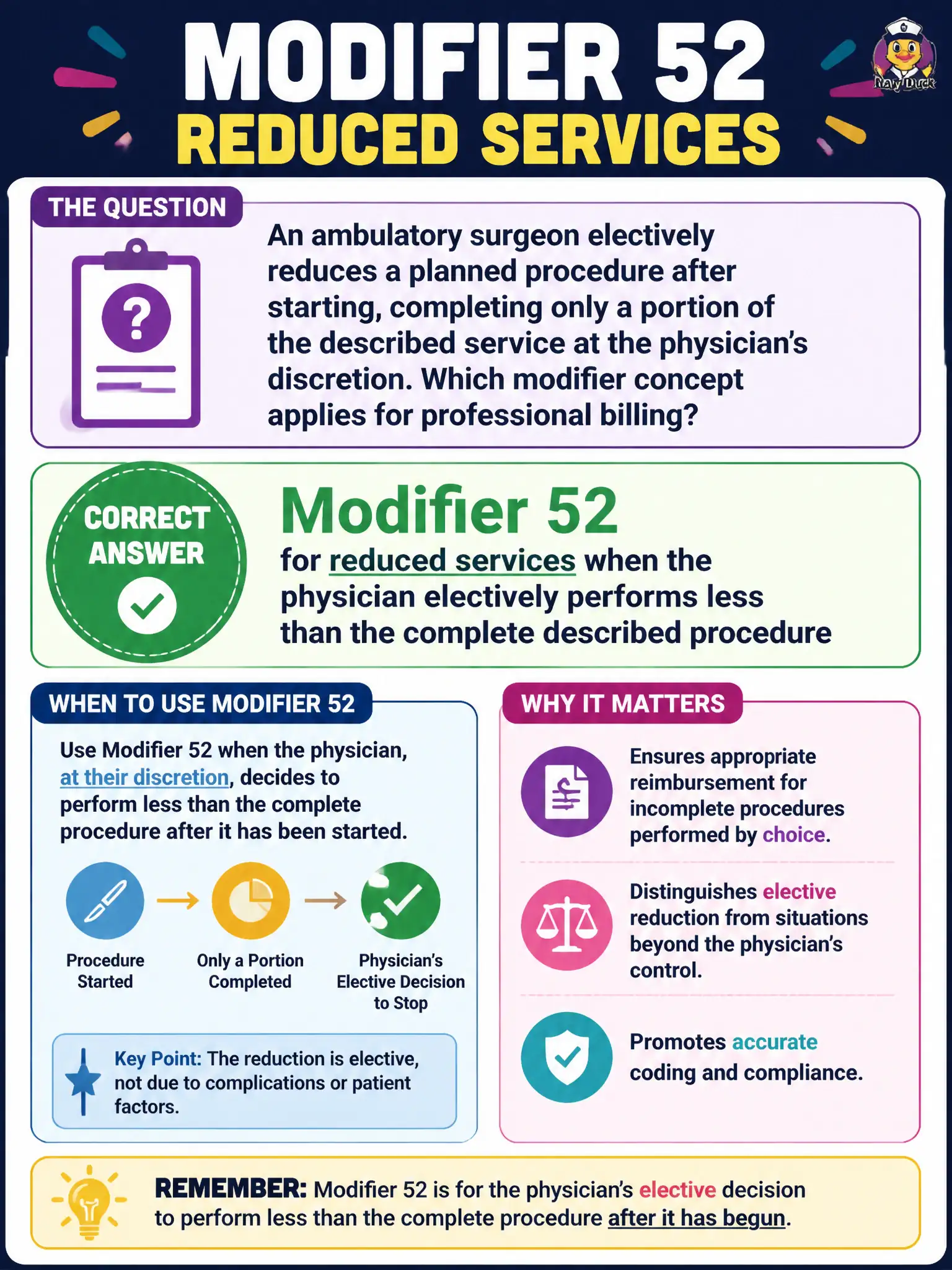
An ambulatory surgeon electively reduces a planned procedure after starting, completing only a portion of the described service at the physician’s discretion. Which modifier concept applies for professional billing?
Select an answer to reveal the explanation.
Short Explanation
Think of modifier 52 like ringing up a sandwich with half the fixings—you still served something, just not the full menu item. When the doctor chooses to do less than the CPT describes, reduced-services thinking is the path—not discontinued, increased, or unbundling modifiers.
Full Explanation
Modifier 52 reports reduced services when the physician electively performs less than the complete described procedure. Elective reduction after starting—completing only a portion at the physician’s discretion—is a reduced-service concept, not automatically a discontinued-for-safety concept. Accurate 52 use in ambulatory community surgery prevents billing a full CPT descriptor for partial elective work.
Modifier 53 because any incomplete procedure is always discontinued for patient safety conflates elective reduction with termination for extenuating circumstances. Modifier 22 because any change in scope automatically means increased work claims the opposite intensity. Modifier 59 because partial work always unbundles a component code misuses distinct-service logic for incomplete primary procedures.
Exam caveat: documentation must explain what was and was not completed and why the service was electively reduced. Operational check: compare the CPT descriptor to the operative narrative, append modifier 52 when electively reduced, narrate the reduction clearly, and do not use 53 unless patient well-being forced discontinuation after anesthesia or as otherwise defined Accurate modifier selection in county and community practices also reduces avoidable denials that divert staff time from patient access..