
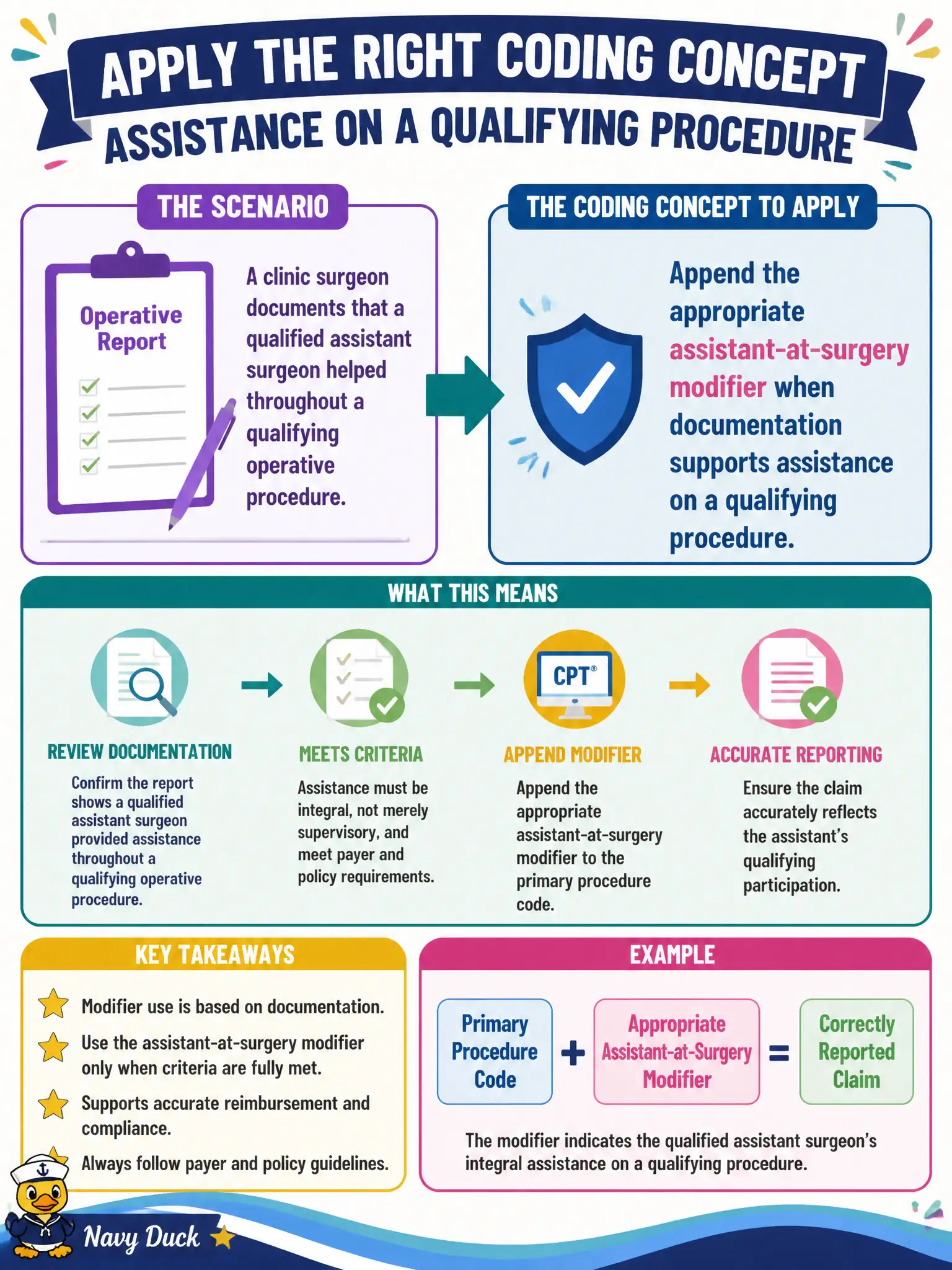
A clinic surgeon documents that a qualified assistant surgeon helped throughout a qualifying operative procedure. Which coding concept should the professional-fee coder apply?
Select an answer to reveal the explanation.
Short Explanation
Assistance is not a free ride on the primary claim. When a real assistant surgeon works a qualifying case and the note says so, hang the assistant-at-surgery modifier family on that helper’s claim—don’t invent bilateral or E/M workarounds.
Full Explanation
When a clinic surgeon documents that a qualified assistant surgeon helped throughout a qualifying operative procedure, append the appropriate assistant-at-surgery modifier for the assistant’s professional fee when documentation supports assistance on a qualifying procedure. Assistant reporting in community ORs recognizes real second-surgeon work while remaining subject to payer assistant-at-surgery indicators and policies.
Reporting only the primary surgeon code and ignoring assistance because assistants never bill professional fees is false for qualifying cases with documented assistants. Appending a bilateral surgery modifier instead of an assistant-at-surgery modifier mislabels assistance as bilaterality. Reporting an unlisted E/M code for the assistant’s intraoperative time invents an E/M from operative assistance.
Exam caveat: not every CPT code is payable with an assistant—check assistant-at-surgery fee-schedule indicators and payer rules. Operational check: name the assistant and role in the op note, confirm the procedure qualifies for assistant billing, append the correct assistant modifier for the assistant’s claim, and avoid bilateral or E/M substitutes Accurate modifier selection in county and community practices also reduces avoidable denials that divert staff time from patient access..