
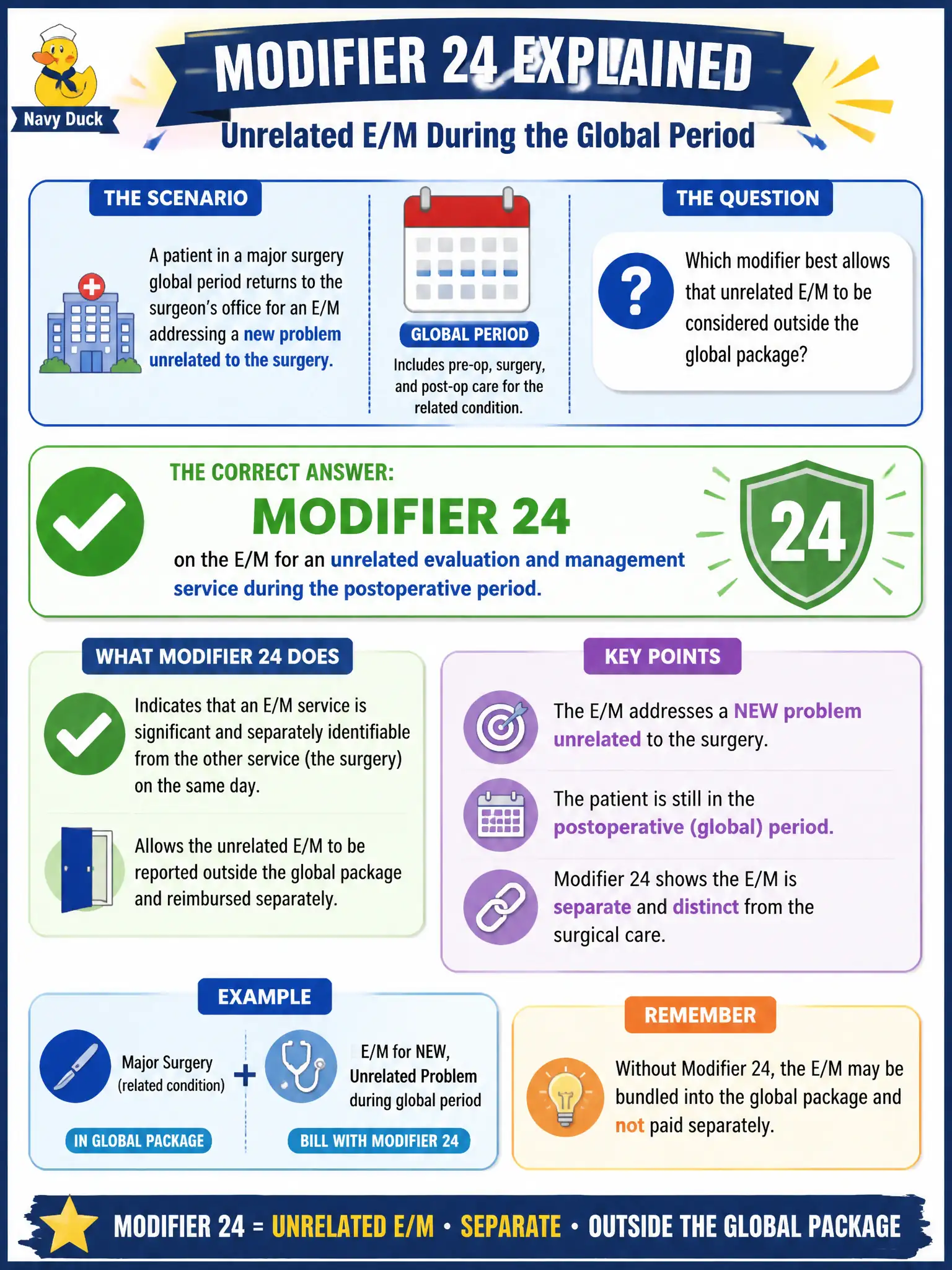
A patient in a major surgery global period returns to the surgeon’s office for an E/M addressing a new problem unrelated to the surgery. Which modifier best allows that unrelated E/M to be considered outside the global package?
Select an answer to reveal the explanation.
Short Explanation
Unrelated office thinking during a surgical global needs modifier 24 on the E/M. It’s the ‘this visit isn’t postop fluff’ sticker.
Full Explanation
Modifier 24 on an E/M allows an unrelated evaluation and management service during the postoperative period to be considered outside the surgical global package. When a major-surgery patient returns to the surgeon’s office for a new problem unrelated to the surgery, 24 protects legitimate problem-oriented evaluation in community surgical clinics without pretending postoperative incision checks are separately payable.
Modifier 25 on the E/M only because a minor procedure was also done months earlier confuses same-day procedure-plus-E/M logic with postoperative unrelated E/M logic. Modifier 57 on the postoperative E/M for every office blood-pressure check misuses decision-for-major-surgery marking. Modifier 79 on the E/M because E/M codes take surgical modifiers interchangeably misapplies an unrelated-procedure modifier to an E/M.
Exam caveat: the E/M must be unrelated to the surgery—routine postoperative wound checks are typically global and not 24-eligible. Operational check: document the unrelated problem distinctly from postoperative surgical care, append modifier 24 to the E/M, link the unrelated diagnosis, and retain global-period awareness on the claim Accurate modifier selection in county and community practices also reduces avoidable denials that divert staff time from patient access..