
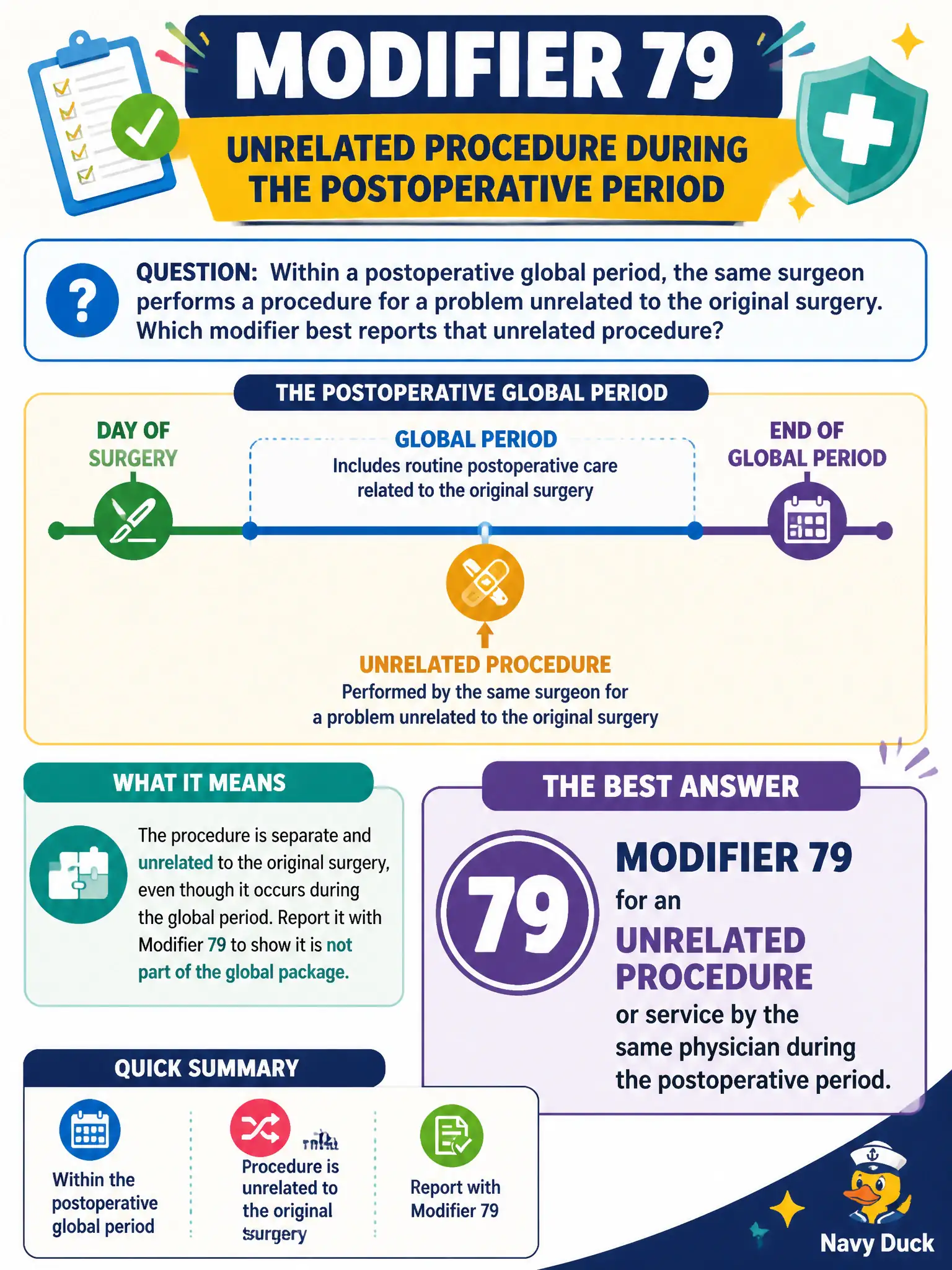
Within a postoperative global period, the same surgeon performs a procedure for a problem unrelated to the original surgery. Which modifier best reports that unrelated procedure?
Select an answer to reveal the explanation.
Short Explanation
Brand-new problem, same surgeon, still inside the global clock—modifier 79 says ‘unrelated procedure.’ Don’t mix it up with the related return-to-OR modifier.
Full Explanation
Modifier 79 reports an unrelated procedure or service by the same physician during the postoperative period of another surgery. When a new problem unrelated to the original surgery requires a procedure inside the global window, 79 communicates unrelatedness so medically necessary civic surgical care is not swallowed by an unrelated global package.
Modifier 78 for every procedure performed after the patient leaves the recovery room over-applies related return-to-OR logic to unrelated work. Modifier 57 on the unrelated procedure instead of on a decision-for-surgery E/M misplaces the decision-for-surgery modifier. Modifier 25 on the surgical code to separate it from the global package misuses an E/M modifier on a surgical line.
Exam caveat: unrelatedness must be clinically true—complications of the original surgery are generally related and may need 78, not 79. Operational check: document the distinct unrelated diagnosis and procedure, confirm the patient is still in a global period of a prior surgery by the same physician, append modifier 79, and avoid borrowing 78 or E/M modifiers as substitutes Accurate modifier selection in county and community practices also reduces avoidable denials that divert staff time from patient access..