
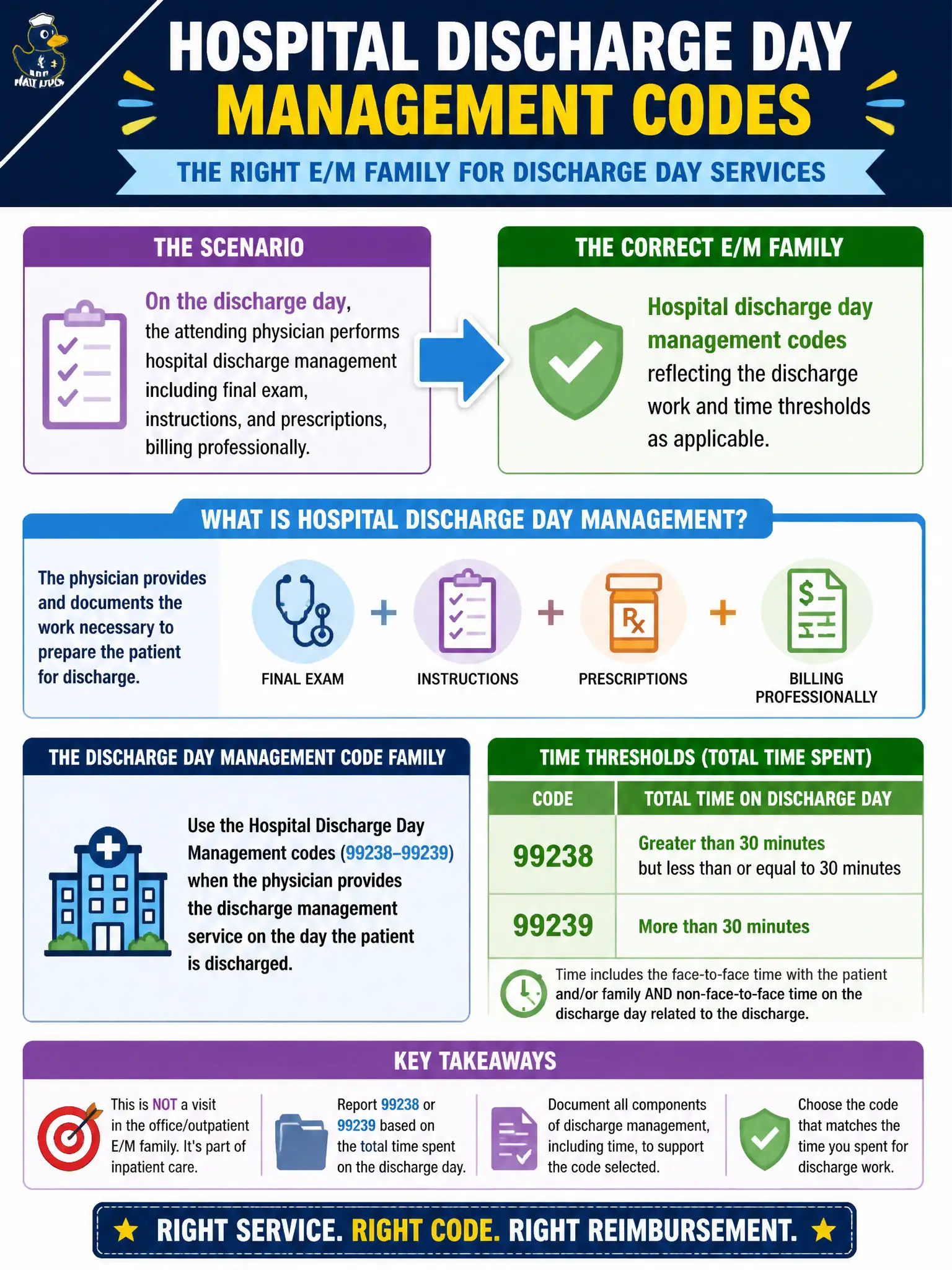
On the discharge day, the attending physician performs hospital discharge management including final exam, instructions, and prescriptions, billing professionally. Which E/M family best fits that service?
Select an answer to reveal the explanation.
Short Explanation
Discharge day has its own professional choreography—final look, instructions, scripts—and discharge management codes own that stage. It’s not an office new-patient visit in disguise.
Full Explanation
Hospital discharge day management codes reflect the attending’s discharge work—final examination, instructions, prescriptions, and related discharge management—with time thresholds as applicable. Professional discharge coding in community hospitals should use that family rather than office, SNF subsequent, or automatic critical care add-ons. Accurate discharge reporting supports continuity and public quality measures tied to transitions of care.
Office new-patient codes with place of service emergency department invent an office/ED hybrid that is not discharge management. Subsequent nursing facility care for every acute hospital discharge misstates an acute discharge as SNF follow-up. Critical care add-on codes solely because discharge teaching occurred invent critical care from teaching alone.
Exam caveat: discharge codes are used on the discharge day by the discharging physician (or qualified professional as allowed)—not routinely on every inpatient day. Operational check: confirm discharge date services (exam, instructions, Rx), apply any required time threshold documentation, select hospital discharge day management, and avoid duplicate subsequent visit coding for the same discharge work.