
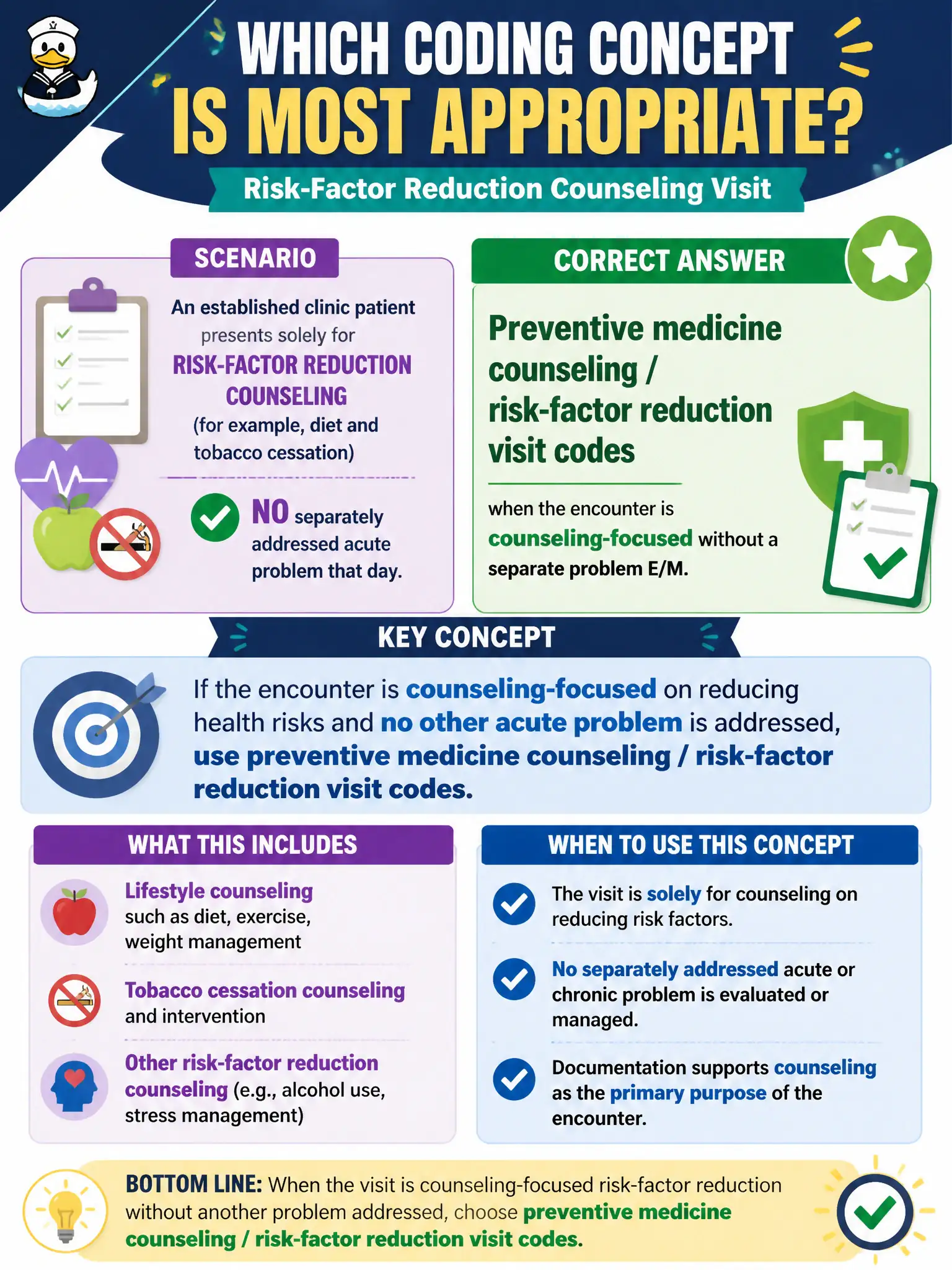
An established clinic patient presents solely for risk-factor reduction counseling (for example, diet and tobacco cessation) with no separately addressed acute problem that day. Which coding concept is most appropriate?
Select an answer to reveal the explanation.
Short Explanation
Pure lifestyle-and-risk counseling without a separate problem workup belongs in preventive counseling land. Don’t inflate it into a problem E/M just because advice was given.
Full Explanation
When an established clinic patient presents solely for risk-factor reduction counseling—such as diet and tobacco cessation—without a separately addressed acute problem that day, preventive medicine counseling / risk-factor reduction visit codes are the appropriate concept. Public health-oriented counseling visits deserve accurate preventive counseling categories so community prevention programs are measured and paid without inflating problem-oriented E/M levels.
Always billing a high-level problem-oriented office E/M for any lifestyle advice upcodes counseling-only encounters. Reporting inpatient consultation codes for outpatient counseling minutes invents inpatient consults from clinic prevention work. Using only modifier 25 on a procedure code with no counseling category fails when no procedure is the subject and counseling is the encounter’s purpose.
Exam caveat: if a significant problem is also evaluated, problem-oriented E/M (with appropriate modifiers) may apply in addition to or instead of pure counseling codes—documentation drives the mix. Operational check: confirm counseling focus and minutes/content, absence of a separately billed problem E/M unless documented, and select preventive counseling/risk-reduction codes accordingly.