
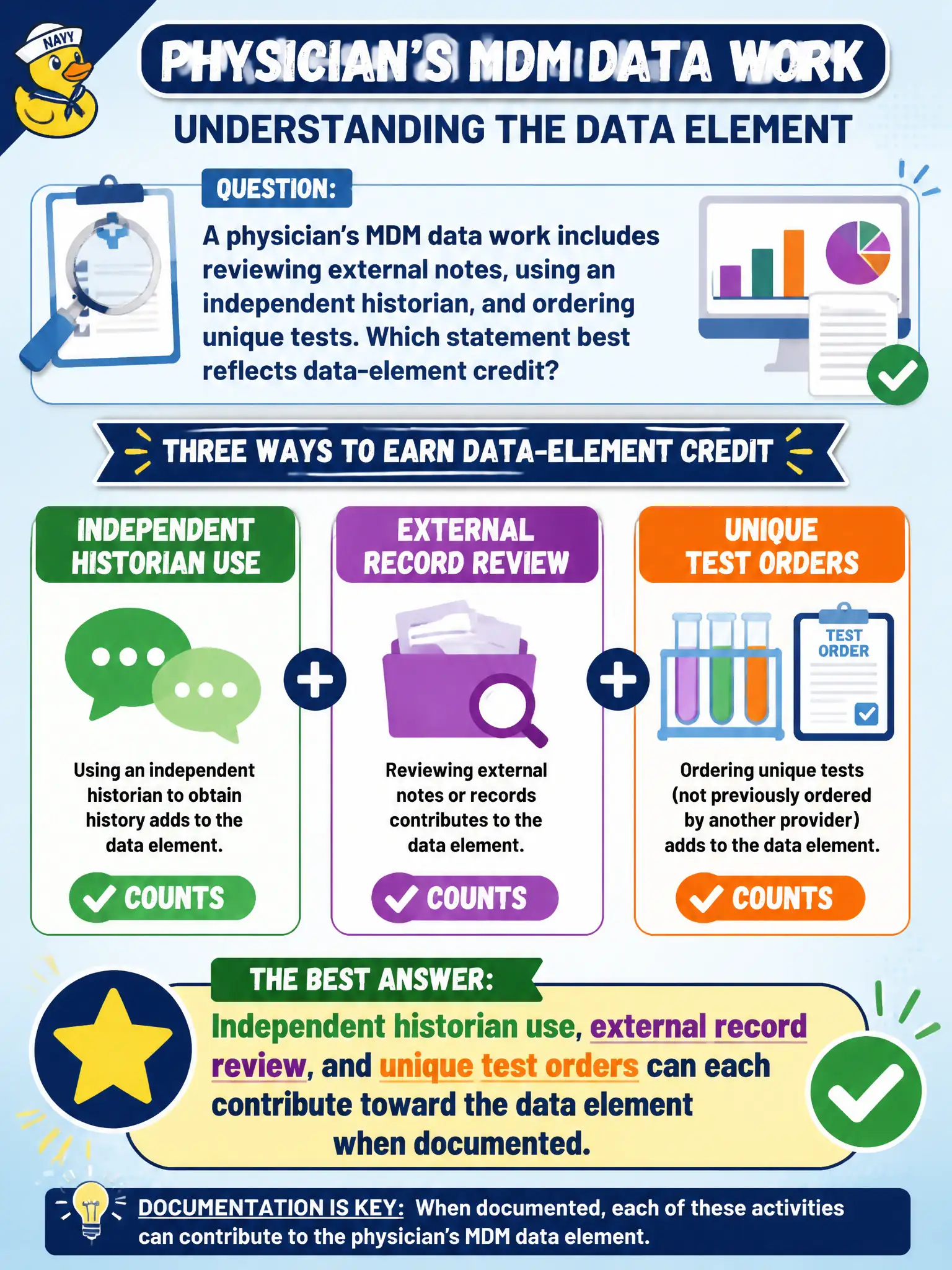
A physician’s MDM data work includes reviewing external notes, using an independent historian, and ordering unique tests. Which statement best reflects data-element credit?
Select an answer to reveal the explanation.
Short Explanation
Data points are like stamps on a passport: independent historian, outside notes, unique tests—each can count when you document them. Don’t invent double credit for the same unique test.
Full Explanation
MDM data credit can accrue from independent historian use, review of external notes, and ordering unique tests when each is documented. These are separate data concepts that help clinicians in community clinics capture the real information work of coordinating care across fragmented public records, schools, and outside facilities. Credit each contributing action appropriately under the data element rules rather than inventing narrow or inflated shortcuts.
Limiting data credit to only the patient’s self-reported home blood pressure app ignores independent historians, external records, and ordered tests that commonly drive MDM in county medicine. Treating data credit as limited to faxing a referral letter with no review understates review and analysis requirements. Double-counting ordering and reviewing the same unique test as four data points without regard to payer and CPT MDM rules invents inflated data scores.
Exam caveat: category limits and unique-test definitions in the MDM data grid must be followed—more paper does not automatically mean more points. Operational check: list independent historian identity and contribution, cite external records reviewed, enumerate unique tests ordered or reviewed per rules, and avoid double-counting the same unique test on public-program claims.