
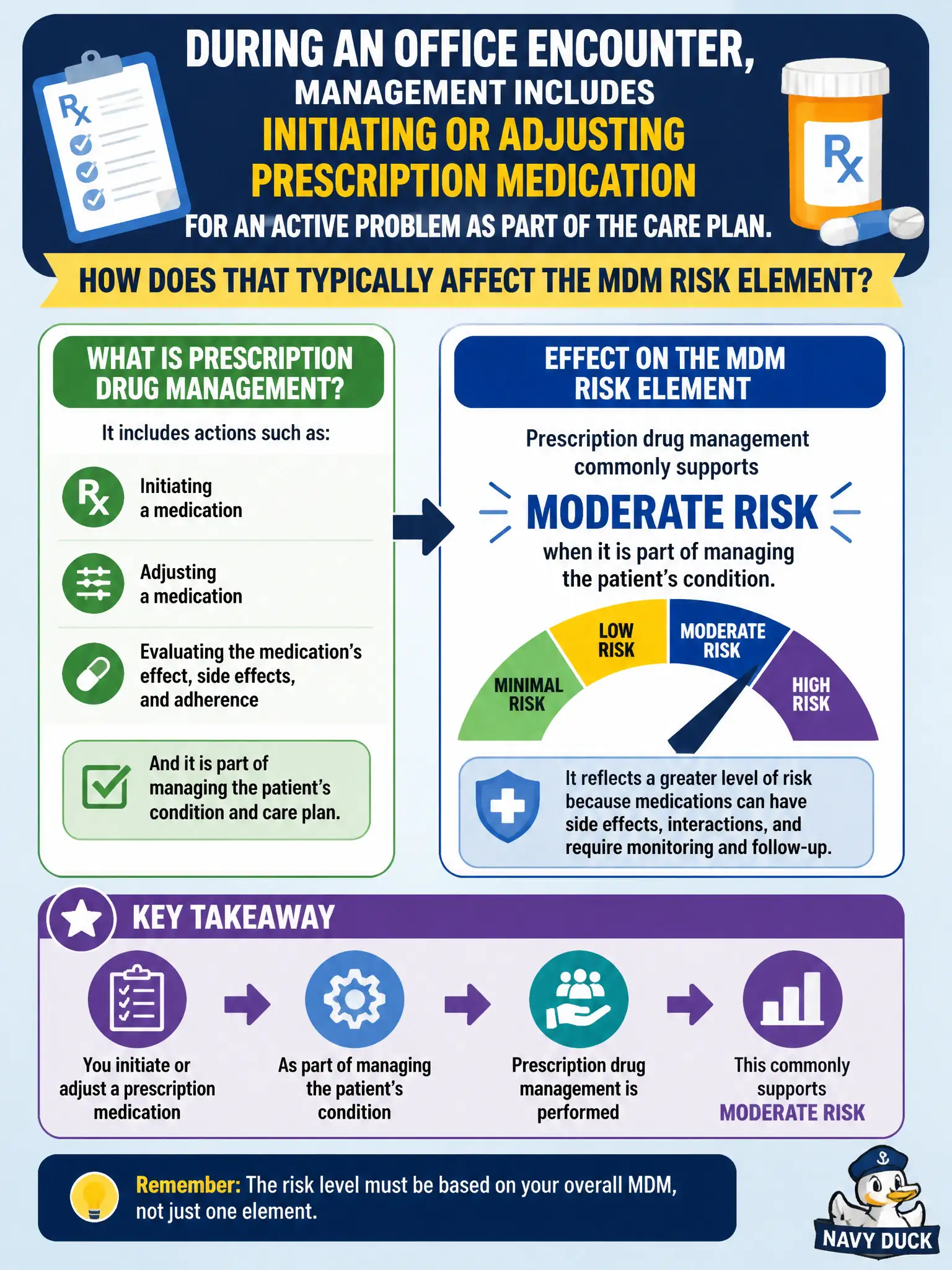
During an office encounter, management includes initiating or adjusting prescription medication for an active problem as part of the care plan. How does that typically affect the MDM risk element?
Select an answer to reveal the explanation.
Short Explanation
Starting or adjusting a real prescription in the plan usually bumps risk into moderate territory. It’s management muscle, not a free high-risk badge for suggesting vitamins.
Full Explanation
Initiating or adjusting prescription medication for an active problem as part of the care plan commonly supports moderate risk in the MDM risk element. Prescription drug management is management intensity, not a free pass to high risk equal to emergency surgery. Recognizing this helps community primary-care teams level visits fairly when chronic disease regimens are actively managed for publicly insured patients.
Treating any OTC recommendation as automatically equal to high risk equivalent to emergency surgery inflates risk without prescription-level management. Claiming prescription management never counts toward risk if labs are also ordered invents an exclusion that MDM rules do not impose. Scoring risk only from the patient’s age, not from management options chosen, ignores the management-based design of the risk element.
Exam caveat: high risk typically requires higher-intensity management options (for example, parenteral controlled substances, decision regarding emergency major surgery, hospitalization) as defined in MDM guidance—not routine outpatient prescription adjustment alone. Operational check: document the prescription initiation or change tied to the problem, score risk as moderate when appropriate, and combine with problems and data for the final MDM level.