
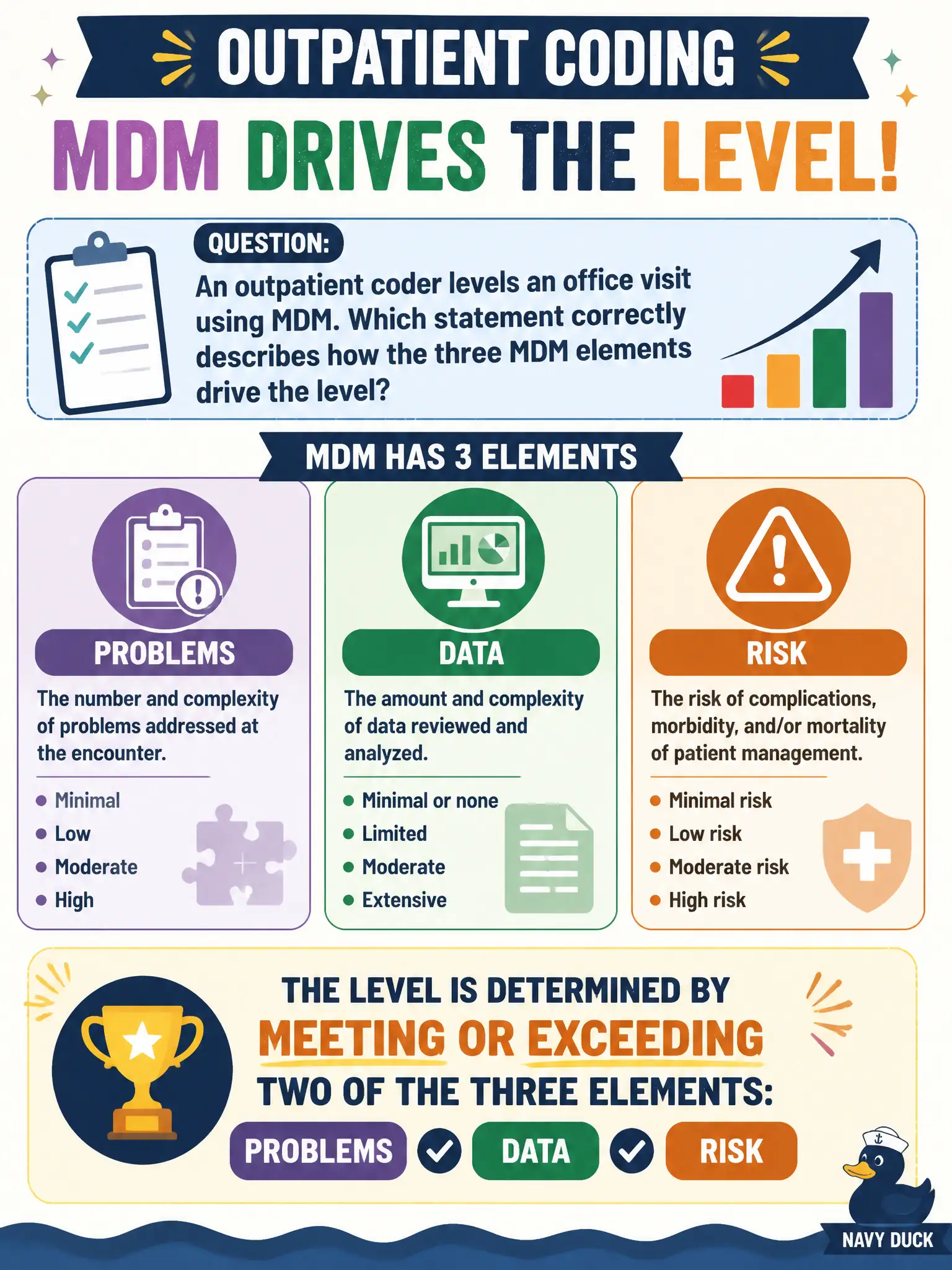
An outpatient coder levels an office visit using MDM. Which statement correctly describes how the three MDM elements drive the level?
Select an answer to reveal the explanation.
Short Explanation
Office MDM is a best-two-of-three contest—problems, data, and risk. You don’t need a perfect sweep of all three boxes to land the level.
Full Explanation
When leveling an outpatient office visit by MDM, the level is determined by meeting or exceeding two of the three elements: problems addressed, data reviewed or ordered, and risk of complications and/or morbidity of patient management. That best-two-of-three model is the core of current office MDM and supports consistent leveling across public clinic panels with variable documentation styles and mixed chronic disease burdens.
Requiring all three MDM elements to independently reach the highest tier for any payable visit overstates the rule and would systematically under-level legitimate moderate and high visits that strong patients still need. Asserting that only the history bullet count sets the level after 2021 office guideline updates revives an obsolete framework retired for office/outpatient coding. Claiming risk alone is ignored and only the number of diagnoses is scored discards two of the three official MDM pillars.
Exam caveat: “problems,” “data,” and “risk” have defined MDM grid meanings—casual synonyms in the note do not automatically equal credit without the documented actions. Operational check: score each MDM element from the note, select the level supported by at least two elements, and keep problem lists, data actions, and management decisions explicit for civic-clinic audit readiness.