
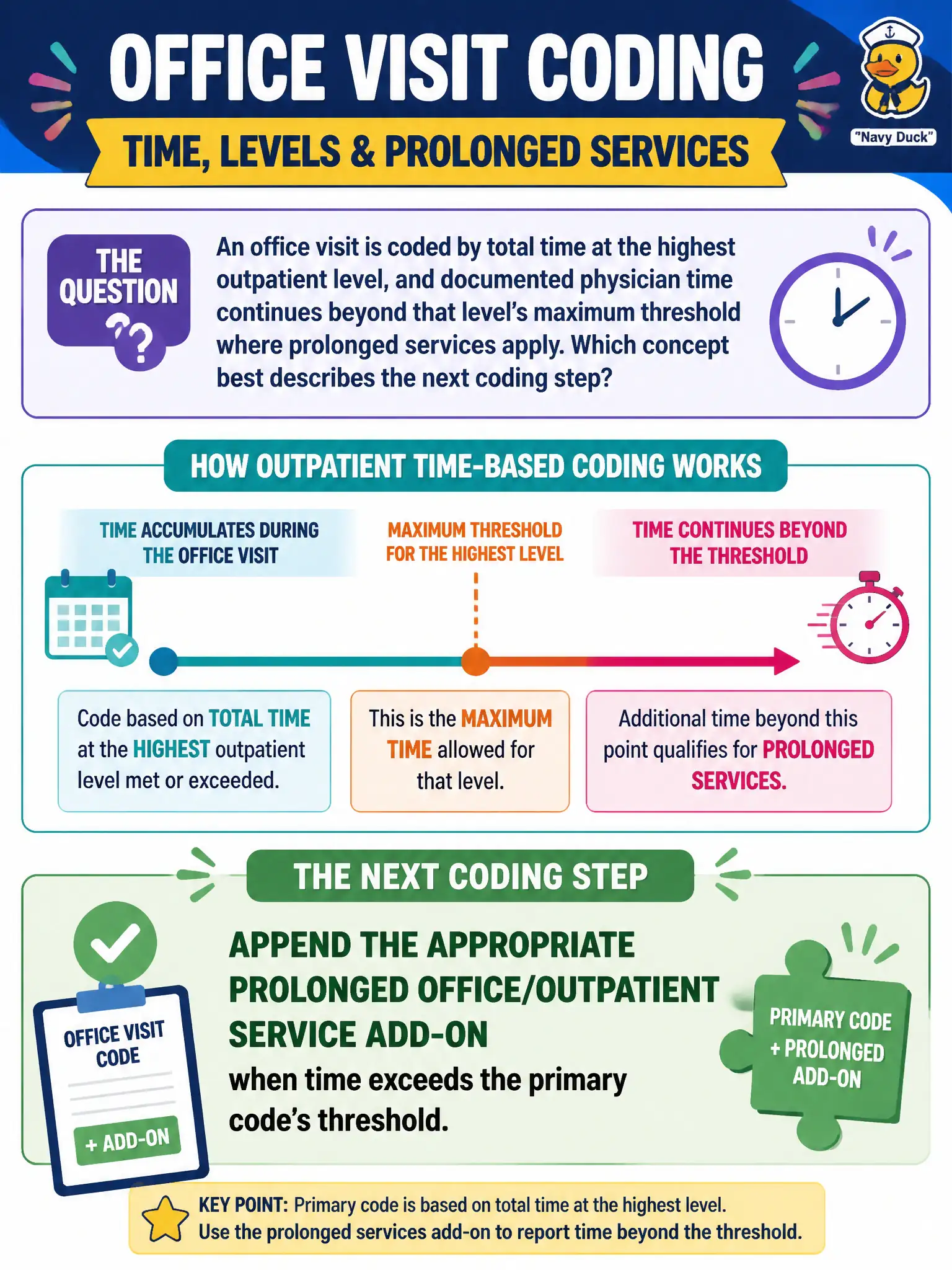
An office visit is coded by total time at the highest outpatient level, and documented physician time continues beyond that level’s maximum threshold where prolonged services apply. Which concept best describes the next coding step?
Select an answer to reveal the explanation.
Short Explanation
When time already maxes the top office level and the clock keeps running past the threshold, prolonged add-ons are the extension cord. You don’t invent a second visit or slap on a random modifier.
Full Explanation
When an office visit is already coded by total time at the highest outpatient level and documented physician time continues beyond that level’s maximum threshold where prolonged services apply, append the appropriate prolonged office/outpatient service add-on. Prolonged add-ons extend the time pathway rather than inventing a second visit. Community clinics serving complex social and medical needs often run long visits; prolonged coding keeps that extra work visible and policy-compliant.
Automatically switching to critical care codes for any visit over 40 minutes invents critical care from outpatient duration. Reporting a second full office E/M on the same day for the extra minutes only fragments one encounter into duplicate primary E/M codes. Using modifier 59 on the primary office code to indicate prolonged work misuses a distinct-procedural-service modifier for time extension.
Exam caveat: prolonged office add-on rules hinge on specific minute thresholds beyond the maximum time for the primary code—meet those published thresholds. Operational check: total clinician time on the date of service, confirm the primary highest-level outpatient code, verify minutes past the prolonged threshold, and append the correct prolonged add-on without critical care substitution.