
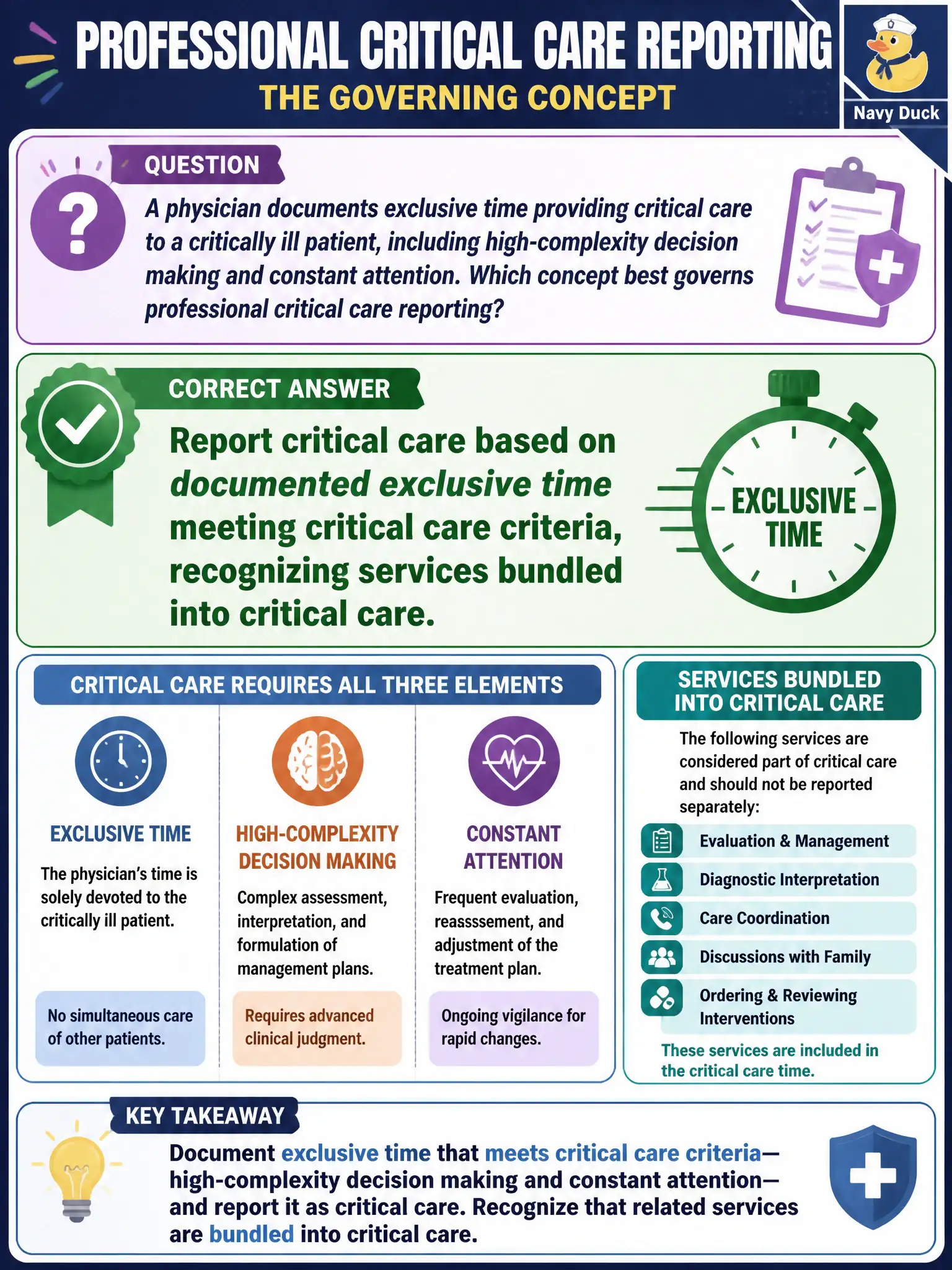
A physician documents exclusive time providing critical care to a critically ill patient, including high-complexity decision making and constant attention. Which concept best governs professional critical care reporting?
Select an answer to reveal the explanation.
Short Explanation
Critical care is a stopwatch plus true critical illness, not a vibe. Exclusive documented time that meets the definition drives the codes, and a lot of routine stuff is already packed inside. Don’t double-dip with a second E/M for the same minutes.
Full Explanation
Professional critical care reporting requires documented exclusive time meeting critical care criteria for a critically ill or injured patient, including high-complexity decision making and constant attention as defined. Report critical care based on that timed exclusive work and recognize services bundled into critical care. In public emergency and hospital settings, honest critical care timing protects both patient-acuity analytics and payment integrity.
Adding a separate ED E/M for every vital-sign check during the same critical care block double-counts work typically packaged into critical care. Using only office prolonged-service add-ons instead of critical care codes misclassifies critical illness management as ordinary outpatient prolonged time. Billing consultation codes whenever another physician is in the building invents a consult from proximity alone.
Exam caveat: critical care is about patient condition plus exclusive clinician time—not location in an ICU doorway without meeting the definition. Operational check: document critical illness, exclusive minutes, and interventions; subtract non-countable time; select critical care codes by time thresholds; and avoid unbundling services CPT treats as included in critical care.