
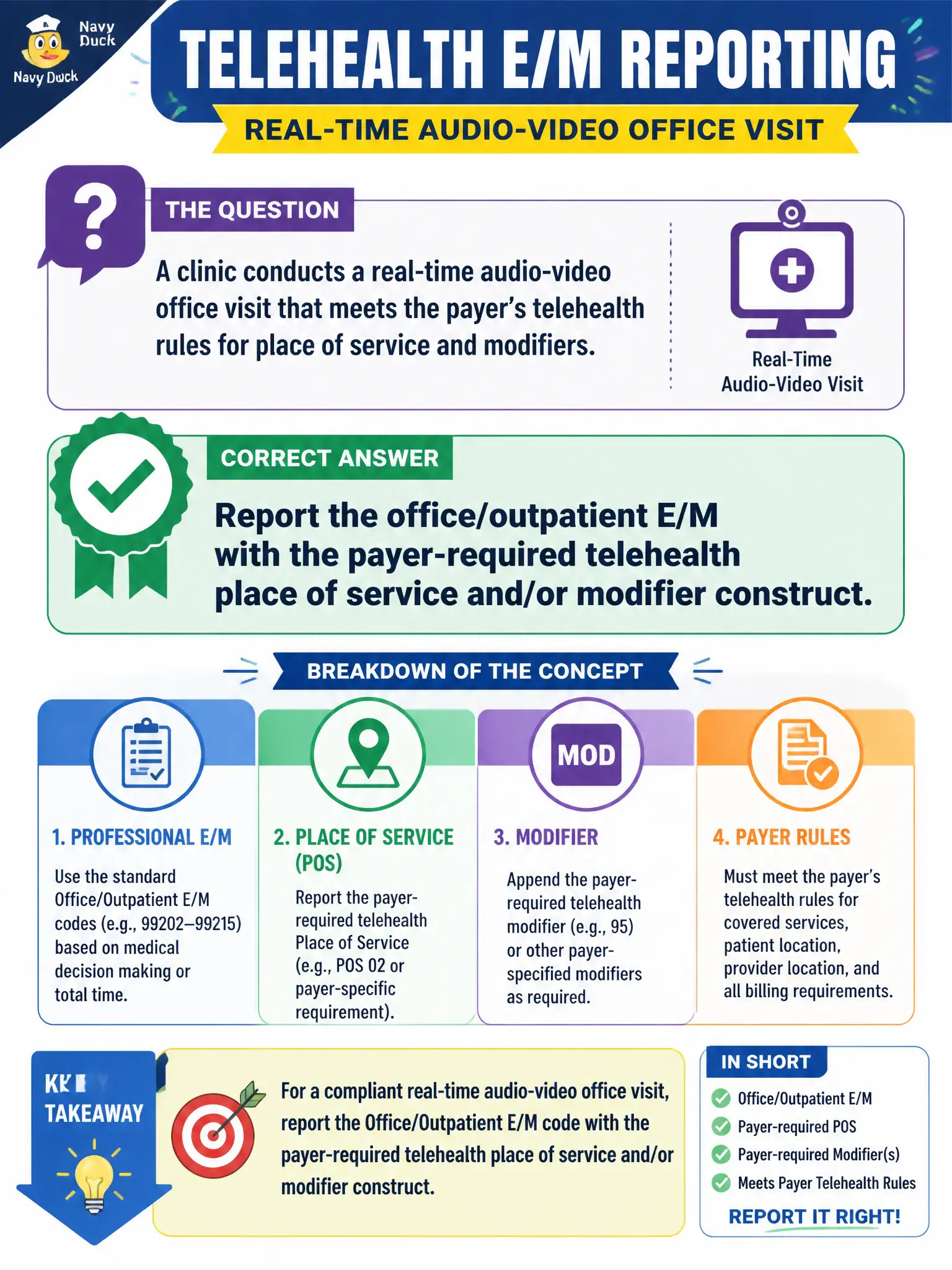
A clinic conducts a real-time audio-video office visit that meets the payer’s telehealth rules for place of service and modifiers. Which reporting concept is most appropriate for the professional E/M?
Select an answer to reveal the explanation.
Short Explanation
Video visits that meet the payer’s telehealth rules are still office E/M—just dressed with the right POS and/or modifier. Don’t invent a new category or drop the professional service entirely.
Full Explanation
A real-time audio-video office visit that meets the payer’s telehealth rules is still reported as an office/outpatient E/M, dressed with the payer-required telehealth place of service and/or modifier construct. Telehealth expands access for rural and mobility-limited civic patients; coding must preserve the professional E/M identity while signaling the virtual modality correctly so public programs can track access without inventing new visit categories.
Always substituting critical care codes for any video visit lasting over 20 minutes invents critical illness from duration alone. Billing only a technical facility fee and never a professional E/M for telehealth erases the clinician’s evaluation. Using nursing facility subsequent codes with modifier 26 for every home video visit misapplies SNF and professional-component radiology logic to an outpatient telehealth E/M.
Exam caveat: eligible code lists, POS values, and modifiers vary by payer and by whether the patient is at home versus another originating site—follow the current telehealth policy for that claim. Operational check: confirm synchronous audio-video modality, append the required telehealth modifier and POS, select the office/outpatient E/M by MDM or time, and retain modality documentation for audit in community telehealth programs.