
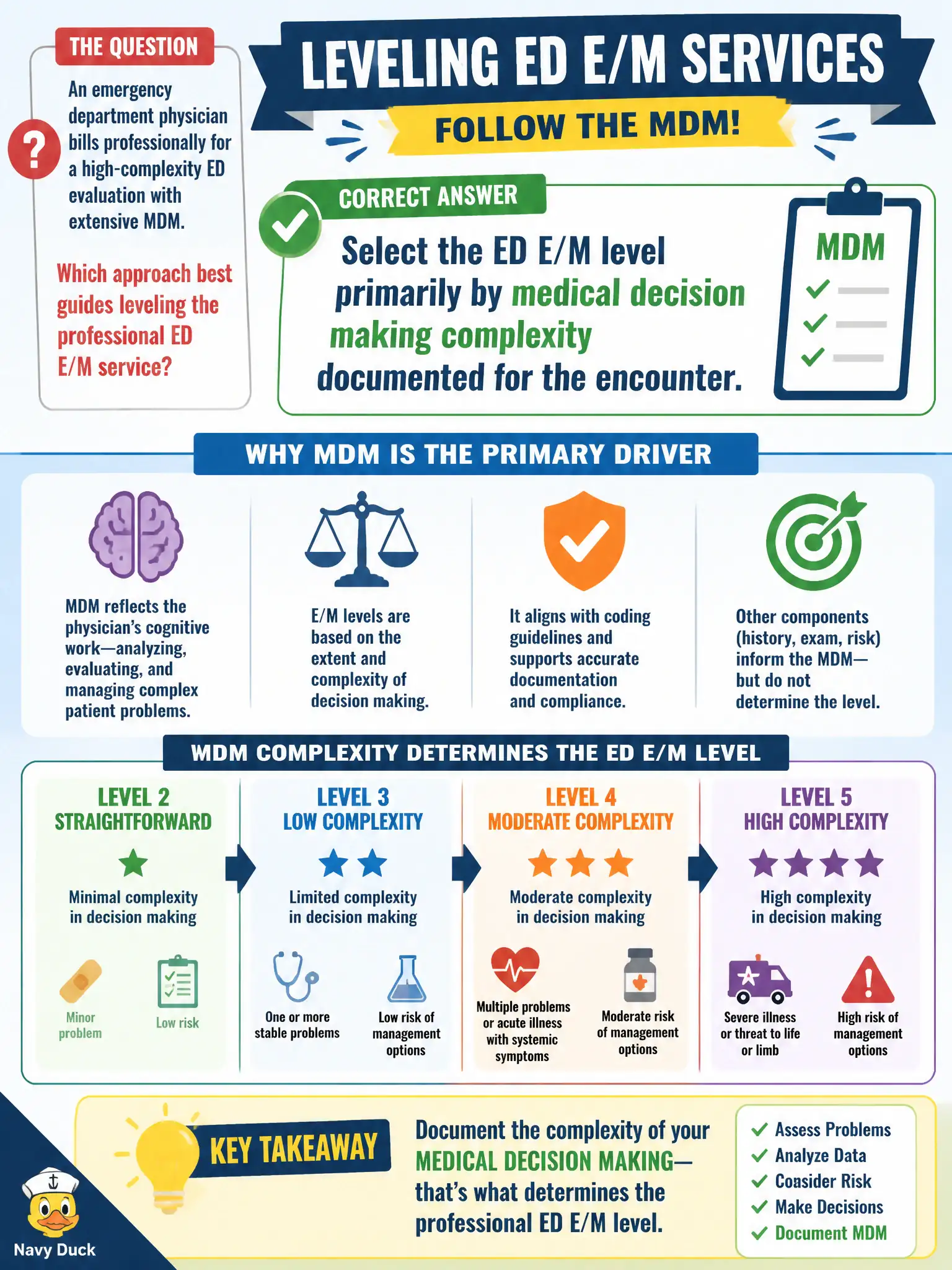
An emergency department physician bills professionally for a high-complexity ED evaluation with extensive MDM. Which approach best guides leveling the professional ED E/M service?
Select an answer to reveal the explanation.
Short Explanation
ED leveling is about how hard the thinking was, not the ambulance siren. High-complexity professional ED E/M rides on documented MDM for that encounter. Treat it like choosing the right gear for the climb you actually made.
Full Explanation
Professional ED E/M leveling is driven primarily by medical decision making complexity documented for the encounter. A high-complexity ED evaluation with extensive MDM supports a high-level professional ED E/M. In public emergency departments, MDM-based leveling reflects true clinical risk and data intensity rather than arrival mode, which improves fairness across Medicaid and uninsured panels.
Always assigning the highest ED E/M level whenever the patient arrives by ambulance substitutes transport method for MDM. Using nursing facility subsequent-care codes because the ED is hospital-owned imports SNF visit families into emergency care. Coding only a facility APC level and omitting any professional E/M for the physician erases the emergency clinician’s professional service.
Exam caveat: ED E/M codes have their own descriptors and are not interchangeable with office levels even when MDM language feels similar. Operational check: score ED MDM elements from the chart, select the matching professional ED E/M level, and coordinate critical care reporting only when critical care criteria—not mere ED location—are met;In public and nonprofit clinics, accurate professional coding also supports transparent stewardship of Medicaid, Medicare, and grant-funded visits, reducing rework from denials that delay revenue needed for community access..