
A rheumatology office performs arthrocentesis of the knee with ultrasound guidance. What reporting concept should be applied?
Select an answer to reveal the explanation.
Short Explanation
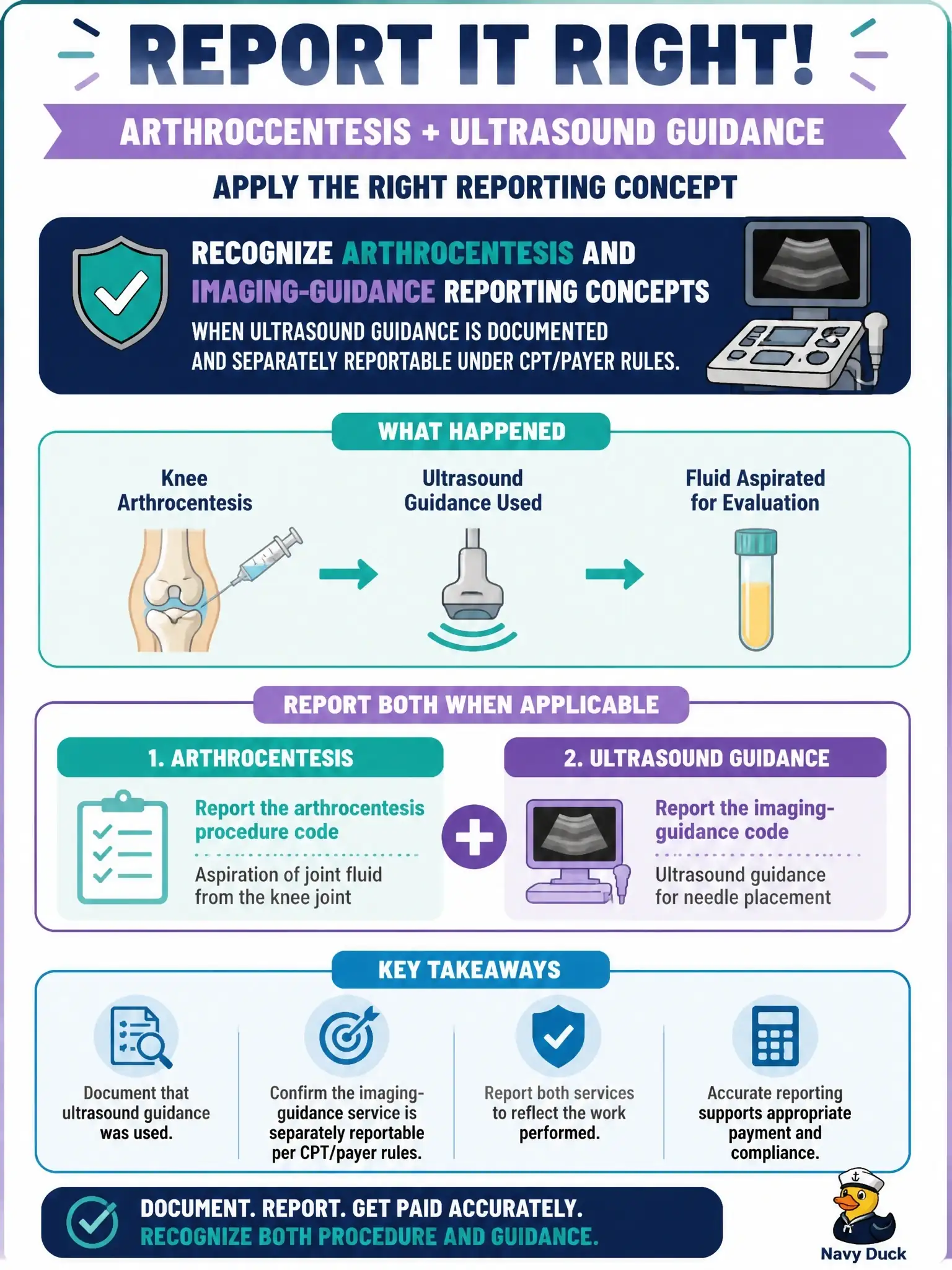
Draining a knee and watching it on ultrasound can be two documented pieces of work—needle into the joint, plus imaging guidance. When coding rules and payer policy allow separate guidance, don’t pretend guidance never existed or that you replaced the whole knee.
Full Explanation
When arthrocentesis of the knee is performed with ultrasound guidance in a rheumatology office, recognize both the arthrocentesis procedure and imaging-guidance reporting concepts when ultrasound guidance is documented and separately reportable under CPT and payer rules. Separating needle joint work from guidance—when allowed—keeps community musculoskeletal claims aligned with technology actually used for safer aspiration.
The approach that always bundles ultrasound guidance into every joint injection with no possibility of separate guidance reporting ignores CPT constructs that sometimes permit separate guidance codes when requirements are met. The approach that codes only a complete knee MRI and omits arthrocentesis reports imaging of a different modality while erasing the aspiration. The approach that reports inpatient joint replacement surgery for office aspiration with guidance invents major operative arthroplasty from an office needle procedure.
Exam caveat: some injection codes include guidance or payers bundle guidance—verify current CPT parentheticals and payer policy before separate reporting. Operational check: document joint aspirated or injected, ultrasound guidance images or stored records, and medical necessity; then apply arthrocentesis plus guidance codes only when separately reportable.