
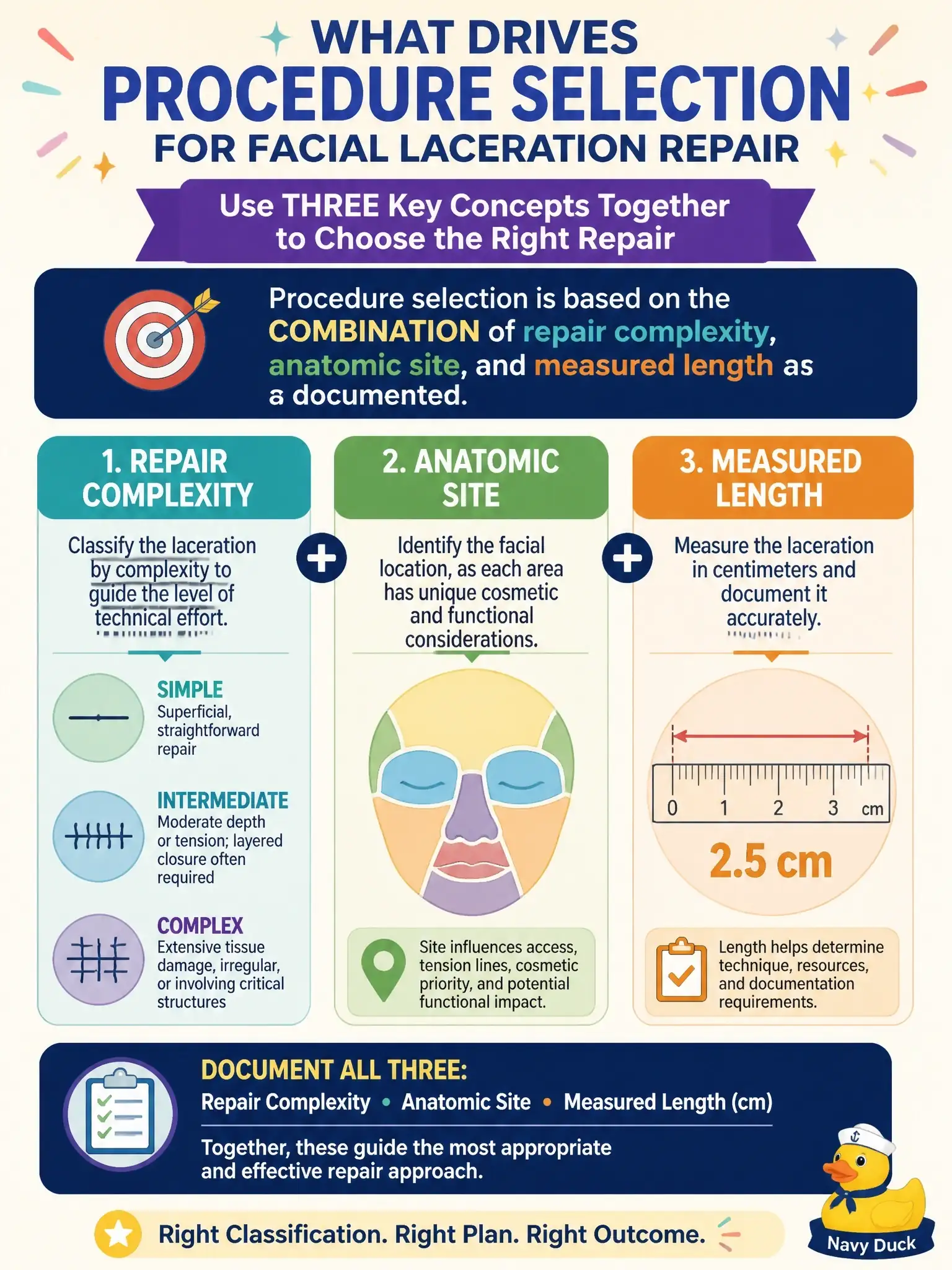
A plastic surgery office repairs a 2.5 cm intermediate facial laceration. Which concepts drive procedure selection?
Select an answer to reveal the explanation.
Short Explanation
A face cut that's layered shut isn't just tape, and size plus location still matter. You need to match repair complexity, anatomic site, and measured length from the note. For a 2.5 cm intermediate facial laceration, that means choosing the code for intermediate repair on the face at that length.
Full Explanation
Laceration repair selection combines repair complexity (simple versus intermediate versus complex), anatomic site, and measured length as documented. The statement selecting repair complexity together with anatomic site and measured length as documented is correct because a 2.5 cm intermediate facial laceration in a plastic surgery office must reflect layered intermediate repair on the face at that length—not a default simple repair or adhesive-only approach. Precise repair coding in community trauma follow-up protects payment integrity and wound-care quality data. The statement that repair codes ignore anatomic site and size once layered closure is mentioned discards two required classification axes. The statement that only wound adhesives are reported and layered repair codes are never used for facial lacerations understates intermediate layered work actually performed. The statement that simple repair is always chosen for any facial wound under 5 cm ignores intermediate or complex techniques when layered closure is documented. Exam caveat: intermediate repair implies layered closure of deeper elements as defined in CPT—documentation must support that depth, not merely the word intermediate. Operational check: confirm complexity definition, anatomic site (face), and measured length in centimeters, then select the matching repair code family and retain wound measurements in the note.