
A primary-care clinic performs a CLIA-waived rapid strep test in the office. What should the physician coder recognize?
Select an answer to reveal the explanation.
Short Explanation
A quick strep swab in the exam room is a real lab service—just a waived one. You still pick the right test family and respect CLIA/waived billing rules. It’s not surgical pathology theater and it’s not ‘free because it was fast.’
Full Explanation
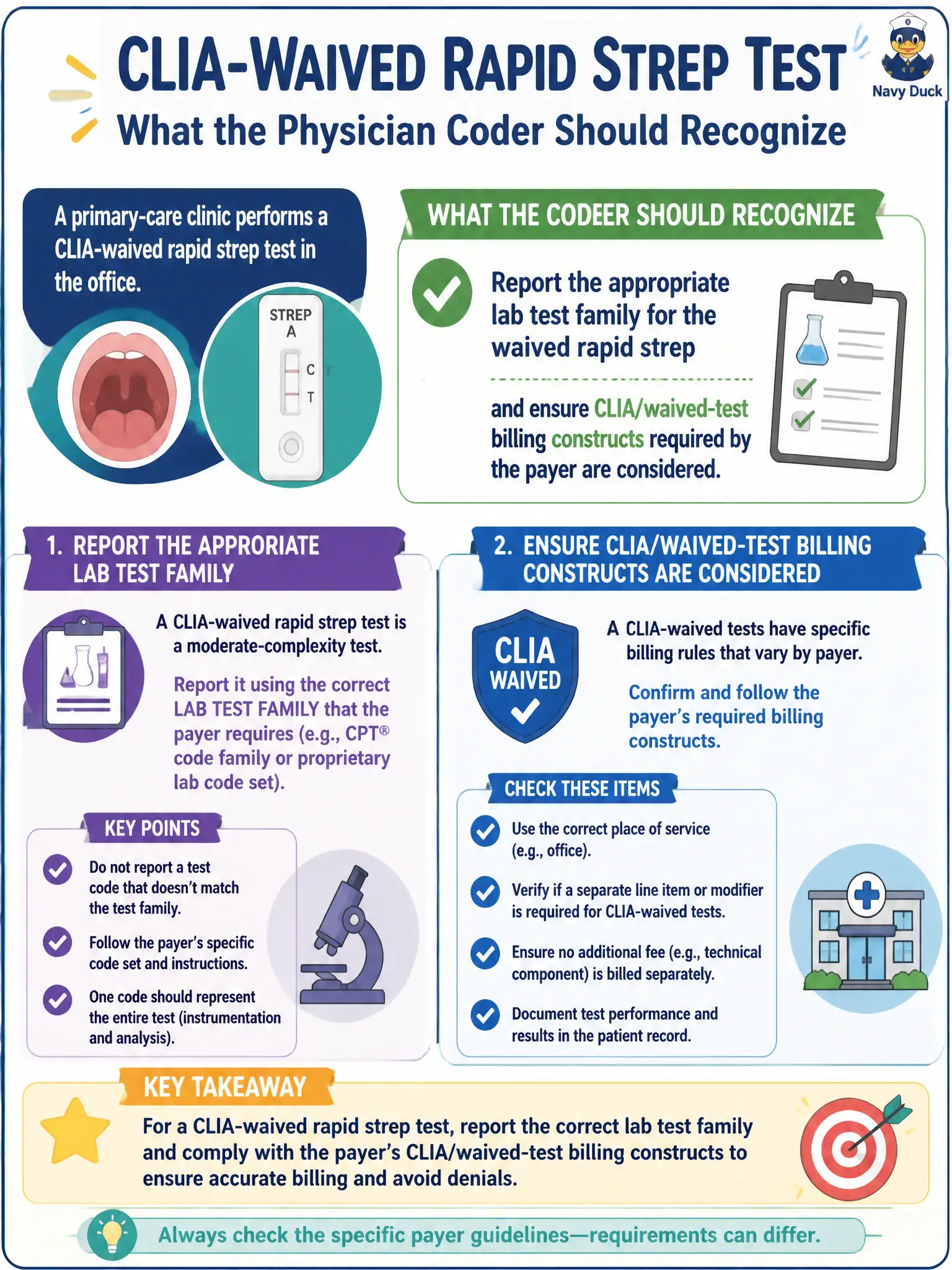
A CLIA-waived rapid strep test performed in a primary-care clinic is a real laboratory service on the professional claim when payer and CLIA constructs are met. Report the appropriate lab test family for the waived rapid strep and consider CLIA/waived-test billing requirements. Point-of-care testing in county clinics improves timely treatment for school-aged and community patients; coding it correctly keeps public lab utilization transparent and auditable.
Claiming in-office waived tests are never reportable on a professional claim contradicts standard physician-office lab reporting when CLIA certification and payer rules allow billing. Restricting clinic billing to only hospital blood-bank panels invents an irrelevant facility limitation that does not govern waived antigen testing. Coding rapid strep as a surgical pathology consultation misclassifies a waived point-of-care test as pathologist consultative microscopic work.
Exam caveat: modifier QW or equivalent waived-test indicators and CLIA identification may be required by the payer even when the clinical concept is straightforward. Operational check: confirm the clinic’s CLIA certificate covers the waived test, select the correct lab code family, append any required waived-test modifier, link the strep-related diagnosis, and retain kit lot or instrument documentation per policy.