
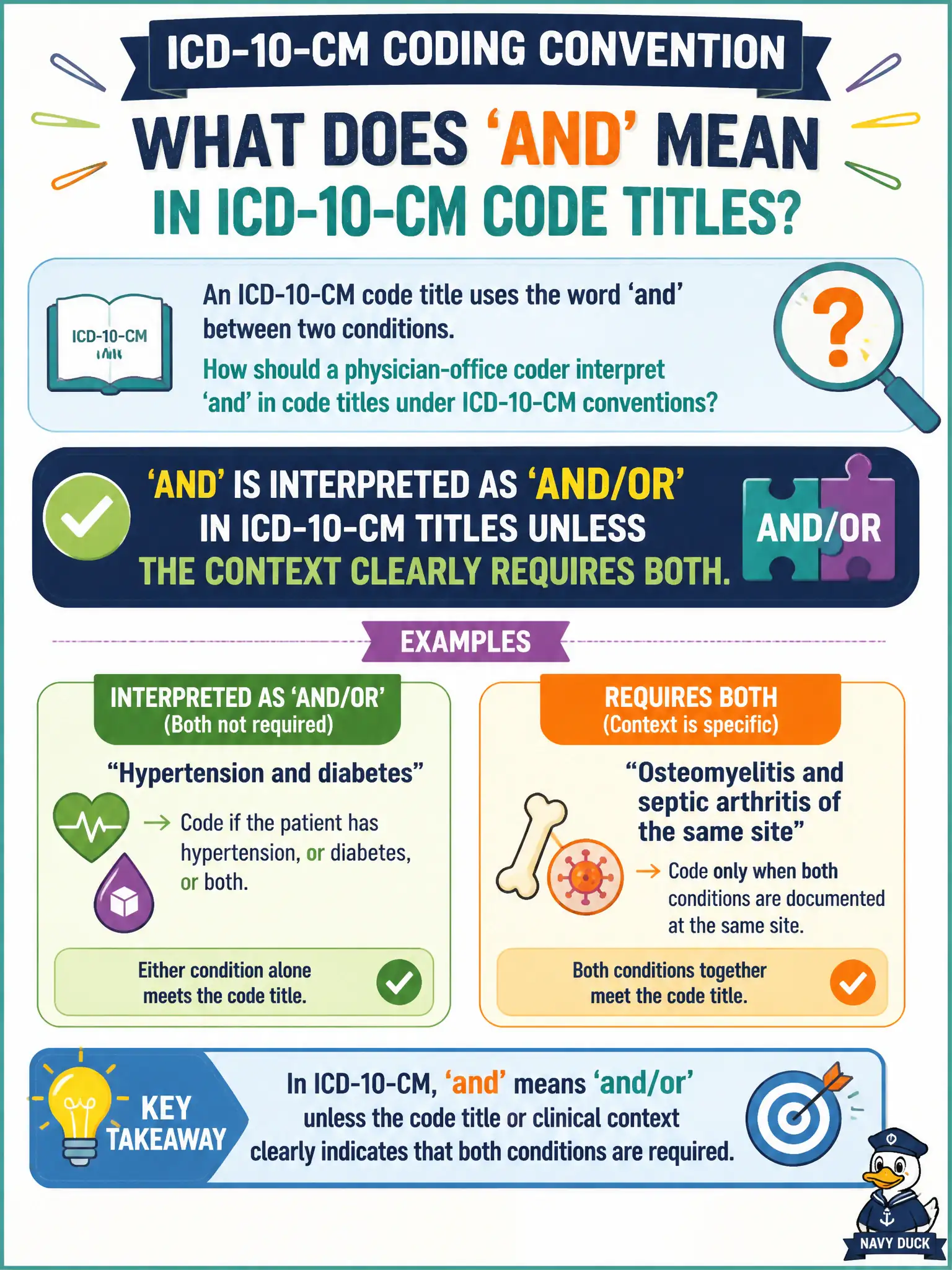
An ICD-10-CM code title uses the word ‘and’ between two conditions. How should a physician-office coder interpret ‘and’ in code titles under ICD-10-CM conventions?
Select an answer to reveal the explanation.
Short Explanation
In ICD-10-CM titles, ‘and’ is the sneaky one—it usually means ‘and/or.’ You don’t automatically need both listed conditions unless the context truly demands it. Read the convention, not everyday English.
Full Explanation
ICD-10-CM coding conventions state that and in a code title should be interpreted as and/or unless the classification context clearly indicates both conditions are required. When an ICD-10-CM code title uses the word and between two conditions, a physician-office coder should interpret and as and/or unless context clearly requires both. Claiming and always requires both conditions to be present or the code cannot be used fails the default convention. Claiming and means the second condition is an Excludes1 note confuses title language with Excludes notes. Claiming and indicates the code is limited to inpatient facility reporting only fails; the convention applies to diagnosis coding on professional claims as well. Exam caveat: still follow any instructional notes that explicitly require multiple conditions—and/or is the title convention, not a license to ignore explicit dual requirements. Operational check: apply and/or to titles unless context demands both, verify instructional notes, and assign the code when documentation supports either or both conditions as the convention allows. In civic and community clinic workflows, document the chosen pathway in the coding rationale so auditors can see how the record supported specificity, sequencing, and instructional-note compliance on the professional claim.