
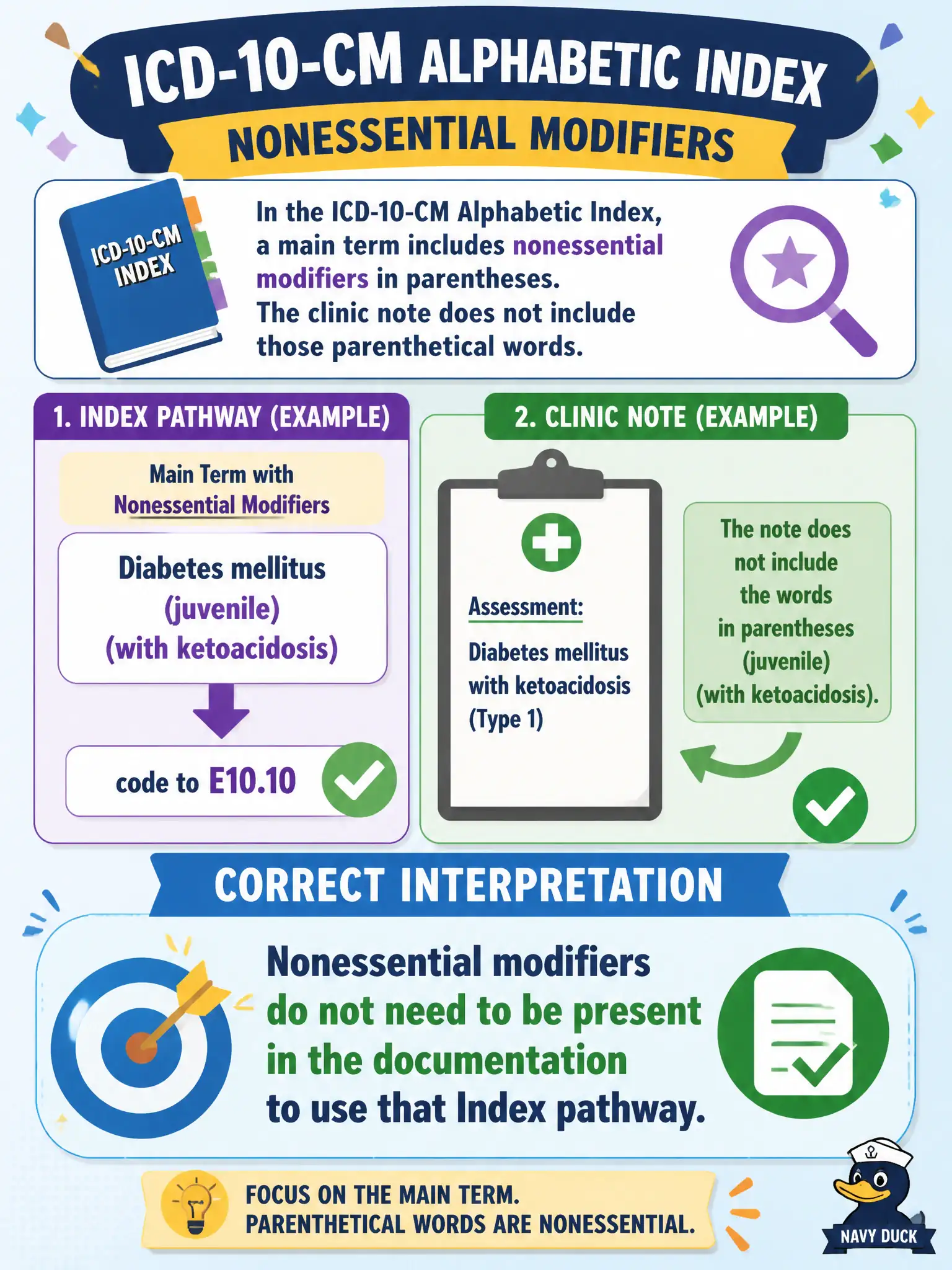
In the ICD-10-CM Alphabetic Index, a main term includes nonessential modifiers in parentheses. The clinic note does not include those parenthetical words. What is the correct interpretation?
Select an answer to reveal the explanation.
Short Explanation
Parentheses in the Index are ‘nice to have,’ not gatekeepers. Those nonessential modifiers can show up in the note—or not—and you can still use the pathway. Don’t reject a valid Index hit just because the optional words are missing.
Full Explanation
Nonessential modifiers appear in parentheses in the Alphabetic Index and do not affect code assignment; their presence or absence in documentation does not block use of that Index entry. When a main term includes nonessential modifiers in parentheses and the clinic note does not include those parenthetical words, the code path can still be used—nonessential modifiers do not need to be present in the documentation. Claiming the code path cannot be used unless every parenthetical word appears fails the nonessential-modifier convention. Claiming parenthetical Index terms always mean the condition is uncodeable in the office setting fails. Claiming nonessential modifiers convert the code into an external-cause code automatically fails. Exam caveat: essential modifiers, typically indented or after a colon, do restrict the pathway and must not be confused with parenthetical nonessential modifiers. Operational check: identify parentheses as nonessential, proceed with the Index pathway when the main concept matches, then verify in the Tabular—do not reject valid hits for missing optional words. In civic and community clinic workflows, document the chosen pathway in the coding rationale so auditors can see how the record supported specificity, sequencing, and instructional-note compliance on the professional claim.