
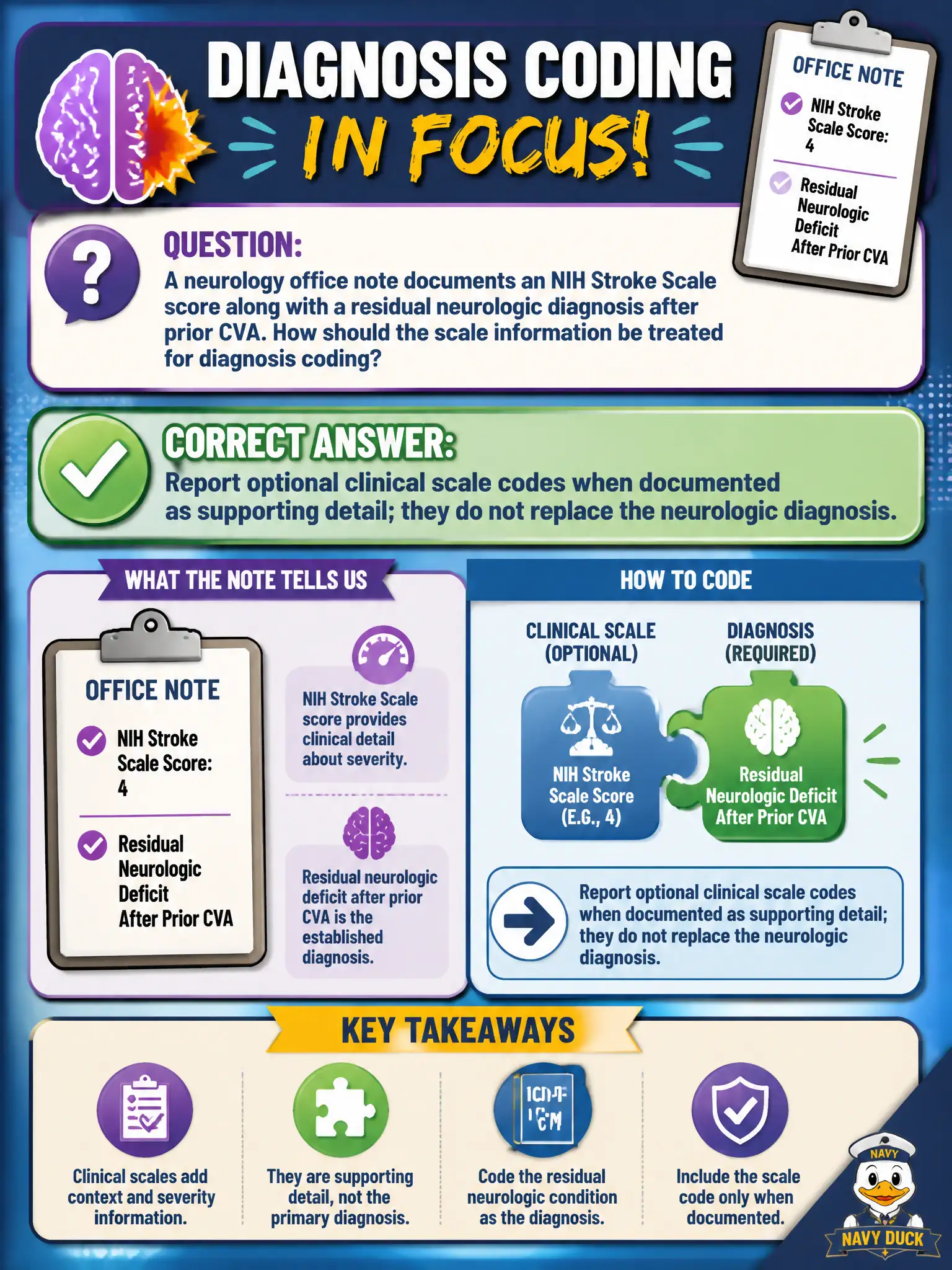
A neurology office note documents an NIH Stroke Scale score along with a residual neurologic diagnosis after prior CVA. How should the scale information be treated for diagnosis coding?
Select an answer to reveal the explanation.
Short Explanation
Scale scores are supporting cast, not the lead actor. NIHSS or GCS codes can add detail when documented, but they don’t boot the actual neurologic diagnosis off the claim. Keep the diagnosis, add the scale if the pathway fits.
Full Explanation
ICD-10-CM includes codes for certain clinical scales such as NIH Stroke Scale components when documented. These codes provide additional clinical detail and do not substitute for the underlying neurologic condition or sequela diagnosis. When a neurology office note documents an NIH Stroke Scale score along with a residual neurologic diagnosis after prior CVA, report optional clinical scale codes when documented as supporting detail; they do not replace the neurologic diagnosis. Replacing the neurologic diagnosis with the NIH Stroke Scale code alone fails. Never reporting scale-related codes on physician claims under any circumstance fails when the classification and documentation support them. Converting any documented scale score into an acute stroke principal diagnosis automatically fails without acute stroke documentation. Exam caveat: scale codes are adjunctive—keep sequela or residual diagnoses as the clinical drivers of care. Operational check: retain the residual neurologic diagnosis, add NIHSS codes if documented and appropriate, and do not invent acute stroke from a scale score alone. In civic and community clinic workflows, document the chosen pathway in the coding rationale so auditors can see how the record supported specificity, sequencing, and instructional-note compliance on the professional claim.