
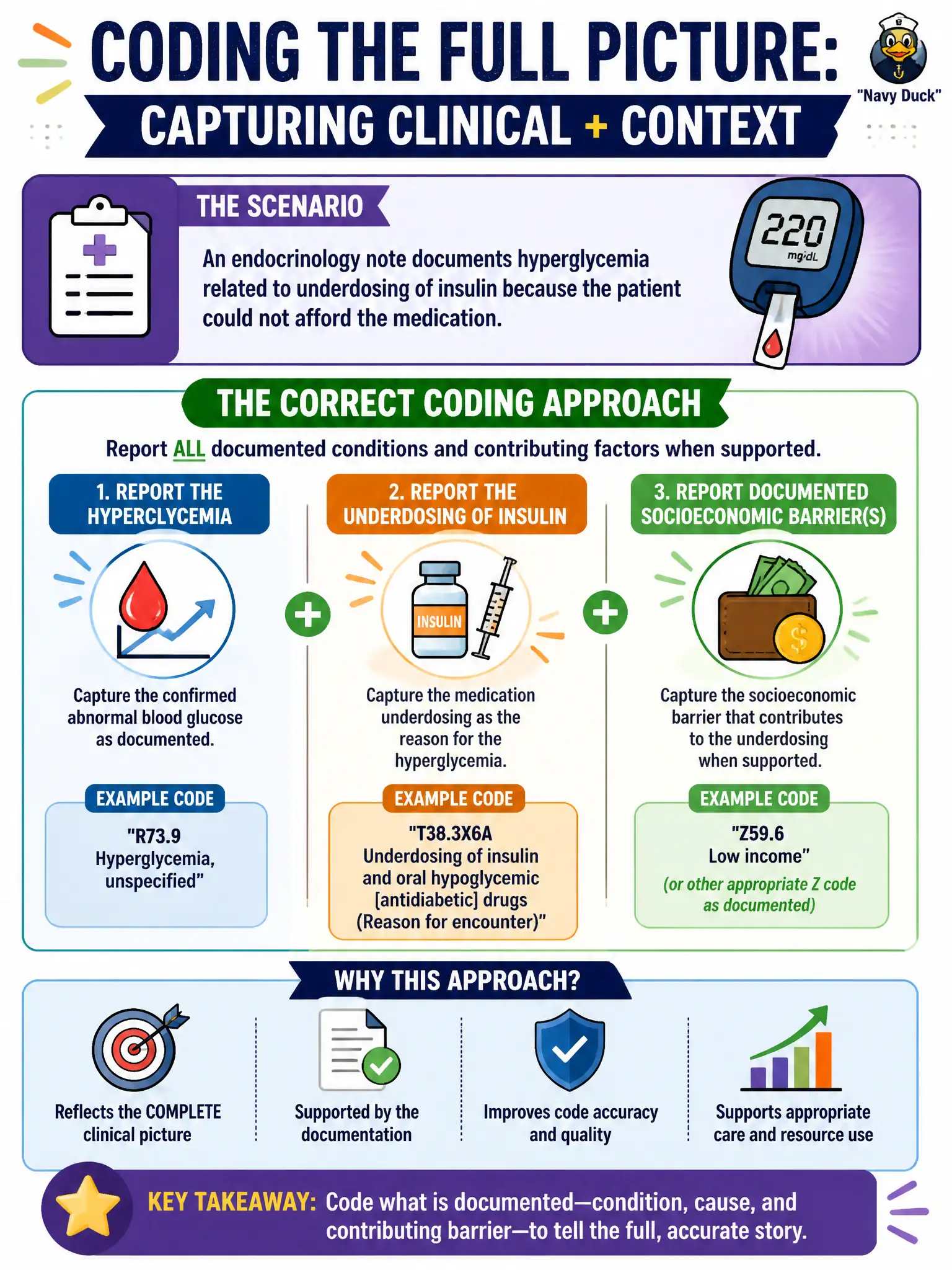
An endocrinology note documents hyperglycemia related to underdosing of insulin because the patient could not afford the medication. Which coding approach best reflects the documentation?
Select an answer to reveal the explanation.
Short Explanation
Underdosing isn’t poisoning—it’s ‘took less than prescribed,’ often with a reason. When cost barriers show up in the note beside hyperglycemia, those pieces can ride along. Capture the clinical problem and the documented why.
Full Explanation
ICD-10-CM provides underdosing codes for taking less of a medication than prescribed, distinct from poisoning or adverse-effect pathways. When an endocrinology note documents hyperglycemia related to underdosing of insulin because the patient could not afford the medication, report the hyperglycemia, the underdosing of insulin, and documented socioeconomic barrier codes that contribute to the underdosing when supported. Coding only diabetes without addressing underdosing or cost barriers because social factors are never coded fails when those factors are documented and relevant. Coding poisoning by insulin rather than underdosing whenever any dose change is mentioned fails the underdosing versus poisoning distinction. Omitting hyperglycemia and reporting only a Z-code for financial hardship fails to capture the clinical problem treated. Exam caveat: civic clinic SDOH coding supplements clinical diagnoses; it does not replace hyperglycemia or diabetes coding. Operational check: code hyperglycemia and insulin underdosing per instructions, add supported financial-hardship SDOH Z-codes, and withhold poisoning classification without overdose or incorrect-use documentation. In civic and community clinic workflows, document the chosen pathway in the coding rationale so auditors can see how the record supported specificity, sequencing, and instructional-note compliance on the professional claim.